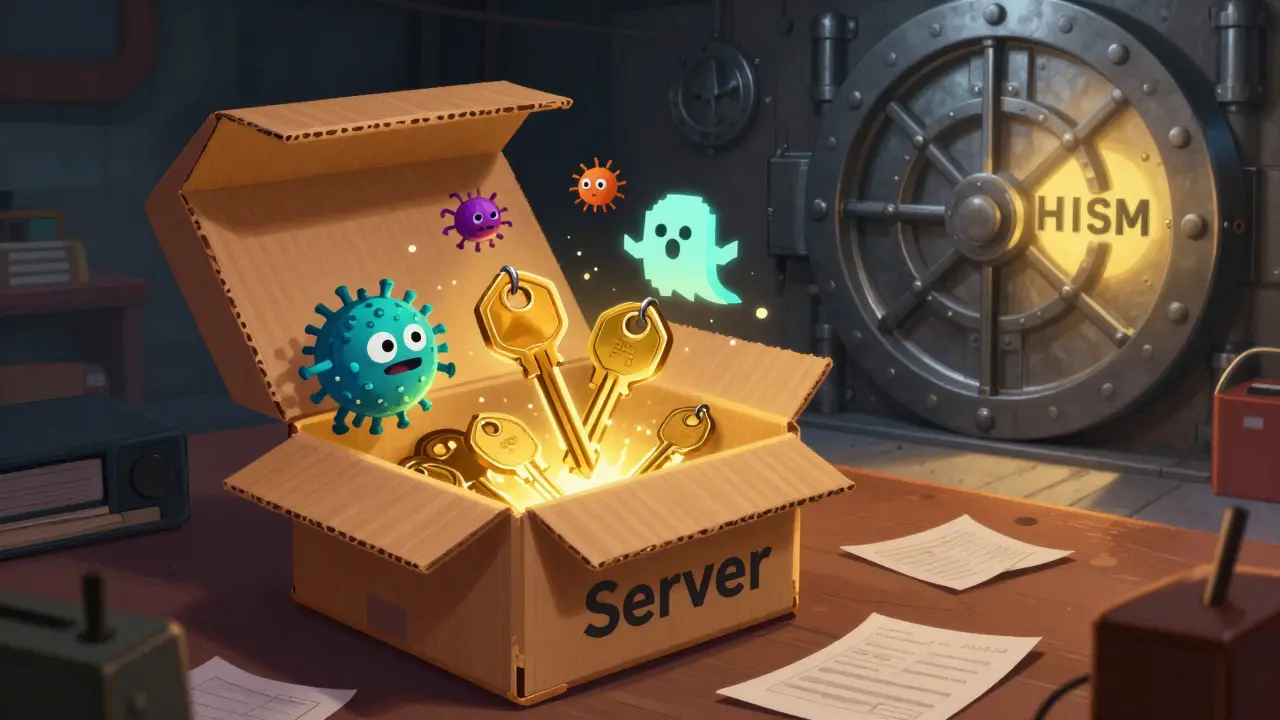
Imagine holding the keys to a vault containing billions of dollars in digital assets. Now imagine those keys are just lines of code sitting on a server connected to the internet. That is the reality for many organizations using traditional software wallets. The stakes couldn't be higher. If that server gets hacked, or if malware infects the system, your private keys-and the assets they control-are gone forever. This is why HSM integration with blockchain has moved from a nice-to-have feature to an absolute necessity for any serious enterprise.
A Hardware Security Module (HSM) is not just another piece of IT equipment. It is a specialized cryptographic device designed to generate, store, and manage cryptographic keys in an isolated, tamper-resistant environment. When you integrate an HSM with a blockchain network, you ensure that private keys never leave the secure hardware perimeter. All sensitive operations, like signing transactions, happen inside the box. For institutions managing Bitcoin, Ethereum, or other digital assets, this distinction between software and hardware security is the difference between sleeping well at night and constant anxiety over potential breaches.
The Core Problem: Why Software Wallets Fall Short
To understand why HSMs matter, we first need to look at how blockchain identities work. On platforms like Ethereum, an account is essentially a public/private key pair. The public key is your address, visible to everyone. The private key is your secret password. In a typical software setup, this private key lives in a file on a computer’s hard drive or in memory while a node is running.
This creates a massive vulnerability surface. Malware can scrape memory. Insider threats can copy files. Infrastructure vulnerabilities can expose data. Even if you encrypt the key, it must be decrypted to use it, meaning it exists in plain text in the system's memory for a brief moment. That moment is often enough for a sophisticated attacker. By moving these keys into an HSM, you eliminate the exposure. The private key is generated within the HSM and never leaves it. You send a transaction request to the HSM, and the HSM signs it internally, returning only the signature. The key itself remains hidden.
How HSM Integration Actually Works
You might wonder how a blockchain node talks to a physical hardware box. The bridge between them is usually the PKCS#11 standard. Think of PKCS#11 as a universal language for cryptographic devices. It allows blockchain applications to communicate with various HSM vendors without needing custom code for each specific machine.
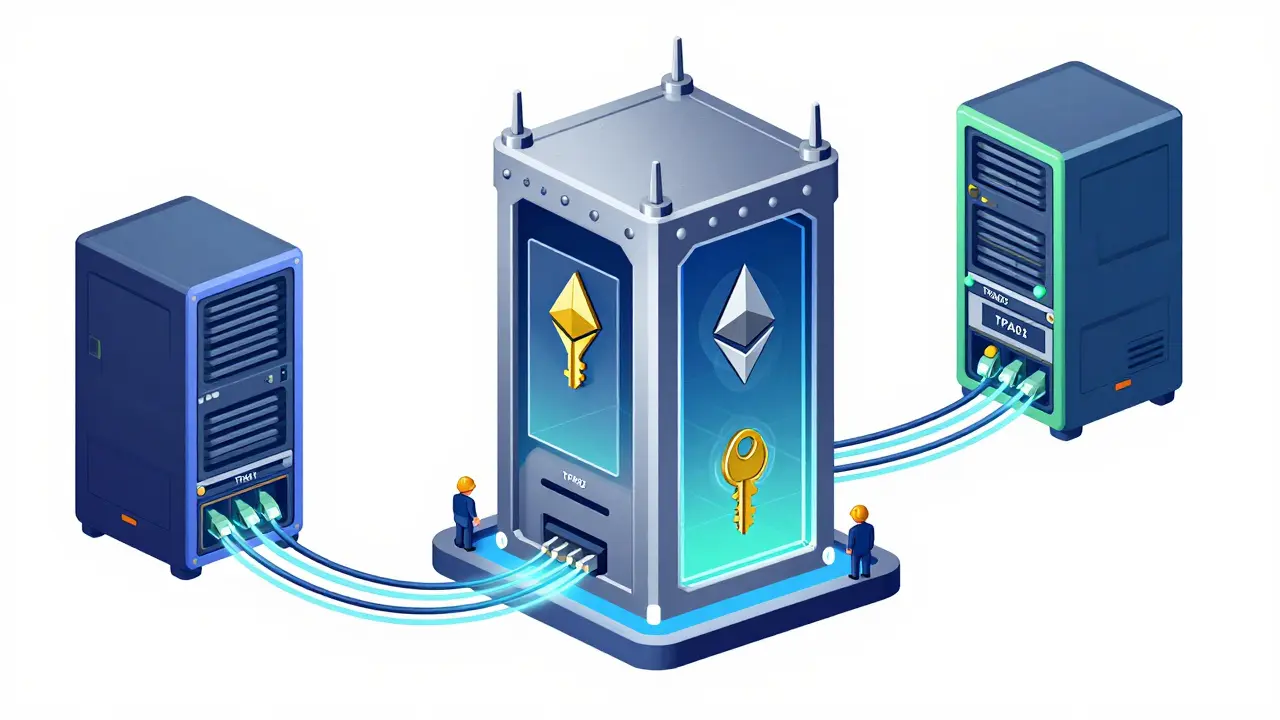
In a typical architecture, you set up partitions on your HSM. Each partition acts like a separate wallet. For example, if you are running two Ethereum nodes, you might create two partitions-let’s call them TPA01 and TPA02. Node one connects to TPA01, and node two connects to TPA02. This separation ensures that even if one node is compromised, the attacker cannot access the keys stored in the other partition. The PKCS#11 interface handles the generation, signing, and backup of keys through standardized libraries, making the integration process smoother and more reliable than building proprietary solutions from scratch.
Choosing Your HSM Vendor and Deployment Model
The market for blockchain-capable HSMs is robust, with several major players offering distinct advantages depending on your infrastructure needs. Here is a breakdown of what different providers bring to the table:
| Provider | Solution Name | Key Feature | Best For |
|---|---|---|---|
| Thales Group | Luna HSM / Luna Cloud HSM | Comprehensive guides for Ethereum; supports ECDSA and BIP32 | Enterprises needing flexible on-premise or cloud options |
| Securosys | Primus Blockchain HSM | Secure Key Access (SKA); policy-driven controls | Organizations requiring granular user permissions and audit trails |
| IBM | IBM Cloud HSM | Native support for IBM Z/LinuxONE clients | Legacy enterprise environments already using IBM infrastructure |
| Dfns | HSM Services | Vendor-agnostic via PKCS#11; multi-chain support | Teams wanting a single integration for multiple blockchains |
When choosing between on-premise and cloud-based HSMs, consider your risk tolerance and operational capacity. On-premise solutions, like the Thales ProtectServer, give you maximum control over physical security. You hold the hardware. However, you also bear the burden of maintenance, power, cooling, and physical access controls. Cloud-based HSM services, such as Luna Cloud HSM, reduce this operational overhead significantly. They scale easily and handle updates automatically, but they introduce a third-party relationship. You are trusting the cloud provider’s security practices. For many financial institutions, a hybrid approach or a dedicated private cloud instance offers the best balance.
Technical Implementation Details
Getting an HSM talking to your blockchain nodes requires precise configuration. Let’s look at a common scenario: integrating Ethereum with a Thales Luna HSM. Before you start, ensure your HSM is initialized and provisioned. You will need to create specific partitions for your nodes. A critical detail here is the mode of operation. If you plan to use BIP32 hierarchical deterministic keys-which are standard for modern wallet structures-you must configure the Luna HSM to operate in Non-FIPS mode. The BIP32 mechanism is currently incompatible with FIPS mode restrictions. Skipping this step will cause your integration to fail during key derivation.
For Ethereum specifically, the HSM generates and safeguards ECDSA (Elliptic Curve Digital Signature Algorithm) keys. These keys are used to sign transactions. The workflow looks like this: your application requests a transaction signature, the HSM verifies the request against its internal policies, signs the data using the private key, and returns the signature. The private key never touches the application layer. Once the transaction is broadcast, the wallet session typically closes until the next authorized request, further minimizing exposure windows.
Security Architecture and Policy Enforcement
Having an HSM is only half the battle. How you manage access to that HSM determines your actual security posture. Modern solutions like Securosys Primus Blockchain HSM introduce features like Secure Key Access (SKA). This isn’t just about keeping hackers out; it’s about controlling who inside your organization can do what.
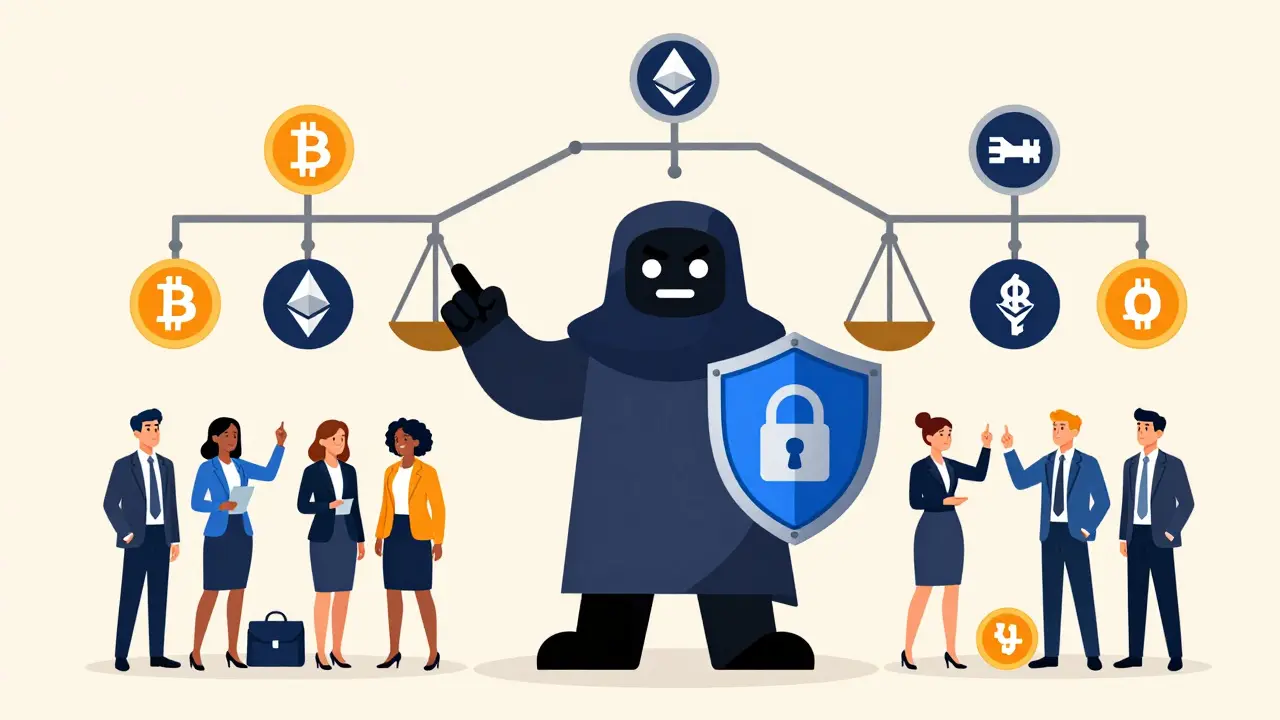
With policy-driven access controls, you can define rules such as "User A can only sign transactions under $10,000" or "Transactions over $100,000 require approval from two different administrators." These policy engines enforce segregation of duties, a critical requirement for regulatory compliance in finance. You can also implement multi-signature workflows where the HSM acts as one of the required signers, adding a hardware-backed layer to your governance framework. This ensures that no single individual can move large sums of assets unilaterally, protecting against both external attacks and internal fraud.
Multi-Chain Support and Future-Proofing
The blockchain landscape is fragmented. You might hold Bitcoin, run an Ethereum node, and interact with Solana or Cosmos ecosystems. Maintaining separate key management systems for each chain is inefficient and risky. Fortunately, modern HSM integrations are becoming increasingly multi-chain capable.
Solutions like Broadcast HSM security architectures provide reference designs for cold, warm, and hot tier configurations across diverse networks including Bitcoin, EVM chains, Solana, and Substrate-based networks like Polkadot. By leveraging standards like BIP32, BIP44, and BIP39 within the HSM, you can manage a unified hierarchy of keys for all your assets. This reduces operational complexity and ensures consistent security policies across your entire portfolio. As new blockchain protocols emerge, the ability to plug them into your existing HSM infrastructure via PKCS#11 means you don’t have to rip and replace your security stack every time a new technology trends.
Common Pitfalls to Avoid
Even with the best hardware, implementation errors can compromise security. Here are some traps to watch out for:
- Ignoring Path Dependencies: Ensure executables like the Go binary for Ethereum nodes are correctly placed in your system PATH. Misconfigured paths can lead to silent failures or fallbacks to less secure local key storage.
- Misconfiguring Partitions: Double-check that each blockchain node is pointing to the correct HSM partition. Cross-contamination can lead to unauthorized access or failed transactions.
- Neglecting Backup Procedures: While HSMs protect against theft, they are not immune to hardware failure. Implement robust backup strategies for your HSM keys, often involving split-key ceremonies where parts of the backup are held by different trusted parties.
- Overlooking Firmware Updates: HSM firmware contains critical security patches. Establish a regular schedule for reviewing and applying updates from your vendor.
Conclusion: Building Trust Through Hardware
Integrating an HSM with your blockchain infrastructure is not just a technical upgrade; it is a statement of intent. It signals to your customers, partners, and regulators that you take custody seriously. Whether you are a cryptocurrency exchange, an institutional custodian, or a DeFi platform, the margin for error with private keys is zero. By leveraging established standards like PKCS#11 and partnering with reputable vendors like Thales, IBM, or Securosys, you build a foundation of trust that software alone cannot provide. The initial investment in hardware and configuration pays off in peace of mind and the resilience needed to operate in the high-stakes world of digital assets.
What is the main benefit of using an HSM for blockchain?
The primary benefit is that private keys never leave the secure hardware environment. This prevents malware, hackers, or insiders from stealing the keys, as all cryptographic operations like signing occur internally within the tamper-resistant device.
Can I use an HSM for multiple blockchains?
Yes. Most modern HSM solutions support multi-chain environments. Using standards like PKCS#11, a single HSM can manage keys for Bitcoin, Ethereum, Solana, and other networks, simplifying your security infrastructure.
Is cloud-based HSM as secure as on-premise?
Cloud-based HSMs offer strong security and convenience but involve trusting a third-party provider. On-premise HSMs give you full physical control. The choice depends on your risk appetite, regulatory requirements, and operational resources.
Why do I need PKCS#11 for HSM integration?
PKCS#11 is a standard API that allows blockchain applications to communicate with various HSM vendors. It ensures interoperability, meaning you can switch HSM providers or add new blockchains without rewriting your core security code.
What happens if my HSM fails?
If an HSM fails, you lose access to the keys stored on it unless you have backups. It is critical to implement a robust backup strategy, often involving split-key recovery procedures, to ensure business continuity.








Jerry CUNNINGHAM SR
May 8, 2026 AT 23:31The distinction between software and hardware security is often overlooked by those who treat digital assets as mere speculation rather than institutional-grade holdings. The article correctly identifies that the moment a private key exists in plaintext memory, even for a microsecond, it becomes vulnerable to sophisticated scraping techniques. I have seen organizations fail because they assumed encryption at rest was sufficient without considering the operational exposure during transaction signing. The PKCS#11 standard provides a necessary abstraction layer that allows enterprises to decouple their application logic from the specific cryptographic hardware vendor. This interoperability is crucial for long-term infrastructure planning. We must recognize that security is not a product but a process of continuous risk mitigation.
Tobias Gjerlufsen
May 9, 2026 AT 19:39you are all missing the point entirely. the problem is not the hardware. the problem is the people using it. an hsm is just a fancy lock on a door that you leave open. i have watched so many companies buy these expensive boxes and then configure them with default passwords or split keys among friends who lose contact. it is pathetic. the technology is sound but the human element is always the weakest link. you can have the most secure hsm in the world but if your admin writes the pin on a sticky note it is useless. stop pretending that buying hardware fixes your culture problems.
Ruben Michel
May 11, 2026 AT 03:53It is quite amusing to see such a simplistic view of enterprise security architecture being presented as gospel. The notion that one can simply plug in an HSM and achieve 'trust' is laughable. True security requires a holistic approach that includes physical access controls, network segmentation, and rigorous audit trails. The Thales Luna solution mentioned is adequate for mid-tier institutions but falls short for sovereign-level custody requirements. One must consider the supply chain risks associated with the silicon itself. Are we truly trusting the manufacturer's word that the firmware has no backdoors? It is a naive perspective that ignores the geopolitical implications of cryptographic dependencies.
Gavin Wonnacott
May 12, 2026 AT 00:35I find this entire discussion rather tedious. You are all dancing around the obvious truth that centralized custodians are inherently flawed regardless of their hardware. Why do we need banks to tell us how to store our own money? The idea that an HSM solves anything is a comforting lie sold by vendors like IBM and Thales to keep the old guard in power. If you really care about security you should be running full nodes and managing your own keys in air-gapped environments. But I suppose that is too difficult for the masses. Keep buying your overpriced hardware boxes while I enjoy the freedom of true decentralization.
Samara McCallum
May 13, 2026 AT 00:30it feels like we are ignoring the bigger picture here. what is the point of securing keys if the blockchain itself is compromised? i think we are putting too much faith in hardware when the underlying protocols might have flaws. also why does everyone assume that cloud hsm is bad? maybe it is just more convenient. i don't know. it seems like everyone is arguing about details while missing the forest for the trees. perhaps we should focus on education instead of expensive gadgets.
Sheldon Friesen
May 14, 2026 AT 18:15Oh, look at us! All so serious about our little hardware boxes! 🙄 But seriously, the part about BIP32 compatibility is crucial. So many devs try to force FIPS mode and wonder why their HD wallets break. It is a classic case of reading the documentation vs guessing. Also, the multi-signature workflow mention is spot on. No single person should hold the keys to the kingdom. It is basic governance 101. Why do we still see solo-key setups in production? Madness! 😂
Tricia Alach
May 14, 2026 AT 20:54i love this post it made me feel smarter already lol. the part about malware scraping memory was scary though. i never thought about that. maybe i should get an hsm too? or just hide my laptop under my pillow? jk. but seriously thanks for explaining pkcs11 in a way i kinda understood. usually these tech blogs are boring af.
Jan Gilmore
May 15, 2026 AT 21:58Let me clear up some misconceptions here. First off, PKCS#11 is not just a 'universal language' it is a strict API specification defined by RSA Security. Second, the claim that cloud HSMs are less secure is debatable. AWS CloudHSM and Azure Dedicated HSM offer dedicated instances that are physically isolated. The threat model changes but the security posture can be equivalent. Third, BIP32 support in Non-FIPS mode is a known limitation of older Luna models but newer versions handle this better. People need to update their knowledge base before commenting on enterprise crypto infrastructure.
Caique Muniz
May 16, 2026 AT 11:50another day another boring tech post. sure sure hardware is good. i get it. but let us be real most of you cant even spell cryptography right. why bother? just use a paper wallet and burn it after sending. problem solved. oh wait you need to sign transactions daily. well good luck with your expensive boxes then. hope they dont catch fire.
Bradley Geldenhuys
May 18, 2026 AT 01:57hey guys lets talk about the philosophy of trust here. when we outsource security to hardware are we outsourcing responsibility? i think yes. we become dependent on the vendor. if thales goes bankrupt what happens to our keys? we need a decentralized approach to key management. maybe sharding the keys across multiple hsms owned by different entities. that would be cool. also typos happen when u type fast sorry bout dat.
robert Whitehead
May 18, 2026 AT 10:57You are all wasting your time discussing implementation details when the fundamental issue is regulatory compliance. Without proper AML/KYC frameworks, having an HSM is irrelevant. You are building a vault for stolen goods. The moral decay of the industry is evident in these technical debates. We need stricter oversight and accountability. Not more hardware toys. The self-righteousness of crypto enthusiasts is blinding. Wake up and smell the regulation coming.
Mike S
May 20, 2026 AT 05:27Ugh, another generic guide. Did you copy paste this from a Thales marketing deck? Probably. The table comparing vendors is biased towards big names. What about smaller players offering better value? And don't get me started on the 'common pitfalls' section. Ignoring path dependencies? Really? That is basic sysadmin stuff. If you need to read a blog post to know that you are not ready for enterprise security. Save your money and hire professionals.
H F
May 21, 2026 AT 22:07Bloody brilliant write-up! Finally someone explains PKCS#11 without making my head explode. I am currently wrestling with a Securosys Primus setup and the policy-driven controls are a game changer. Being able to set transaction limits based on user roles saves us from so much headache. Just wish the documentation was a bit clearer on the edge cases. But overall, great insight into the hardware side of things. Cheers!
Michael Berggren
May 23, 2026 AT 06:52This is exactly the kind of content we need! 🔒✨ Integrating HSMs is not just about security; it is about peace of mind. I recently helped a DeFi protocol move their hot wallet keys to a cloud HSM and the difference in confidence levels among the team was night and day. The PKCS#11 standard makes it so much easier to switch providers if needed. Don't sleep on this tech! It is the backbone of institutional adoption. 💪🚀
Kiran CS
May 23, 2026 AT 20:01How quaint. You believe that a piece of hardware can solve the inherent volatility and speculative nature of digital assets. The irony of seeking 'security' in a market built on disruption is palpable. Your reliance on legacy vendors like IBM and Thales shows a lack of imagination. True innovation lies in algorithmic security, not physical locks. But I suppose for the corporate drones among you, this level of complexity is sufficient. Carry on with your safe, boring compliance.
Bijan Das
May 24, 2026 AT 14:09look at all these smart people talking about hsm. meanwhile i just use a usb stick and hide it in my sock drawer. works fine for me. why spend thousands on a box when you can spend nothing? you are all being scammed by tech companies. simple as that. the government wants you to use these things so they can track your money. wake up sheeple.
John Gonzalez Bentham
May 25, 2026 AT 16:33typical contrarian take but i agree with the skepticism about cloud hsm. trust no one. especially not amazon. they will sell your keys to the highest bidder. on-premise is the only way. also the article misses the point about quantum computing. current hsm algorithms will be broken soon. we need post-quantum cryptography now. everything else is a bandaid.
Ellie Riddell
May 27, 2026 AT 00:37I sit back and watch the drama unfold. Everyone so passionate about hardware security. Meanwhile, the biggest hack last week was due to a phishing email sent to the CEO. You can have the best HSM in the world but if social engineering bypasses it, what is the point? It is funny how we focus on technical solutions for human problems. Anyway, nice read. Thanks for sharing.
Ankush Pokarana
May 27, 2026 AT 15:09the journey to secure key management is long and winding. one must understand that security is not a destination but a continuous practice. the integration of hsm with blockchain is a significant step forward but it requires careful planning and execution. the choice of vendor depends on many factors including budget scalability and support. i recommend taking time to evaluate each option thoroughly. do not rush into decisions. patience is key in this field.
Bianca Vilas Boas Lourenço
May 27, 2026 AT 17:45omg this is so stressful reading about hacks and breaches 😱. i feel like i need to wrap my computer in bubble wrap and bury it in the backyard. why does security have to be so complicated? can we just have a magic button that says 'secure'? anyway i guess i will stick to my paper wallet and pray nothing happens. good luck everyone you will need it 💔.
Yash Lodha
May 28, 2026 AT 20:56They want you to believe that hardware security modules are safe. But who controls the hardware? Who audits the firmware? There are backdoors in every chip produced by major manufacturers. It is a global surveillance network disguised as financial security. The elites use these systems to monitor and control the flow of capital. Do not fall for the illusion of privacy. The only true security is anonymity and cash. Everything else is a trap.
Destiny Kilby
May 28, 2026 AT 21:18i appreciate the detailed explanation of how hsm protects private keys. it helps me understand why my company is investing in this technology. the fear of losing assets is real and knowing that there is a physical barrier gives some comfort. i hope the implementation goes smoothly for everyone involved. thank you for sharing this information it is very helpful for those of us who are not experts in cryptography.
Shelby Cantu
May 30, 2026 AT 21:08Great points on the partition strategy. Separating keys by node is essential for containment. Keep your teams focused on best practices.