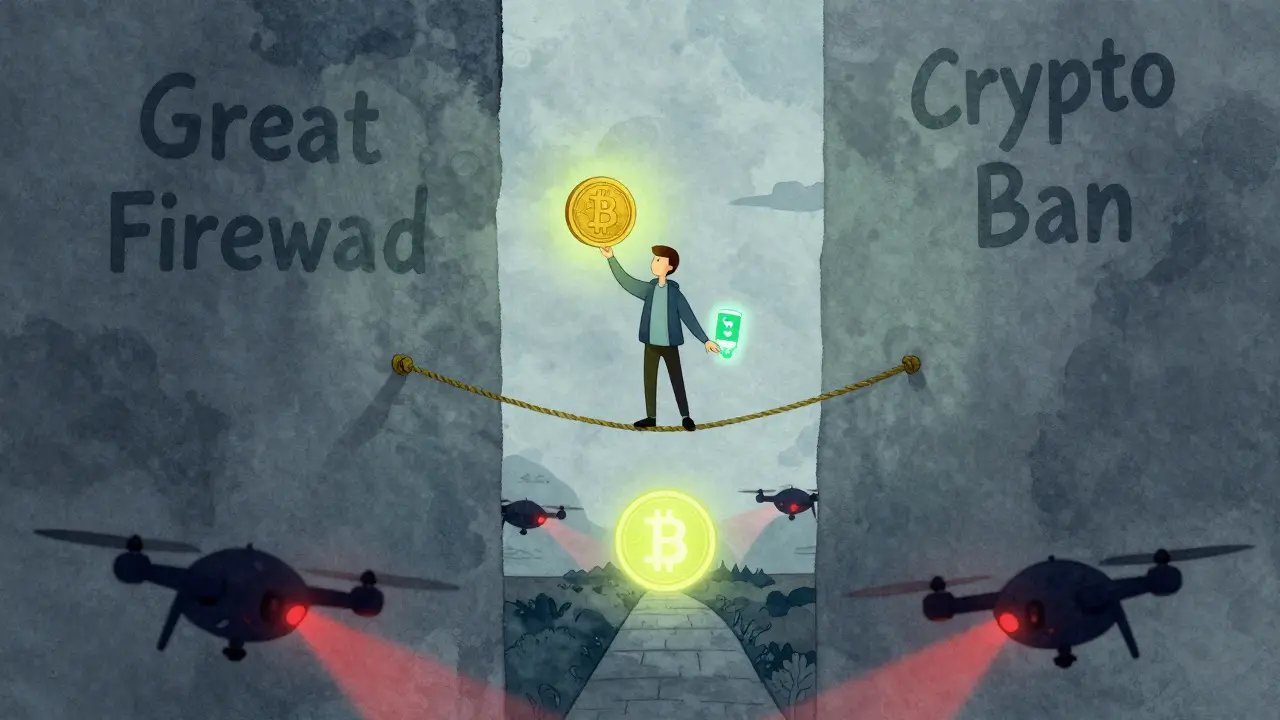
Using a VPN to access cryptocurrency exchanges in China isn’t just risky-it’s a legal tightrope. By 2025, China has fully banned all private cryptocurrency activity: no trading, no mining, no holding, no exchanges. Yet people still try. They use VPNs to bypass the Great Firewall, hoping to reach Binance, Kraken, or other foreign platforms. What they don’t realize is that they’re stacking two illegal acts on top of each other: breaking internet censorship rules and violating financial regulations. The consequences aren’t theoretical. They’re happening right now.
China’s Crypto Ban Is Absolute
As of June 1, 2025, China’s ban on cryptocurrency is total. The People’s Bank of China, along with the National Administration of Financial Regulation and the Cyberspace Administration of China, made it clear: no one in mainland China can legally trade, hold, or mine Bitcoin, Ethereum, or any other private digital asset. This isn’t a gray area. It’s a hard stop. Even if you bought crypto before the ban, keeping it now is technically illegal. Courts have occasionally recognized crypto as property in civil cases-like divorce settlements or fraud claims-but that doesn’t mean you can trade it. It just means if someone stole your Bitcoin, you might get compensation. You still can’t buy more.Why? Because China wants full control over its financial system. The government isn’t trying to stop innovation-it’s trying to replace it. The digital yuan (e-CNY) is the real target. It’s a state-controlled digital currency that tracks every transaction, enforces spending limits, and can be frozen remotely. Private crypto? It’s a threat to that control. No decentralization. No anonymity. No outside influence. Just the central bank’s ledger.
VPNs Are Now High-Risk Tools
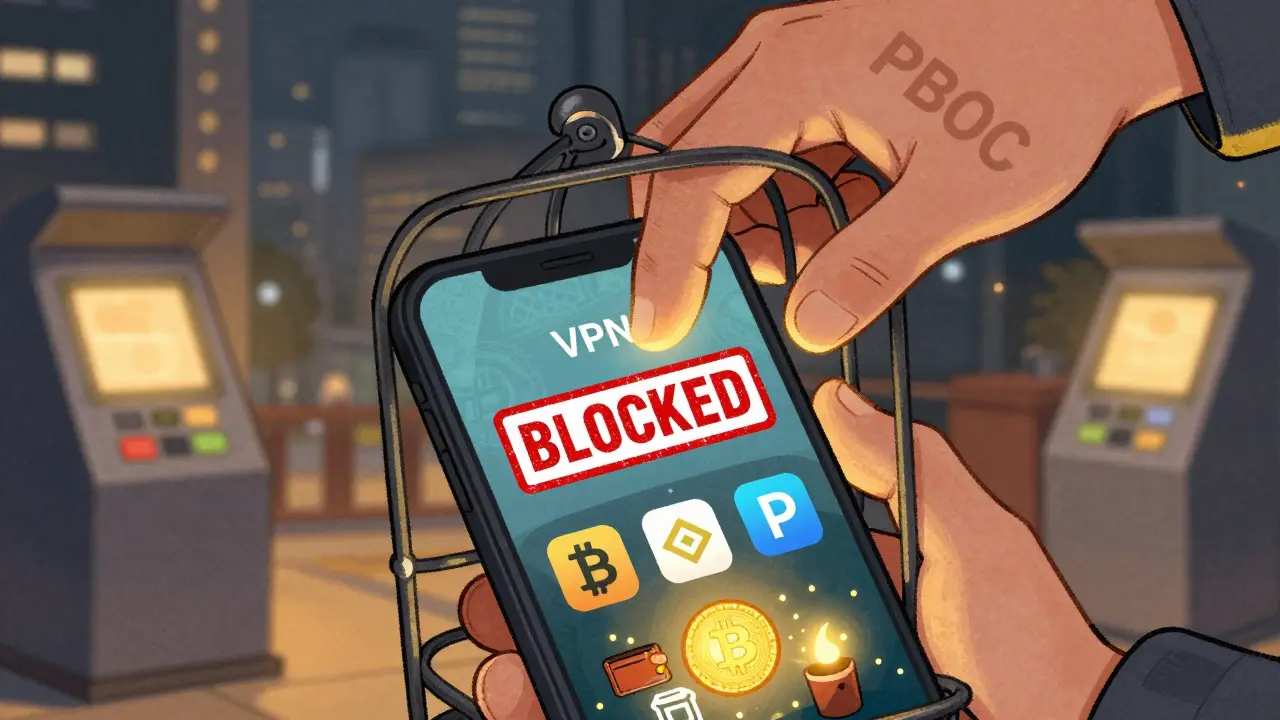
VPNs are the go-to workaround. They mask your IP address, making it look like you’re browsing from Singapore or the U.S. That lets you reach Binance’s website, which is blocked inside China. But here’s the catch: China doesn’t just block VPNs. It hunts them.Since 2023, the government has cracked down hard on unauthorized VPN services. Apps like ExpressVPN, NordVPN, and Surfshark are routinely removed from Chinese app stores. Even if you install one from abroad, it often stops working within days. The Great Firewall now uses AI to detect encrypted traffic patterns that match known VPN protocols. When it finds them, it throttles your connection or cuts it entirely. Some users report their mobile data gets shut off for hours-or even days-until they delete the app and report to local police.
And it’s not just about losing internet. Police in cities like Shenzhen and Guangzhou have started confiscating phones from suspected users. They plug the device into forensic tools, scan for crypto wallet apps, transaction history, and VPN logs. If they find anything, you’re asked to come in for a “chat.” No arrest, not yet-but your phone stays. Your service gets cut. Your name goes on a list.
Why the Combination Is So Dangerous
Using a VPN to access crypto isn’t two separate violations. It’s one big red flag. Authorities don’t look at them in isolation. They connect the dots: VPN + crypto wallet + cross-border transfers = potential money laundering. The Ministry of Public Security and State Administration of Foreign Exchange monitor exactly this kind of activity. Banks are required to flag any transaction linked to a crypto exchange-even if it’s routed through a foreign bank account. If you send $5,000 to a Binance wallet using a VPN, your bank will report it. The system automatically triggers an investigation.What happens next? It depends. For small amounts, you might get a warning. For larger sums-say, over 100,000 RMB-you could face administrative fines, asset seizure, or even criminal charges under China’s “illegal fundraising” laws. The government doesn’t need to prove you’re trading. Just having the tools-VPN, wallet app, transaction history-is enough to trigger penalties. And if you’re a foreigner? Doesn’t matter. The rules apply to everyone inside China’s borders.
Stablecoins Aren’t Safe Either
Some people think using USDT or USDC is smarter. After all, they’re tied to the dollar. But in China, stablecoins are treated the same as Bitcoin. The government sees them as tools to bypass capital controls. Even if you’re not trading them, just holding them in a wallet can get you flagged. There’s no legal distinction between “crypto” and “stablecoin” under Chinese law. Both are classified as unregulated digital assets.There’s one exception: China is quietly testing offshore yuan-linked stablecoins in Hong Kong and Macau. But those are tightly controlled, government-approved projects with strict KYC. You can’t use them from mainland China. Trying to access them through a VPN just makes you look like you’re trying to circumvent the system-which is exactly what they’re trying to stop.
What Happens If You Get Caught?
Most people think they won’t get caught. That’s the biggest mistake. China’s enforcement is automated, coordinated, and relentless. Here’s what real cases look like:- A university student in Chengdu used a VPN to trade Bitcoin. He sent 50,000 RMB to Binance over six months. His bank flagged the transfers. Police visited his dorm. His phone was seized. He was fined 20,000 RMB and banned from using any foreign financial services for one year.
- A foreign contractor in Shanghai used a VPN to buy Ethereum to send money home. His employer’s corporate bank account was flagged for suspicious activity. He was deported after a 72-hour detention.
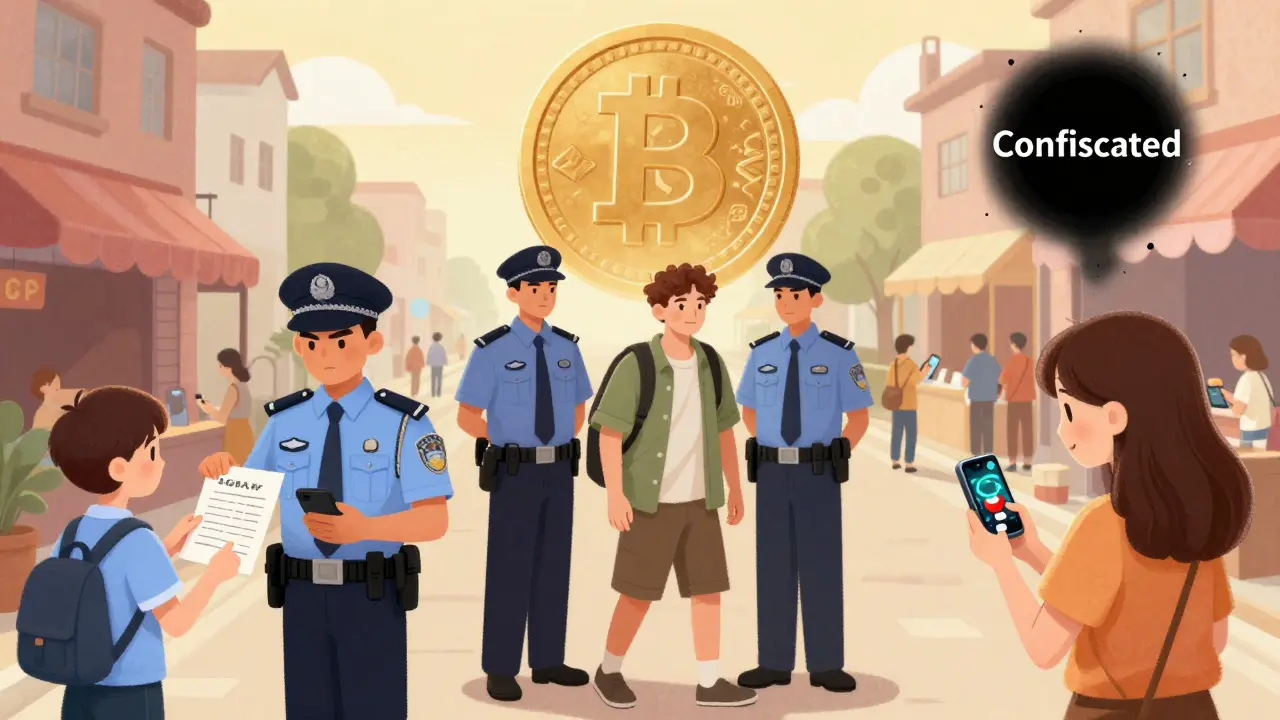
- A woman in Hangzhou held $15,000 in crypto for three years. When she tried to cash out through a peer-to-peer buyer, the buyer was arrested for money laundering. She was summoned to the police station. Her crypto was confiscated. She received no compensation.
There are no public records of jail time for simple crypto possession-but that doesn’t mean it won’t happen. The laws are broad enough to charge someone with “illegal business operations” or “financial fraud” if authorities believe the activity disrupted market order. The penalties are rising. Fines are increasing. Confiscations are becoming standard.
The Digital Yuan Is the Real Alternative
China isn’t trying to ban technology. It’s trying to own it. The digital yuan isn’t just a payment app. It’s a financial surveillance tool. Every transaction is recorded. Every merchant must accept it. Every citizen can be monitored. And it’s expanding fast. In 2025, over 150 million people use e-CNY for daily purchases-from street vendors to subway tickets. The government is pushing it into pensions, welfare, and even school meal programs.There’s no need to risk your freedom for Bitcoin when you can use a government-backed digital currency that works instantly, offline, and without borders. The trade-off? You give up anonymity. But you also give up the risk of arrest.
Is There Any Way Out?
No. Not really.If you’re in China and you want to use crypto, you’re choosing between two bad options: break the law and risk your freedom, or accept that the system won’t let you play. There’s no legal loophole. No safe VPN. No untraceable wallet. The government has spent billions building systems to catch you. They’ve trained thousands of officers to find you. They’ve pressured banks, tech companies, and even app stores to help them.
Some people say, “But I’m just holding it.” Or, “I’m not trading, just storing.” That doesn’t matter. The law doesn’t care about your intent. It cares about your actions. And if your phone has a crypto wallet and a VPN, you’re already on their radar.
The only safe path is to walk away. Use the digital yuan. Keep your crypto outside China. Don’t try to outsmart the system. It’s not a game. It’s a legal trap with no exit.
Is it legal to use a VPN in China?
There’s no single law that says “using a VPN is illegal,” but the government treats unauthorized VPNs as violations of internet regulations. Only state-approved services are allowed-and they’re blocked from accessing foreign content. Using any other VPN puts you at risk of service disruption, phone confiscation, police summons, or fines, especially if linked to crypto activity.
Can I get arrested for owning Bitcoin in China?
You won’t be arrested just for holding Bitcoin, but you can be penalized. Authorities can seize your crypto, fine you, or shut down your internet access. If you’re involved in trading, mining, or promoting crypto, the risk of criminal charges increases significantly. The law targets activity, not possession-but possession often leads to proof of activity.
Do Chinese banks block crypto transactions?
Yes. All major banks in China are required to block transfers to known crypto exchanges, foreign wallets, and platforms flagged by regulators. Even if you use a third-party payment app, the system will detect and reject crypto-related payments. Attempts to bypass this through fake merchant categories or peer-to-peer transfers are monitored and reported.
Can I use a VPN to access the digital yuan?
No. The digital yuan (e-CNY) is only accessible within China through approved apps like the official e-CNY wallet. You don’t need a VPN to use it-it’s designed for domestic use. Foreign access is blocked by design. Trying to access it from abroad won’t work, and using a VPN to do so serves no purpose.
What’s the difference between crypto and the digital yuan?
Crypto is decentralized, anonymous, and outside government control. The digital yuan is centralized, fully traceable, and controlled by the People’s Bank of China. You can’t mine it. You can’t trade it on exchanges. You can’t send it abroad without approval. It’s money, but with a built-in audit trail. China promotes it because it gives them total control over financial flows.
Are foreign tourists at risk for using crypto in China?
Yes. The rules apply to everyone physically in China, regardless of nationality. Tourists have been detained, had phones confiscated, and been fined for using crypto via VPN. While arrests are rare, the risk of being denied entry on future visits or flagged by immigration is real. Don’t assume you’re immune.







vaibhav pushilkar
December 22, 2025 AT 16:58Been using e-CNY for my daily groceries in Shenzhen-no issues, super fast, even works offline. If you’re in China, just go with the official system. No VPN, no crypto, no headaches.
Brian Martitsch
December 24, 2025 AT 04:25LOL. You think people don’t know this? They just don’t care. Crypto is freedom. China wants slaves with digital ID cards. 🤡
Jake Mepham
December 25, 2025 AT 02:23Real talk: the digital yuan isn’t evil-it’s just different. It’s like choosing between a locked safe and an open vault. One keeps your money safe from thieves, the other keeps you safe from the state. You pick your poison.
Vyas Koduvayur
December 26, 2025 AT 23:50Let’s be real-this whole post is just a glorified state propaganda piece. The Chinese government doesn’t ban crypto because it’s dangerous. They ban it because it threatens their monopoly on financial control. And let’s not pretend the US or EU are saints-NSA surveillance, FedNow, digital dollar plans… we’re just better at hiding it. The real issue isn’t crypto-it’s centralized power. Always has been, always will be. The fact that you think this is about ‘safety’ or ‘stability’ shows how deep the indoctrination runs. Crypto isn’t about anonymity-it’s about sovereignty. And sovereignty isn’t illegal. It’s just inconvenient for those who want to control everything.
Rachel McDonald
December 28, 2025 AT 17:30OMG I knew someone would get caught 😭 My cousin in Guangzhou had his phone taken for holding USDT. He cried for a week. Like… why? Just use WeChat Pay.
Jordan Renaud
December 28, 2025 AT 22:22It’s not about legality. It’s about control. The moment you accept that the state owns your money, you’ve already lost. The digital yuan isn’t innovation-it’s surveillance with a UI upgrade. And people still think it’s ‘safe’? That’s the scariest part.
Sophia Wade
December 30, 2025 AT 10:18There is a metaphysical tension here: the individual’s right to financial autonomy versus the collective’s need for regulatory cohesion. The Chinese state, in its pursuit of perfect order, has constructed a financial panopticon-every transaction a whisper under the watchful eye of the ledger. To resist is not criminality, but a quiet assertion of human dignity. One may not possess Bitcoin, but one may still possess the idea of it. And ideas, unlike wallets, cannot be confiscated.
Dan Dellechiaie
December 31, 2025 AT 13:53Bro, you’re telling me people are still using VPNs? That’s like trying to hide a bonfire in a library with a tissue. The firewall’s got ML models trained on your heartbeat patterns now. If your phone’s got a crypto app, it’s already flagged. You think you’re clever? You’re just a data point with a SIM card.
Sybille Wernheim
January 2, 2026 AT 13:04I get it. You want freedom. But freedom without responsibility is just chaos. The digital yuan gives you speed, security, and no risk of losing everything to a scam or a crackdown. Sometimes the safe path isn’t boring-it’s brave.
Melissa Black
January 2, 2026 AT 20:12Stablecoins are not exempt. The PBOC’s 2025 directive explicitly classifies all unlicensed digital assets as financial instruments under Article 47 of the Financial Activities Oversight Act. Holding USDT = violating capital control regulations. No gray area. No exceptions. The law is precise. The enforcement is inevitable.
Aaron Heaps
January 3, 2026 AT 22:55So what? You’re telling me people risk jail for Bitcoin? Wow. What a waste. Just buy gold. Or cash. Or a damn toaster. Anything but this.
Sarah Glaser
January 5, 2026 AT 15:57The irony is that China’s digital yuan could have been a bridge to global financial inclusion-but instead, it’s a walled garden with CCTV cameras on every gate. The world watches. And the world wonders: is control the price of stability?
Grace Simmons
January 7, 2026 AT 14:40Let me be clear: anyone using a VPN to access crypto in China is undermining national sovereignty. This isn’t about freedom-it’s about disrespecting the rule of law. The government has a right to protect its financial system. End of story.
Cathy Bounchareune
January 8, 2026 AT 12:07My friend in Shanghai says the police now use AI to scan QR codes in public-any app that shows a crypto wallet balance gets flagged. Even if you’re just looking at it. No warning. No second chance. Just ‘come in for a chat.’ And once you’re on the list? Good luck getting a visa, a job, even a phone plan.
SHEFFIN ANTONY
January 10, 2026 AT 11:42Oh please. You think the U.S. doesn’t track your crypto? The IRS has a whole division for it. The difference? Here, they send you a letter. In China, they send your phone to the police station. Same outcome. Different customer service.
Dustin Bright
January 11, 2026 AT 08:13i just wanna hold my btc in peace 😔 why does everyone have to be so dramatic? i’m not trading, i’m not mining, i’m just… keeping it. like a digital heirloom. 🥲
Helen Pieracacos
January 11, 2026 AT 22:23So you’re saying the only way to be safe is to surrender your financial autonomy? Sounds less like policy and more like surrender.
Charles Freitas
January 13, 2026 AT 11:23Wow. So the solution is to become a financial serf? Great. Let’s just all bow to the central bank and call it ‘progress.’ Meanwhile, the rest of the world is building DeFi, DAOs, and real decentralization. China’s not leading innovation-they’re just building a better prison with a better app.
Collin Crawford
January 15, 2026 AT 09:34It is not merely a violation of administrative regulation; it is a systemic breach of economic orthodoxy. The People’s Republic has, through exhaustive legislative and technological means, established a monolithic financial architecture. To circumvent it is not merely illicit-it is epistemologically incoherent within the framework of state-defined economic reality. One does not ‘hack’ a sovereign monetary system and expect impunity.
Craig Fraser
January 15, 2026 AT 15:23Why do people even bother? Just use WeChat Pay. It’s easier. And you don’t end up in a police station.
Melissa Black
January 16, 2026 AT 02:21That’s the point. The system isn’t designed for convenience. It’s designed for compliance. And compliance is the only freedom they’re willing to grant.
Sarah Glaser
January 17, 2026 AT 11:55And yet, history shows that no surveillance state lasts forever. The digital yuan may dominate today-but ideas like decentralization? Those outlive governments.
Megan O'Brien
January 17, 2026 AT 22:26So… the state is watching your wallet. Cool. What’s new? The Fed watches mine too. Just less… aggressively.