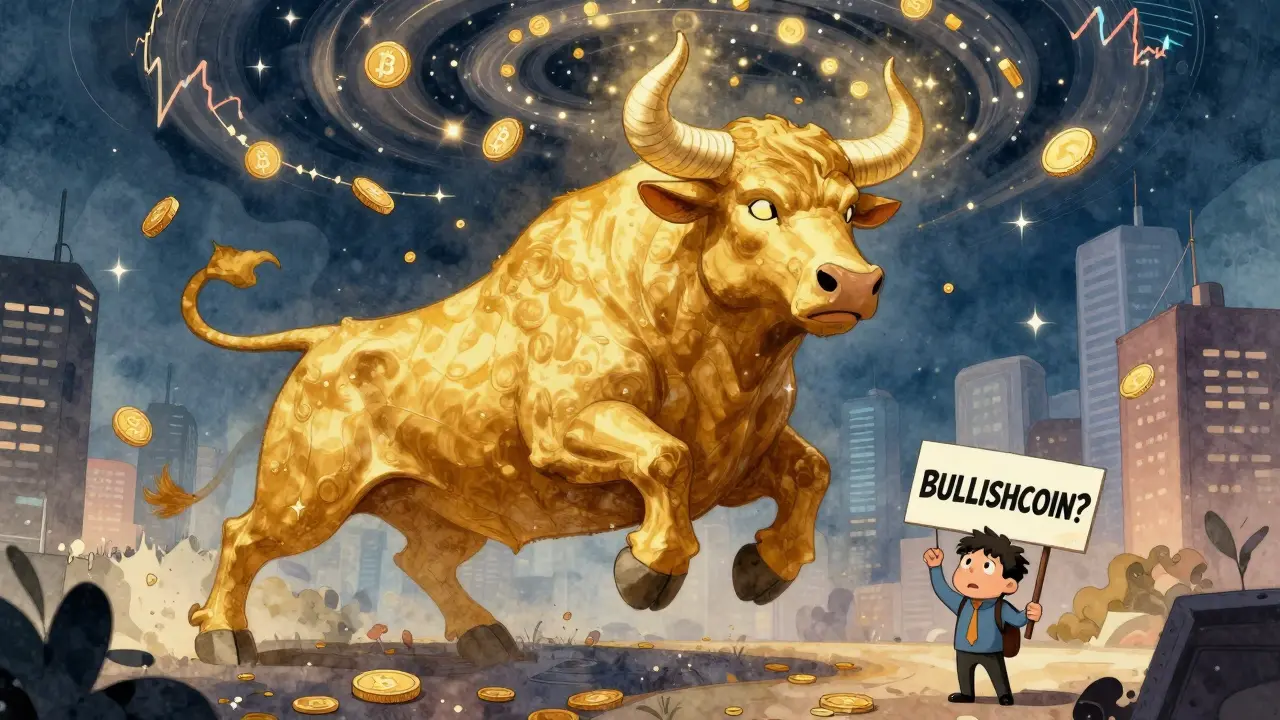
There is no cryptocurrency coin called "BULLISH." If you searched for it hoping to buy a token with that name, you’re not alone - many new traders make this mistake. But here’s the truth: bullish isn’t a coin. It’s a mindset. It’s a market condition. It’s the reason prices shoot up when everyone starts believing the next big move is upward.
Think of it like this: when you hear "bullish," picture a bull charging forward with its horns pointed up. That’s not just a cute metaphor - it’s how traders have described rising markets for over a century. In crypto, a bullish trend means prices are climbing, demand is outpacing supply, and people are buying, not selling. It’s when Bitcoin hits a new all-time high, when Ethereum breaks past $4,000, and when even obscure altcoins start climbing 20%, 50%, or 100% in a week.
What Actually Makes a Market Bullish?
A bull market in crypto doesn’t just mean "prices went up a little." It’s a sustained move - typically a 20% or more increase from a recent low. And it doesn’t happen overnight. Most crypto bull runs last between 6 months and 2 years. The last major one started in late 2020 and peaked in November 2021. The one before that? 2017. These cycles don’t follow a calendar, but they do follow patterns.
What triggers them? A few things:
- Major institutional adoption - like when PayPal started letting users buy crypto, or when BlackRock filed for a Bitcoin ETF.
- Network upgrades - Ethereum’s Merge in 2022 cut energy use by 99.95% and sparked massive confidence.
- Macroeconomic shifts - when inflation hits, people look for alternatives to fiat. Crypto often becomes the go-to.
- Media hype - not the kind that says "this coin will moon," but real news: Coinbase listing a new token, a big company adding Bitcoin to its balance sheet.
When these things happen, traders start buying. More buying means prices rise. Rising prices attract more buyers. That’s the feedback loop. And that’s what a bullish market looks like in real time.
Bullish Isn’t Just About Price - It’s About Sentiment
Price moves because of psychology. If 70% of traders believe prices will go up, they act on it. They buy. They hold. They stop selling. That’s why sentiment indicators matter just as much as charts.
One of the most telling signs? The Fear & Greed Index. When it hits "Extreme Greed" (above 80), you’re usually near the top of a bull run. When it’s below 20 ("Extreme Fear"), that’s often when smart money starts buying. In March 2025, the index hovered around 65 - solidly in the "Greed" zone. That meant traders were confident, but not yet panicking. A classic mid-bull phase.
Another clue? Trading volume. If Bitcoin’s daily volume jumps from $10 billion to $30 billion in a week, something’s shifting. Volume confirms price moves. Without volume, a rally is just noise.
And then there’s social sentiment. Tools like LunarCrush and CryptoPanic track how often coins are mentioned on Twitter, Reddit, and Telegram. In late 2024, Solana was mentioned 3x more than Ethereum on crypto Twitter. That didn’t mean Solana was fundamentally better - but it meant traders were excited. And excitement drives buying.
How to Spot a Bullish Pattern (Without Getting Scammed)
There are dozens of candlestick patterns traders use to spot bullish turns. The most reliable? Two:
- Bullish Engulfing: A small red candle (price down) is followed by a large green candle (price up) that completely covers the previous one. It says: "Buyers took control." When this happens on high volume, it’s a strong signal.
- Bullish Harami: A long red candle, then a small green one inside its body. It’s subtle. It says: "The downtrend is weakening." Often a precursor to a bigger move.
These patterns don’t work in isolation. A bullish engulfing on a 1-hour chart? Maybe a fakeout. On a 4-hour chart, with rising volume and a break above a key resistance level? That’s a trade setup.
Also look for support zones. If a coin drops to $120 three times and bounces each time, that $120 level becomes a magnet. When price returns to $120 and starts climbing again? That’s bullish confirmation.

Bullish vs. Bearish - Why It Matters
Knowing whether the market is bullish or bearish changes everything. In a bullish market:
- You buy and hold.
- You look for dips to add more.
- You avoid selling out of fear.
In a bearish market? You do the opposite. You wait. You protect capital. You look for short opportunities.
Most people lose money in crypto not because they picked the wrong coin - but because they traded against the trend. They bought in a bear market thinking "it’s cheap," only to see prices drop 60% more. Or they sold in a bull market thinking "it’s too high," then watched the coin 5x in the next month.
According to Kraken’s 2025 survey, 63% of crypto traders admitted emotional decisions hurt their returns. That’s not because they’re dumb. It’s because they didn’t understand the difference between a real trend and a hype spike.
What to Do When You Think the Market Is Bullish
If you’re convinced we’re in a bull run - here’s what actually works:
- Stick to top 10 coins. Bitcoin, Ethereum, Solana, Cardano, Polkadot. These have liquidity, history, and institutional backing. Don’t chase random memecoins unless you’re okay losing it all.
- Use dollar-cost averaging. Buy $100 every week, no matter the price. You’ll smooth out volatility.
- Set alerts. If Bitcoin breaks $70,000, get notified. If Ethereum hits $3,500, get notified. Don’t stare at charts all day.
- Take profits. If your portfolio doubles, sell 25%. Lock in gains. That way, even if the market crashes, you still walk away ahead.
And remember: bull markets don’t last forever. They end when greed turns to panic. When everyone’s buying, and no one’s selling - that’s when the top is near.

Common Mistakes New Traders Make
Here’s what goes wrong:
- Buying a coin just because it’s called "BullishCoin" - there is no such thing.
- Chasing pumps on Telegram groups. Those are often exit scams.
- Ignoring volume. A price spike with low volume? It’s fake.
- Thinking one chart pattern = guaranteed profit. No pattern works 100% of the time.
- Not having a plan. "I’ll sell when it doubles" is a plan. "I’ll sell when I feel like it" is not.
There’s a trading platform called Bullish.com. It’s legit. It lets you trade Bitcoin and Ethereum with low fees. But it’s not a coin. It’s a place to trade. Don’t confuse the platform with the concept.
Final Thought: Bullish Is a Process, Not a Coin
You won’t find a "BULLISH" token on CoinGecko. But you will find bullish conditions every few years. And when they come, they create fortunes. Not because of magic. But because of patience, preparation, and discipline.
Learn to read the market. Not the noise. Not the memes. The price action. The volume. The sentiment. That’s how you ride a bull - not by buying a coin named after it, but by understanding what makes it charge.
Is there a cryptocurrency called BULLISH?
No, there is no cryptocurrency token or coin named "BULLISH." The term refers to market sentiment - a bullish trend means prices are rising and investor confidence is high. Some trading platforms, like Bullish.com, use the name, but they don’t issue a coin called BULLISH.
How do I know if the crypto market is bullish?
Look for three things: sustained price increases (20%+ from recent lows), rising trading volume, and positive sentiment across major coins like Bitcoin and Ethereum. Tools like the Crypto Fear & Greed Index and on-chain data from Glassnode can help confirm the trend.
Can I trade a "bullish" coin?
No, you cannot trade a coin called "Bullish." But you can trade assets during a bullish market. Focus on major cryptocurrencies like Bitcoin, Ethereum, or Solana, and use technical indicators like bullish engulfing patterns to time your entries.
What’s the difference between a bull market and a pump?
A bull market is a sustained upward trend lasting weeks or months, driven by real demand and fundamentals. A pump is a short-term, often manipulated price spike that lasts hours or days, usually followed by a crash. Bull markets have volume and news behind them. Pumps have memes and Telegram groups.
Should I buy crypto if I think the market is bullish?
If you believe a bull market is underway, yes - but do it strategically. Focus on top-tier assets, use dollar-cost averaging, and set clear profit targets. Never invest more than you can afford to lose. Bull markets can last a long time, but they always end. Prepare for that.



Brenda White
March 17, 2026 AT 04:40lol i just searched "bullish coin" on binance and got 12 results. one was literally "BULLISH TOKEN" with 0 volume. i thought i was going crazy. turns out im not the only one dumb enough to think it was a real coin 😅
Ernestine La Baronne Orange
March 17, 2026 AT 13:33Okay, but let’s be real-this whole "bullish is a mindset" thing is just Wall Street’s way of making people feel like they’re deep thinkers while they’re literally just gambling with their rent money. I’ve watched people buy Dogecoin because "the vibes are good," then cry when it drops 80%. It’s not a mindset-it’s a psychological trap dressed up as finance. And don’t even get me started on the Fear & Greed Index-people treat it like a horoscope. "Oh, it’s at 65, so I’m gonna buy more!" No. You’re just feeding the machine. The market doesn’t care about your feelings. It eats optimism for breakfast.
Manali Sovani
March 17, 2026 AT 18:24It is a matter of profound concern that individuals continue to conflate linguistic metaphor with financial instrument. The term "bullish" is, by definition, a descriptor of market sentiment, not a tradable asset. One cannot purchase an emotion, nor should one invest capital on the basis of anthropomorphized bovine behavior. The proliferation of such misconceptions is symptomatic of a broader degeneration in financial literacy.
Konakuze Christopher
March 18, 2026 AT 20:10They’re not stupid. They’re being targeted. Every "BullishCoin" you see is a honeypot. Every meme coin with "bull" in the name? A rugpull waiting to happen. They want you to think it’s a coin. So you buy it. So they dump. So you lose. It’s not ignorance. It’s designed.
Bryan Roth
March 19, 2026 AT 04:52Really appreciate this breakdown. I used to chase every pump until I realized I was just chasing hype, not trends. Now I wait for the combo: price up + volume up + sentiment up. And I stick to BTC and ETH. No more random tokens. I’ve made more in 6 months of DCA than I did in 2 years of FOMO. You don’t need to be smart-you just need to be consistent.
sai nikhil
March 19, 2026 AT 15:56While the article provides a comprehensive overview, I believe the emphasis on institutional adoption as a primary driver may overlook the grassroots movements in emerging markets. In India, for instance, retail adoption is growing not because of BlackRock, but because of peer-to-peer platforms and local education initiatives. The narrative needs to be more inclusive.
Kira Dreamland
March 21, 2026 AT 13:49So true. I thought "Bullish" was a coin too. Then I read the article and felt dumb but also relieved. Like, phew, I’m not the only one. Thanks for clearing that up.
Shreya Baid
March 23, 2026 AT 00:47The psychological underpinnings of market behavior are often neglected in favor of technical indicators. While volume and candlestick patterns are useful, they are mere reflections of collective human emotion. The true driver of a bull market is not data-it is trust. Trust in technology. Trust in decentralization. Trust that there is a better system. When that trust crystallizes across millions, the price follows. Not the other way around.
Christopher Hoar
March 23, 2026 AT 13:52bullish? more like bullsh*t. everyone’s acting like they’re Warren Buffett when they buy eth at 3.5k. bro you bought it because you saw it on a discord thread. that’s not bullish, that’s desperate. and don’t even get me started on "dollar cost averaging"-you’re just throwing money into a black hole hoping it turns into a unicorn.
Robert Kunze
March 23, 2026 AT 22:40honestly i thought there was a coin called bullish. i even checked coinmarketcap twice. i feel kinda dumb now but also glad i found this. the part about volume confirming moves? that’s new to me. i always just looked at price. thanks for the clarity.
Sarah Zakareckis
March 24, 2026 AT 08:03Love this. The 3-part confirmation-price, volume, sentiment-is the holy trinity. I use it every time. And DCA? Non-negotiable. I’ve been doing $50/week for 18 months. My portfolio’s up 300%. Not because I’m smart. Because I showed up. Consistency > timing. Always.
Diane Overwise
March 26, 2026 AT 06:51Oh wow. So "Bullish" isn’t a coin…? I guess I’ve been investing in vibes this whole time. 🤡💸
Graham Smith
March 26, 2026 AT 14:41The notion that institutional adoption drives bull runs is a fallacy propagated by centralized finance apologists. Real adoption occurs at the edge-in unbanked communities, in remittance corridors, in peer-to-peer networks. BlackRock’s ETF filing doesn’t create value. It extracts it. The true bull market is decentralized, permissionless, and invisible to Wall Street.
Anastasia Danavath
March 26, 2026 AT 14:58sooo... no bullish coin? 😐 well that's a bummer. i was gonna buy 10000 and call it my "bull run" portfolio. guess i'll just stick to btc. 🤷♀️
anshika garg
March 27, 2026 AT 10:39There is a beauty in the idea that a word-bullish-can move markets more than any algorithm. It speaks to the poetry of human greed, hope, and collective delusion. We don’t trade coins. We trade stories. And right now, the story is: "The future is decentralized." That’s enough to move mountains. Or at least, to move 10,000 ETH.
Bruce Doucette
March 28, 2026 AT 03:36Of course there’s no "BULLISH" coin. That’s the point. They want you to think there is. So you waste time searching. So you miss the real signals. So you buy at the top. It’s all a distraction. The real play is in the quiet. The ones who aren’t talking. The ones who bought when it was at $20k. Not the ones screaming "BULLISH" on Twitter.
Ross McLeod
March 29, 2026 AT 00:42Let’s not romanticize the "bull market." It’s just a euphemism for a speculative bubble that lasts longer than usual. The 2021 run was fueled by stimulus checks, Reddit, and FTX’s marketing budget. The 2017 run was fueled by ICOs and Telegram bots. This one? ETFs and AI hype. It’s not a trend-it’s a sequence of manipulated narratives. The only thing that’s constant is the fact that most people lose money. Always.
rajan gupta
March 30, 2026 AT 11:04bullish? 🐂✨ it's all just vibes bro. i bought 5000 shiba because the moon was in leo and the crypto gods whispered "go". now i'm rich. or i'm broke. either way, the journey was sacred. 🙏🌌
Billy Karna
April 1, 2026 AT 03:09One thing the article misses: the role of liquidity mining and yield farming in sustaining bullish sentiment. In DeFi, you don’t just hold-you earn. And when APYs hit 15-30% on stablecoin pairs, that’s not speculation. That’s economic incentive. People aren’t buying crypto because they think it’ll go up-they’re buying because they’re getting paid to hold it. That’s a fundamentally different dynamic than retail FOMO. And it’s why bull markets in crypto last longer than in equities.
Cheri Farnsworth
April 1, 2026 AT 22:10It is imperative that market participants distinguish between semiotic representation and financial instrument. The term "bullish" denotes a condition of market sentiment, not a tradable security. Misconceptions of this nature contribute to systemic inefficiencies in retail investor behavior.
Gene Inoue
April 2, 2026 AT 08:14you think you're smart for "understanding bullish"? nah. you're just another guy who read a blog and thinks he's now an expert. real traders don't care about fear & greed index. they don't care about volume. they just watch the order book. and when they see 5000 BTC sitting at 70k waiting to be eaten? that's when they move. not before. not after. right then. you? you're still checking twitter.
Ricky Fairlamb
April 3, 2026 AT 09:08Of course there’s no "BULLISH" coin. That’s the whole point of the narrative. The system wants you to believe that the solution to financial insecurity is buying a token with a cute name. Meanwhile, the real power-blockchain infrastructure, settlement layers, custody solutions-is being quietly acquired by institutions under the guise of "innovation." You’re not investing in crypto. You’re funding a surveillance capitalism pipeline. And you’re proud of it.