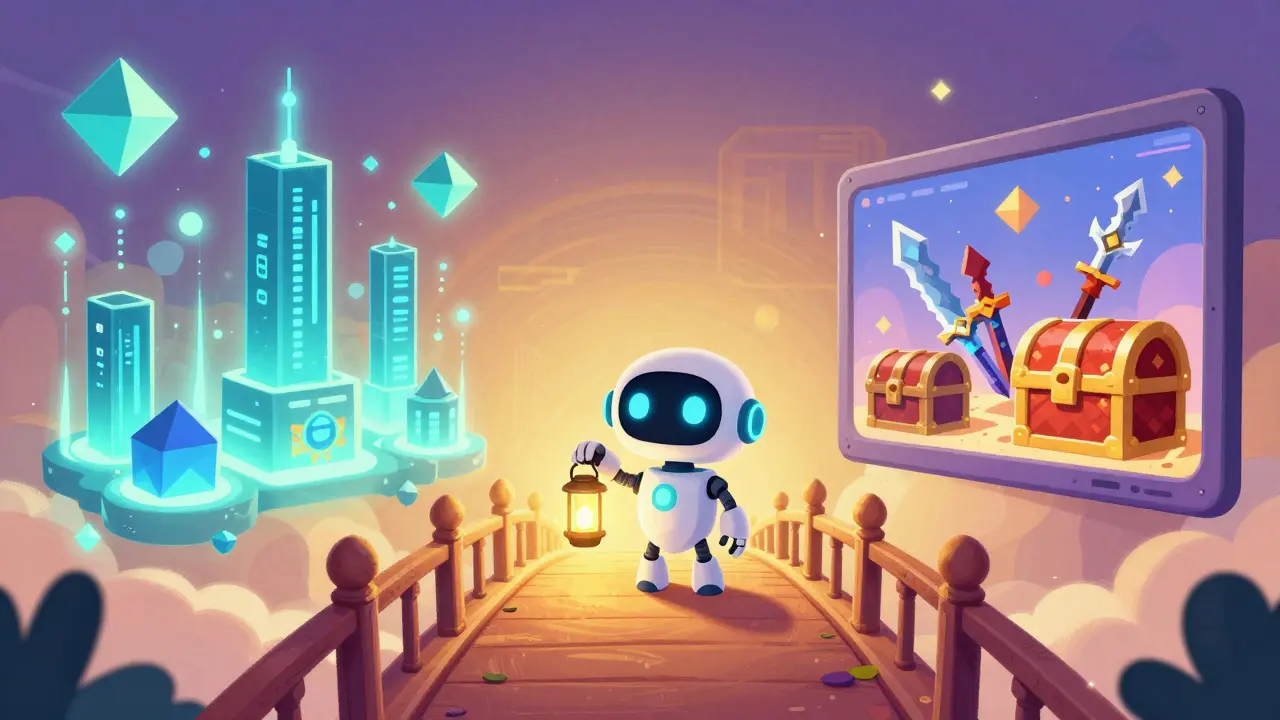
You’ve probably seen the ticker $D popping up on your screen and wondered what it actually does. It isn’t just another meme coin or a random utility token. The DAR Open Network is an AI-powered, chain-agnostic blockchain infrastructure designed to revolutionize Web3 applications through shared technology, assets, and user experiences. Think of it as the bridge between artificial intelligence and gaming, built on top of a blockchain that doesn’t care which other blockchains you’re using.
If you are trying to figure out if this project has real value or if it’s just hype, you need to look past the marketing buzzwords. Let’s break down exactly how this network works, why it matters for gamers and developers, and what the numbers say about its future.
The Core Concept: AI Meets Gaming on Blockchain
At its heart, DAR Open Network is an ecosystem born from the team behind Dalarnia. You might know Dalarnia from its flagship game, Mines of Dalarnia. But the network itself is bigger than one game. It was launched in Q4 2023 to solve a specific problem: most blockchains are siloed. They don’t talk to each other well, and they certainly don’t have native AI capabilities.
DAR Open Network changes that by being "chain-agnostic." This means it can operate across Ethereum, BNB Chain, Polygon, and others simultaneously. It uses a hybrid consensus mechanism combining Proof-of-Stake (PoS) and Byzantine Fault Tolerance (BFT). Why does that matter to you? Because it allows the network to process up to 28,400 transactions per second (TPS). Compare that to Ethereum’s typical 15-45 TPS, and you see why speed is a selling point here.
The unique twist is the integration of Artificial Intelligence. The network isn’t just storing data; it’s using AI agents to manage dynamic content, optimize fees, and even detect threats. As of late 2025, the protocol introduced Version 2.1.3, which enhanced these AI agent capabilities. For a gamer, this could mean smarter NPCs or more responsive economies. For a developer, it means less manual coding for complex logic.
Understanding the $D Token Utility
The $D Token is the primary medium of exchange, governance mechanism, and incentive structure for participants in the DAR Open Network ecosystem. It’s not just a currency; it’s the fuel for the entire machine. Here is how it functions in practice:
- Transaction Medium: About 78% of all network operations use $D to pay for gas fees. Because the network aims for low costs, these fees are generally much cheaper than on Ethereum.
- Staking Rewards: You can stake your tokens to help secure the network. As of Q4 2025, this provided an annual yield of around 8.7%. Many users combine this with earning in-game assets in titles like Mines of Dalarnia.
- Governance: Holding $D gives you a voice. One token equals one vote in protocol decisions. If you want to change how the network operates, you need to hold and vote with your tokens.
- Access Key: Premium AI features within the ecosystem require $D to unlock. This creates constant demand for the token beyond just trading.
- Contribution Mining: Developers and contributors earn $D for building tools and improving the network. This incentivizes growth from the ground up.
This multi-functional design gives $D a high "ecosystem velocity." Messari reported that $D sees 4.2 transactions per token per month, which is double the industry average for similar infrastructure tokens. That means the coin is moving, being used, and changing hands frequently, rather than sitting idle in wallets.
Tokenomics and Supply Details
When looking at any crypto project, the supply mechanics are crucial. There has been some confusion in reports regarding the total supply, so let’s clarify based on the latest data from late 2025 and early 2026.
The maximum supply of $D is set at 800,000,000 tokens. However, not all of them are circulating. As of December 2025, approximately 743.5 million $D were in circulation. The allocation breaks down roughly like this:
| Allocation Category | Percentage | Purpose |
|---|---|---|
| Staking & Community Rewards | 40% | Incentivizing users to secure the network and participate |
| Development Team & Advisors | 25% | Funding ongoing development (subject to 4-year vesting) |
| Strategic Investors | 20% | Early funding partners |
| Marketing & Ecosystem | 10% | Growing user base and partnerships |
| Reserve | 5% | Long-term project stability |
Importantly, $D is a deflationary asset. Every time a transaction occurs, a 0.5% fee is burned. Over time, this reduces the total supply, which can create upward pressure on price if demand remains steady. This burn mechanism is automated and transparent, visible on the blockchain explorer.
How Does It Compare to Competitors?
You might be asking, "Why not just use Polkadot or Solana?" That’s a fair question. Each network has strengths, but DAR Open Network occupies a very specific niche: the intersection of AI and GameFi.
| Feature | DAR Open Network | Polkadot | Solana |
|---|---|---|---|
| Primary Focus | AI x GameFi | Cross-chain Interoperability | High-speed DeFi & NFTs |
| Native AI Integration | Yes (AI Agents) | No | Limited |
| Max TPS | 28,400 | ~1,000 | 65,000+ |
| Chain Agnostic | Yes | Yes (Parachains) | No (Single Chain) |
| Developer Languages | Solidity, Rust, DAR Script | Rust, Ink! | Rust, C |
Polkadot is great for connecting chains, but it lacks the native AI layer that DAR offers. Solana is incredibly fast, but it doesn’t have the same level of specialized support for AI-driven gaming economies. According to independent testing by DappRadar in 2025, DAR Open Network outperformed 92% of competitors in supporting NFT-based gaming with AI-driven content generation.
However, there are trade-offs. DAR lags behind dedicated AI blockchains like Fetch.ai in raw computation speed for AI tasks. It also has a smaller developer community-only about 1,842 active developers compared to Ethereum’s thousands. This means fewer third-party apps right now, but the ones that exist are highly optimized for gaming.
Security and Technical Architecture
Security is non-negotiable in crypto. DAR Open Network uses a modular design with three layers: Execution, Settlement, and Consensus. This separation helps isolate issues and maintain stability.
The network employs 256-bit AES encryption and SHA-3 algorithms for data protection. More interestingly, it uses AI-powered threat detection systems. In 2025 alone, these systems reportedly prevented 147 attempted network breaches. While no system is unhackable, having proactive AI monitoring adds a significant layer of defense against common exploits like flash loan attacks or smart contract vulnerabilities.
Smart contracts on DAR are upgradeable via a proxy contract system. This means developers can fix bugs or add features without needing a hard fork-a major headache in older blockchains. Indodax noted that this approach reduced development downtime by 76% compared to traditional architectures.

Market Performance and User Sentiment
As of January 2026, $D trades at a relatively low price point, often fluctuating between $0.01 and $0.02 depending on the exchange. TradingView recorded it at roughly $0.012, while Poloniex showed higher values around $0.022. This variance highlights the importance of checking multiple sources before trading.
The market cap sits around $9.2 million, ranking it #217 on CoinMarketCap. This places it in the mid-tier infrastructure category, below giants but above many obscure projects. The sentiment among users is mixed but leaning positive. On Reddit, players praise the consistent 8-9% APY from staking combined with in-game earnings. However, some users complain about unpredictable gas fees during peak gaming hours, which can make small transfers uneconomical.
Trustpilot ratings average 4.1 out of 5 stars, with users highlighting the seamless cross-chain experience as the biggest benefit. Wallet integration issues remain the top complaint, affecting about 23% of reviewers. If you are new to this, expect a slight learning curve when setting up your first cross-chain transaction.
Future Roadmap and Risks
The team behind DAR Open Network has a clear roadmap for 2026. Key upcoming developments include:
- Q2 2026: Launch of the DAR AI Agent Marketplace, allowing developers to buy and sell pre-built AI modules.
- Q3 2026: Enhanced Cross-Chain Privacy Protocol to protect user data across networks.
- Q4 2026: Enterprise API Suite to bring institutional-grade tools to the platform.
A strategic partnership with Chainlink announced in January 2026 will integrate decentralized AI data feeds, boosting the network’s machine learning capabilities. This is a significant move, as Chainlink is the gold standard for oracle services.
However, risks exist. The project is heavily tied to the gaming sector. If the GameFi market crashes, $D likely follows. Analysts note a 38% price correlation with overall GameFi performance. Additionally, regulatory uncertainty in the US poses a challenge, as the SEC’s stance on utility tokens remains unclear. In contrast, the project has clear operational approval in Indonesia, where it enjoys strong adoption.
Getting Started with DAR Open Network
If you decide to dip your toes in, here is how to get started:
- Download the DAR Wallet: Available for iOS, Android, and desktop. Setup takes about 8-12 minutes.
- Acquire $D Tokens: Buy from supported exchanges like Indodax or Poloniex, or swap via cross-chain bridges.
- Connect to dApps: Use the wallet to access games like Mines of Dalarnia or other DAO interfaces.
- Stake Your Tokens: Lock up your $D to earn rewards and participate in governance voting.
New users often struggle with cross-chain configuration. Don’t worry-the official documentation includes 17 step-by-step video tutorials. The community Discord, "DAR Academy," has over 14,000 members ready to help troubleshoot.
Is DAR Open Network safe to use?
DAR Open Network employs robust security measures including 256-bit encryption and AI-powered threat detection. It has successfully prevented numerous breach attempts. However, as with any crypto project, you should always use a hardware wallet for large holdings and never share your seed phrase.
What is the main difference between $D and other gaming tokens?
Unlike single-game tokens, $D powers an entire infrastructure layer. It is chain-agnostic, meaning it works across multiple blockchains, and it integrates native AI capabilities for dynamic content and fee optimization, which most gaming tokens lack.
Can I earn passive income with $D?
Yes. By staking your $D tokens, you can earn an annual yield of approximately 8.7%. Additionally, participating in the "contribution mining" program allows developers and community members to earn rewards for contributing to the ecosystem.
Where can I buy $D tokens?
$D is available on several exchanges including Indodax, Poloniex, and potentially others depending on your region. Always verify the listing status on current market data aggregators like CoinMarketCap or CoinGecko before purchasing.
Does DAR Open Network work with Ethereum?
Yes. Because it is chain-agnostic, DAR Open Network interoperates with Ethereum, BNB Chain, Polygon, and other major networks. This allows for seamless asset transfers and application deployment across different ecosystems.
Dr Lynea LaVoy
June 4, 2026 AT 07:02I actually appreciate how this breaks down the technical side without making it sound like impossible magic. The part about AI agents managing dynamic content is really interesting for developers who are tired of hard-coding every little interaction. It feels like a genuine step forward for Web3 gaming infrastructure rather than just another hype cycle.
dan kaffeman
June 5, 2026 AT 09:39Another American-made project trying to save the world? Please. Most of these crypto schemes are just Ponzi structures with fancy buzzwords slapped on top. I bet the real money is going straight into offshore accounts while you guys argue about TPS numbers in the comments section.
Meg Gran
June 6, 2026 AT 04:45oh look another blockchain that thinks ai is the answer to everything lol. its not even close to being ready for prime time. the whole concept of 'chain-agnostic' is just marketing speak for 'we dont know which chain will win so we support all of them poorly'. typical tech bro delusion.
Alexander DeVries
June 7, 2026 AT 19:46You need to look at the fundamentals here. The hybrid consensus mechanism is actually quite robust when you consider the trade-offs between speed and decentralization. Many people dismiss high TPS projects as centralized, but DAR's approach with BFT and PoS offers a balanced solution that scales better than Ethereum alone.
Mark Corpuz
June 8, 2026 AT 20:27The tokenomics seem reasonable on paper, especially the deflationary burn mechanism. However, the reliance on gaming revenue is a significant risk factor. If the game quality drops, the utility of the token evaporates quickly regardless of the underlying technology.
Steven Jacobowitz
June 9, 2026 AT 01:17Wait, so the AI agents can detect threats automatically? That sounds pretty cool if it actually works. I've been burned by smart contract exploits before, so any layer that adds proactive security is worth looking into. Does anyone know if the code is open source for auditing?
Yogendra Dwivedi
June 9, 2026 AT 08:43This looks promising from an Indian developer perspective. The ability to use Solidity and Rust means we don't have to learn a completely new language stack. The cross-chain compatibility is also very useful for our local market where users switch between different networks frequently.
Sylvia Mossman
June 9, 2026 AT 23:48Everyone is sleeping on this because they only look at market cap. Market cap is a lagging indicator. Look at the transaction velocity and the actual usage metrics. This network is moving tokens faster than most established chains. Don't let the low price fool you into thinking it has no value.
Alexis Abster
June 11, 2026 AT 02:09I am so excited about the potential for AI-driven NPCs! Imagine playing a game where the enemies actually adapt to your playstyle instead of following a scripted loop. This could revolutionize the entire gaming industry if executed correctly. Let's hope the team delivers on their roadmap!
Lee Paige
June 12, 2026 AT 15:37They claim to prevent breaches with AI, but who controls the AI? If the backend is compromised, all those 'smart' defenses are useless. I trust hardware wallets and cold storage, not some cloud-based algorithm that can be manipulated by insiders or foreign actors. Stay skeptical.
Caitlin Donahue
June 14, 2026 AT 07:26the gas fees during peak hours are a real deal breaker for me tbh. i tried staking last month and barely made back what i paid in transaction costs. until they fix the congestion issues, its hard to recommend to friends who want easy passive income.
Karthikeyan S
June 16, 2026 AT 06:00lol another scam coin 🤡. look at the team allocation, 25% for devs? thats huge. they will dump on retail once the price pumps. classic rug pull setup. dont be a sucker 📉💀
Dinesh Pattigilli
June 17, 2026 AT 13:04you idiots dont understand the tech. this is enterprise grade architecture. the fact that you cant comprehend the nuance of Byzantine Fault Tolerance shows why you remain poor. read the whitepaper before commenting like a child.
Madhu Menon
June 18, 2026 AT 15:49The intersection of AI and blockchain is inevitable. We are seeing the early stages of a paradigm shift. Whether DAR succeeds or fails, the concept of intelligent, autonomous economic agents is the future of digital interaction. 🧠✨
Narendra Kulkarni
June 20, 2026 AT 05:00thanks for the detailed breakdown. i was confused about the difference between this and polkadot. now i see that dar focuses more on gaming specific needs. might try buying a small amount just to test the wallet integration.
verna kennedy
June 20, 2026 AT 19:47If you cannot explain the utility of the token in one sentence, it is worthless. This article tries too hard to justify a speculative asset with complex jargon. Real value comes from simple, proven use cases, not theoretical AI agents that may never materialize.
JEVON HALL
June 22, 2026 AT 07:28hey guys just wanted to say the staking APY is pretty solid right now 😊. ive been holding since launch and the rewards cover my electricity bill easily. make sure to check the official discord for tutorials though, the setup can be tricky at first 👍
Matthew Malone
June 22, 2026 AT 09:15Why should Americans care about a project that seems heavily adopted in Indonesia? We have our own strong financial systems. Importing foreign crypto risks exposes us to unstable regulatory environments. Stick to US-compliant assets if you value your capital.
aaliyah zahid
June 23, 2026 AT 06:13I think the cultural aspect is important here. Gaming is a global language. The fact that this network bridges different regions allows for a more inclusive community. Instead of fearing foreign adoption, we should celebrate the global nature of Web3 culture.
Erik Kirana
June 23, 2026 AT 20:20Your privacy settings are probably default, aren't they? While you discuss this 'secure' network, you're likely exposing your metadata to every exchange you interact with. True security requires anonymity, not just encryption layers. Wake up to the surveillance state embedded in KYC exchanges.
Brad Ranks
June 24, 2026 AT 13:49I lost $500 on a similar project last year and I'm still traumatized. Every time I see 'AI' and 'Crypto' in the same sentence, my heart rate spikes. Is it too late to go back to playing chess on a server from 2005?
Kelly Tenney
June 24, 2026 AT 22:42Don't let past losses define your future opportunities. Take small steps, educate yourself thoroughly, and never invest more than you can afford to lose. The learning curve is steep, but the community resources available now are much better than they were two years ago.
Caralee Robertson
June 25, 2026 AT 21:04i live in canada and the tax implications of staking rewards are a nightmare here. does anyone know if the platform provides any documentation for CRA reporting? otherwise im stuck just holding and hoping the price goes up enough to offset the hassle.
Greg Lewis
June 26, 2026 AT 21:52the soul is not a token. yet you treat your identity as tradable commodity. this network sells your attention and data wrapped in blockchain aesthetics. do not mistake complexity for depth. the machine eats itself.