
Imagine losing your college diploma. Or worse-someone fakes it, and you can’t prove you earned it. For years, paper certificates, PDFs, and email verifications have been the norm. But what if your degree, certification, or training could never be lost, forged, or deleted? That’s what professional credentials on blockchain are doing right now. No middlemen. No waiting weeks for verification. Just instant, tamper-proof proof of what you know.
What Are Blockchain Credentials, Really?
Professional credentials on blockchain aren’t just digital versions of your resume. They’re cryptographically signed, permanently stored records of your achievements-like a degree, a course completion, or a safety certification-that live on a public, decentralized ledger. Think of them as digital badges with a built-in fingerprint. Each one is tied to your identity, signed by the issuer (like a university or employer), and locked into a blockchain so no one can change it.
These credentials are stored in your personal digital wallet-not on a company server or a university database. You control them. When an employer asks for proof, you share a link. They click it. The system checks the blockchain. In seconds, they see: Yes, this person completed the course. Yes, it was issued by MIT. Yes, it hasn’t been altered. No phone calls. No transcripts. No fraud.
How It Works: DIDs, ZKPs, and Digital Signatures
Behind the scenes, three key technologies make this possible:
- Decentralized Identifiers (DIDs) - These are unique, self-owned digital IDs that don’t rely on Google, Facebook, or any company. You own yours. It’s like a username no one else can take.
- Zero-Knowledge Proofs (ZKPs) - This lets you prove you have a credential without showing the credential itself. For example: you can prove you’re over 21 without showing your ID. Or prove you passed a compliance course without revealing your score.
- Cryptographic Signatures - When MIT issues your diploma, it signs it with a private key. Only their system can do that. Anyone can check the signature against the public key on the blockchain. If it matches? It’s real.
These aren’t theoretical. They’re used daily by universities, companies, and governments. The University of Nicosia has issued over 1,000 blockchain diplomas since 2017. MIT released its first blockchain-based certificates in 2019. And the government of Malta is using blockchain to issue official academic records to its citizens.
Who’s Issuing These Credentials?
You’re not just getting credentials from universities anymore. Employers, online learning platforms, nonprofits, and even hackathons are issuing them.
- Credly and Accredible are the biggest platforms. They let organizations issue digital badges that work across systems. You can collect badges from Coursera, Google, and your employer-all in one place.
- The Digital Assets Council of Financial Professionals (DACFP) offers the Certificate in Blockchain and Digital Assets (CBDA), updated in March 2025. It’s designed for financial advisors who need to guide clients on crypto, wallets, taxes, and regulations. CBDA-certified pros can prove their expertise instantly to clients and firms.
- Concentric Sky helps schools and workforce programs issue credentials for micro-skills: things like “Advanced Excel,” “Project Management,” or “Cybersecurity Awareness.”
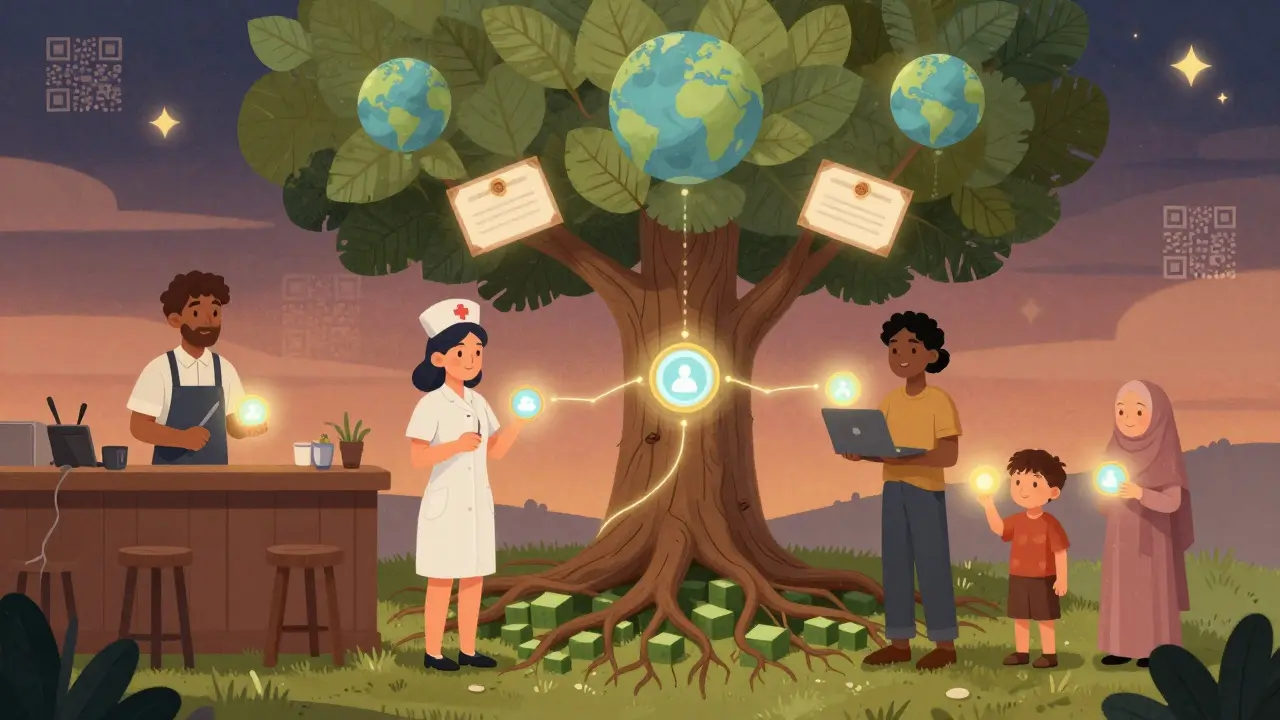
These aren’t just for CEOs or engineers. A barista who completed a food safety course? A volunteer who trained in disaster response? A freelance graphic designer who finished a Figma certification? All can now carry verifiable proof of those skills-anywhere, anytime.
Why This Matters for Jobs and Careers
Recruiters spend an average of 7 seconds scanning a resume. If you’ve got a blockchain credential attached to your LinkedIn or portfolio, you’re not just another applicant-you’re a verified candidate.
Here’s how it changes things:
- No more fake degrees - A 2024 study by the University of California found that 23% of job applicants falsify their education. Blockchain makes that impossible.
- Faster hiring - Instead of waiting 3 weeks for transcript verification, a hiring manager checks a blockchain record in under a minute.
- Global recognition - If you moved from Nigeria to Australia, your blockchain diploma still works. No need to re-certify or pay for credential evaluations.
- Skills over schools - You don’t need a degree from Harvard to prove you’re skilled. Maybe you learned Python through a 6-week bootcamp. Now, you can prove it.
Companies like IBM, Deloitte, and PwC are already using blockchain credentials to verify employee training. One Australian tech firm reported cutting onboarding time by 60% after switching to blockchain-based certifications for cybersecurity training.
Real-World Use Cases Beyond Education
It’s not just about degrees. Blockchain credentials are being used in surprising places:
- Healthcare - Nurses and doctors can carry verifiable records of their training, vaccinations, and certifications. Hospitals instantly verify them without calling past employers.
- Refugees and displaced people - Many flee with no documents. Organizations like the UN are piloting blockchain credentials so refugees can prove their education and job skills-even if they lost their papers.
- Trade unions and apprenticeships - Electricians, plumbers, and welders can now prove their training hours and certifications digitally, making it easier to move between states or countries.
- Volunteering and community work - A person who led 50 community cleanups can now earn a blockchain badge for leadership and environmental action-something employers can verify.
This isn’t science fiction. It’s happening now. The University of Texas at Austin started issuing blockchain diplomas in 2023. Malta’s national blockchain credential system went live in late 2024. And the World Economic Forum is pushing for global standards so credentials work across borders.
What You Can Do Today
If you’re looking to get ahead, here’s how to start:
- Look for blockchain-issued credentials - When taking a course, ask: “Can this be issued as a blockchain credential?” Many platforms now offer it as an option.
- Use a digital wallet - Get a wallet like Microsoft’s ION or a wallet that supports Verifiable Credentials (VCs). Store your badges there.
- Add them to LinkedIn - LinkedIn now supports blockchain credential verification. Click “Add license or certification” and select “Blockchain-verified.”
- Encourage your employer - If your company offers training, ask if they can issue blockchain credentials. It’s cheaper, faster, and more secure than paper.
Even if you’re not tech-savvy, you don’t need to be. The system works in the background. You just share a link. The tech handles the rest.
The Bigger Picture: A Lifelong Record of Your Skills
Think about your career. You’ve taken courses. Done internships. Led teams. Learned new software. But most of that never gets recorded. Blockchain changes that.
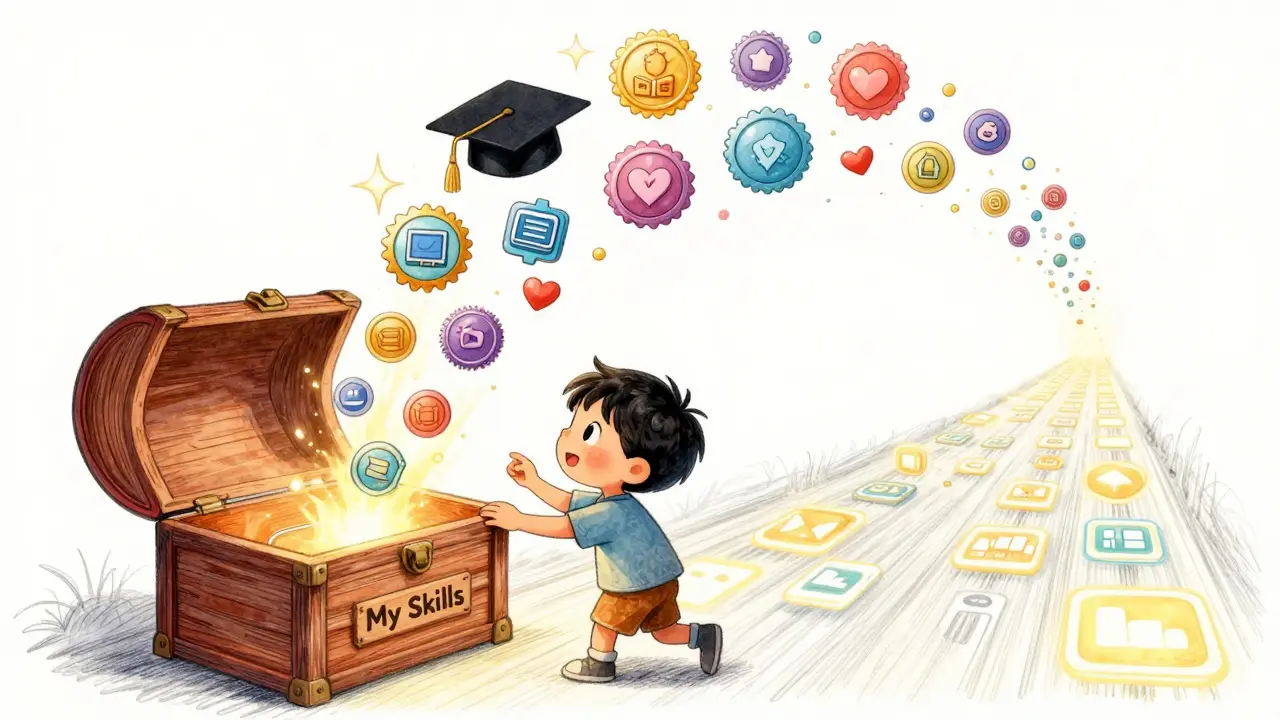
Imagine a lifelong record of your skills-not just your degree, but every certification, every project, every training. A record that moves with you. That can’t be lost. That employers, clients, and institutions can trust instantly.
This isn’t about replacing diplomas. It’s about adding layers. A degree says you studied for four years. A blockchain badge says you completed a 40-hour course in AI ethics. Or you led a team through a cybersecurity drill. Or you passed a compliance exam in 2025.
The future of work isn’t just about who you know. It’s about what you can prove.
Are blockchain credentials legally recognized?
Yes, in many countries. The European Union, Singapore, and Australia are actively recognizing blockchain-issued credentials under digital identity laws. In the U.S., states like California and New York accept them for professional licensing. The key is that the issuer must be accredited-just like a university or certification body. A blockchain credential from a reputable institution carries the same legal weight as a paper one.
Can I lose my blockchain credentials?
No-not if you manage your wallet properly. The credentials live on the blockchain, which is permanent. But if you lose access to your digital wallet (your private keys), you won’t be able to share them. That’s why it’s critical to back up your wallet using a recovery phrase and store it securely-like a physical key. Think of it like losing your house key. The house is still there. You just can’t get in.
Do I need cryptocurrency to use blockchain credentials?
No. Blockchain credentials don’t require Bitcoin, Ethereum, or any crypto. They run on public blockchains designed for identity and verification-like the Ethereum-based Verifiable Credentials network or the Sovrin network. You don’t need to buy, trade, or hold any digital currency. It’s purely about secure record-keeping.
How do employers verify blockchain credentials?
Employers use a simple verification tool-often a website or app. They enter the credential’s unique link or scan a QR code. The system checks the blockchain, confirms the issuer’s digital signature, and shows whether the credential is valid and unaltered. No login, no password, no form to fill out. It’s instant and automated.
Can blockchain credentials be revoked?
Yes, but only by the original issuer. If someone cheated on a certification, the issuing body can revoke the credential. That revocation is recorded on the blockchain too. So if an employer checks later, they’ll see: “Issued on Jan 15, 2025. Revoked on March 5, 2026.” This prevents fraud while keeping the record transparent.
What’s the difference between blockchain credentials and NFTs?
NFTs (non-fungible tokens) are often used for art or collectibles and are tied to ownership. Blockchain credentials are about identity and verification. They’re built on the same tech but serve a different purpose. A credential isn’t something you own like a digital painting-it’s proof of something you did. Think of it as a digital passport, not a digital trading card.
Final Thought: The New Standard
Twenty years ago, having a resume was enough. Ten years ago, LinkedIn changed the game. Now, blockchain credentials are changing it again. They’re not a trend. They’re infrastructure. The same way email replaced postal mail, blockchain credentials will replace paper diplomas and manual verification.
If you’re a student, a worker, a trainer, or a hiring manager-this matters. Because in a world where trust is scarce, verifiable proof is everything.


Bryan Roth
March 14, 2026 AT 11:32sai nikhil
March 16, 2026 AT 03:46Sahithi Reddy
March 17, 2026 AT 17:04George Hutchings
March 18, 2026 AT 04:57Henrique Lyma
March 18, 2026 AT 18:08Steph Andrews
March 20, 2026 AT 05:50shreya gupta
March 21, 2026 AT 20:58Derek Lynch
March 23, 2026 AT 11:27Heather James
March 24, 2026 AT 22:34Sarah Hammon
March 26, 2026 AT 14:26iam jacob
March 26, 2026 AT 22:19Diane Overwise
March 28, 2026 AT 13:36Graham Smith
March 29, 2026 AT 16:32Jerry Panson
March 31, 2026 AT 04:01Katrina Smith
March 31, 2026 AT 21:31Anastasia Danavath
April 2, 2026 AT 11:51anshika garg
April 3, 2026 AT 00:04Bruce Doucette
April 3, 2026 AT 00:18