
Germany has long been a beacon of regulatory clarity in the chaotic world of digital assets. While many countries are still debating whether Bitcoin is money, property, or a scam, Germany recognized Bitcoin as a 'unit of account' back in 2013. That early move set the stage for what exists today: a mature, strict, but highly transparent regulatory environment overseen by BaFin, the Federal Financial Supervisory Authority (Bundesanstalt für Finanzdienstleistungsaufsicht). If you are looking to launch a crypto business in Europe, or if you are an individual navigating the complex web of German tax laws, understanding BaFin’s oversight is not optional-it is survival. As we move through 2026, the landscape has shifted dramatically with the full implementation of the EU’s Markets in Crypto-Assets Regulation (MiCAR). The days of operating in gray areas are over. Today, compliance is the only game in town.
The Regulatory Backbone: From KWG to MiCAR
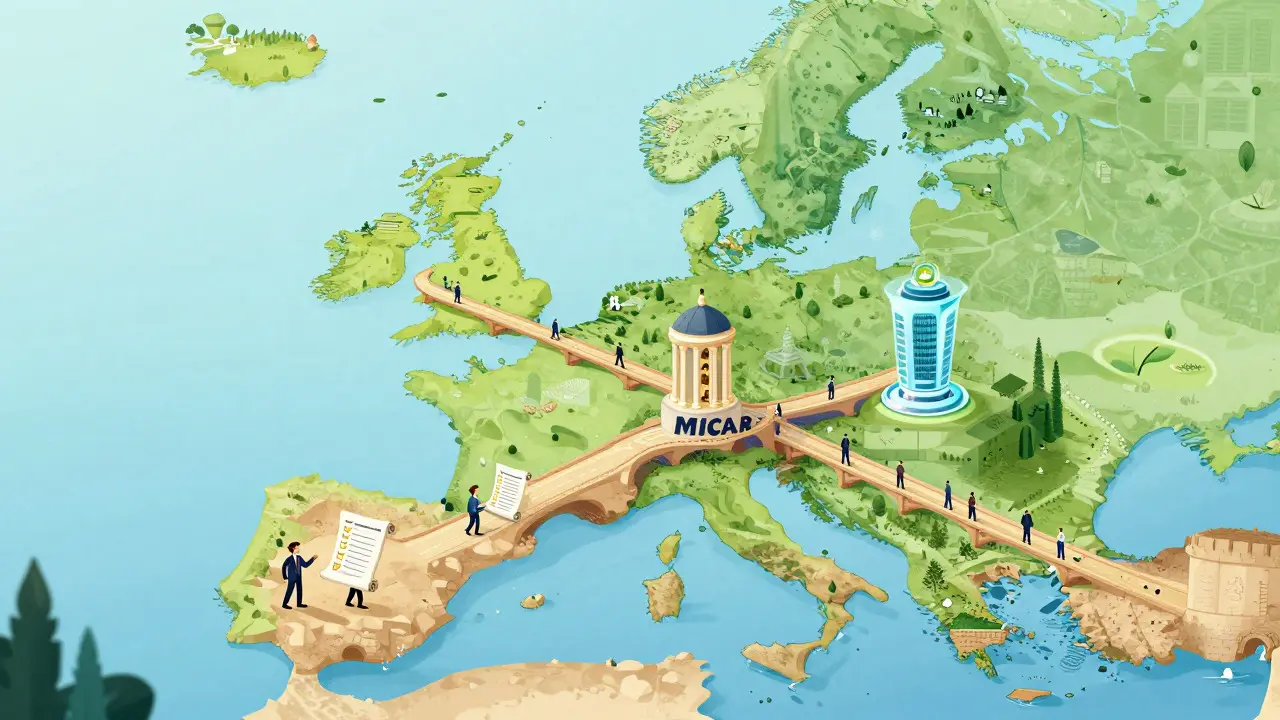
To understand where things stand in 2026, you have to look at how the framework evolved. For years, BaFin regulated crypto services under the German Banking Act (Kreditwesengesetz or KWG). This law classified crypto assets as financial instruments, meaning that anyone providing custody, trading, or exchange services needed a formal BaFin authorization. The transition to MiCAR (Markets in Crypto-Assets Regulation) was a massive undertaking. Implemented via the Act on the Digitalisation of the Financial Market (FinmadiG) and the Act on the Supervision of Markets for Crypto-Assets (KMAG), these laws created a bridge between old national rules and new EU-wide standards. Here is the critical detail for businesses: existing licenses were grandfathered until December 31, 2025. If you held a BaFin license before that date, you had a clear window to transition to a MiCAR-compliant passport. Now, in 2026, any new entrant must meet MiCAR standards from day one. This means uniform rules across the European Union, but with BaFin acting as the gatekeeper for German operations.
Who Needs a BaFin License? Defining the Scope
Not everyone touching crypto needs a license, but the line is thinner than you might think. BaFin’s authority extends to any entity providing crypto-asset services within German jurisdiction. This includes:
- Custody Services: Holding private keys on behalf of clients.
- Trading and Exchange Operations: Matching buyers and sellers.
- Stablecoin Issuance: Creating and managing asset-backed tokens.
- Advisory Services: Providing investment advice on crypto assets.
The Authorization Process: Efficiency Meets Scrutiny
In the past, getting a BaFin license was a marathon. Following the Wirecard scandal, BaFin became known for exceptionally thorough-and slow-reviews. But the landscape has changed. In recent years, BaFin has streamlined its approach, setting strict deadlines and demanding compact presentations. As of 2025 and 2026, decisions on MiCAR applications are being issued within months, not years. This shift reflects a desire to attract high-quality market participants while maintaining rigorous oversight. The application process now requires:
- Detailed Business Plans: Clear demonstration of how your service fits within MiCAR categories.
- IT Security Audits: Proof of robust cybersecurity infrastructure to protect consumer assets.
- AML/KYC Frameworks: Comprehensive systems for identity verification and transaction monitoring.
- White Paper Submission: For issuers, a detailed white paper approved by BaFin before public offerings.
Compliance in Action: AML, KYC, and the Travel Rule
Anti-Money Laundering (AML) compliance is non-negotiable. Germany implements the international "travel rule" through the German Crypto Asset Transfer Regulation (KryptoWTransferV). This regulation mandates that all crypto transfers include information about both the originator and the beneficiary. For businesses, this means integrating robust Know Your Customer (KYC) procedures. You must verify the identities of all parties involved in a transaction. Failure to do so can result in heavy fines or license revocation. BaFin conducts ongoing supervision, checking that companies adhere to minimum IT infrastructure requirements and maintain accurate records. The focus on traceability ensures that crypto remains a tool for innovation, not anonymity for illicit activities. This aligns with the Financial Action Task Force (FATF) standards, positioning Germany as a leader in responsible crypto regulation.
Tax Implications: What Changed in 2025?
For individuals and businesses, tax treatment is just as important as regulatory approval. On March 6, 2025, the Federal Ministry of Finance (BMF) published updated circulars that reshaped the tax landscape for crypto assets. Key changes include:
- Terminology Shift: The term "virtual currencies" was replaced with "crypto assets," reflecting broader recognition.
- Staking Differentiation: Active staking (providing validation services) is treated differently from passive staking (earning rewards), impacting income classification.
- DeFi Guidelines: For the first time, clear guidelines were issued for decentralized finance activities, addressing liquidity provision and yield farming.
- Valuation Rules: Taxpayers must use daily market rates for valuing crypto assets, with stricter documentation requirements.

Enforcement Cases: Lessons from Ethena GmbH
Regulatory theory meets reality in enforcement actions. A notable case occurred on June 25, 2025, when BaFin ordered the winding up of Ethena GmbH’s operations related to USDe stablecoins in Germany. Token holders were given until August 6, 2025, to redeem their tokens, with a special representative overseeing the process. This case highlights BaFin’s willingness to act swiftly against entities that fail to meet regulatory standards or pose risks to consumers. It serves as a stark reminder that even innovative products like algorithmic stablecoins are subject to strict oversight. Businesses must ensure their models are sustainable and compliant before launching.
Practical Steps for Compliance in 2026
If you are entering the German market, here is your checklist:
- Determine Your Status: Are you a service provider, issuer, or user? Define your role clearly.
- Assess Licensing Needs: Consult with legal experts to see if your activities trigger BaFin authorization requirements.
- Implement AML/KYC: Build systems that comply with KryptoWTransferV and FATF travel rule standards.
- Prepare Documentation: Draft white papers, business plans, and IT security audits well in advance.
- Monitor Tax Obligations: Stay updated on BMF circulars and maintain detailed transaction records.
Do I need a BaFin license to accept crypto payments for my online store?
Generally, no. If you accept cryptocurrency as a substitute currency for goods or services, it is not considered a financial service. However, if you use a third-party payment processor that lacks a license, you could face legal issues. Ensure your payment partner is BaFin-authorized.
How long does it take to get a BaFin crypto license in 2026?
Following recent reforms, BaFin aims to issue decisions within a few months for MiCAR-compliant applications. Previously, the process could take years. Efficiency has improved significantly, but thorough preparation is still essential.
What is the impact of MiCAR on German crypto regulations?
MiCAR replaces fragmented national rules with uniform EU-wide standards. In Germany, it is implemented via FinmadiG and KMAG. All crypto-asset service providers must hold a MiCAR license by 2026, ensuring consistent oversight across Europe.
Are foreign-based crypto companies subject to BaFin oversight?
Yes, if they actively target German residents or maintain a physical presence in Germany. BaFin considers domestic connections sufficient for jurisdiction. Exceptions exist for passive services initiated solely by the customer.
How has crypto taxation changed in Germany since 2025?
The Federal Ministry of Finance introduced clearer guidelines for DeFi, differentiated active vs. passive staking, and mandated daily market rate valuation. Strict documentation and retention obligations apply to all taxpayers.


Paul Smith
August 3, 2026 AT 19:59Finally, some clarity! 🇩🇪 Germany really did set the gold standard here. It’s awesome to see them embracing innovation while keeping things safe for everyone. The MiCAR transition sounds intense but totally worth it for the long game. 🚀💎
Namrata Mapgaonkar
August 4, 2026 AT 21:59honestly this is soo much better than the chaos we have in india right now 😅
we still dont know if crypto is legal or illegal half the time lol. germany is winning at life with these clear rules. i wish our govt would just pick a side already.
Subhash Kashyap Dm
August 5, 2026 AT 17:19they are just creating more red tape to control the masses
ba fin is a puppet of the central banks trying to kill decentralized finance before it gets too big
travel rule is basically global surveillance
wake up sheeple
Eric Zehr
August 7, 2026 AT 08:13I think there is real value in having a structured framework like this. It might feel restrictive at first, but it actually opens doors for institutional adoption that were previously closed. When you have clear rules, you have trust. And trust is what brings the big money into the space. It is encouraging to see BaFin moving faster on approvals too; efficiency matters just as much as oversight.
amy miranda
August 8, 2026 AT 12:51It is absolutely disgusting how they treat small businesses. You think you are just selling coffee for Bitcoin and suddenly you are a financial institution? The moral decay of society is evident when we allow regulators to overreach into simple commerce. They care about their fines, not your livelihood. It is a disgrace.
Rita Dutta
August 10, 2026 AT 05:22the concept of 'substance over form' is truly a philosophical nightmare isnt it?
who decides what substance means? is it the intent of the soul or the mechanics of the code? ba fin plays god with definitions. it reminds me of plato's cave where shadows are mistaken for reality. we are dancing on the edge of a regulatory abyss and calling it progress lol.
Ed Wallace
August 12, 2026 AT 01:50There is something deeply poetic about the shift from wild west chaos to structured order. It mirrors the human journey from adolescence to maturity. We needed the freedom to explore, but now we need the boundaries to build something lasting. The tax changes on staking are particularly interesting-differentiating active work from passive reward feels like a recognition of labor versus luck.
Billy Cunningham
August 13, 2026 AT 10:33So much reading for so little gain. My eyes hurt. 😫
Qolbina Islami
August 14, 2026 AT 01:25GERMANY IS THE ONLY COUNTRY THAT MATTERS!!!
EVERYONE ELSE IS FAILING!!! BA FIN IS STRONG!!! WE NEED THIS KIND OF POWER IN AMERICA!!! SHUT DOWN THE SCAMMERS!!! PROTECT OUR PEOPLE!!! 🔥🔥🔥
SUBHAM CHOUDHURY
August 16, 2026 AT 00:08You can do this! 💪 Just take it one step at a time. Don't let the complexity overwhelm you. Every expert was once a beginner. Focus on your business plan and you will succeed!
Pernelia Wahkan
August 17, 2026 AT 13:53The nuance regarding third-party payment processors is a critical detail often overlooked by small merchants. If you accept crypto directly, you are fine, but outsourcing that function to an unlicensed entity creates a liability web that could ensnare you. It is a classic case of vicarious liability in digital finance. I recommend auditing your entire stack, not just your wallet addresses. The Ethena case proves that BaFin has teeth, so do not assume your size offers protection.
Joshua Hofford
August 18, 2026 AT 21:25Hey folks, just wanted to say that despite the heavy regulations, this is actually a good sign for the industry. It means we are becoming a legitimate part of the global economy. I remember back in 2013 when people laughed at Bitcoin being a unit of account. Now look at us. We are navigating complex tax laws and compliance frameworks. It is all part of the growth process. Stay positive and keep learning!
Rodmun Tarnowski
August 19, 2026 AT 14:07Indeed!; The clarity provided by MiCAR is unprecedented.; Furthermore, the streamlined application process is a welcome relief.; However, one must remain vigilant regarding AML compliance.; The travel rule is non-negotiable.; Let us proceed with caution and optimism!;