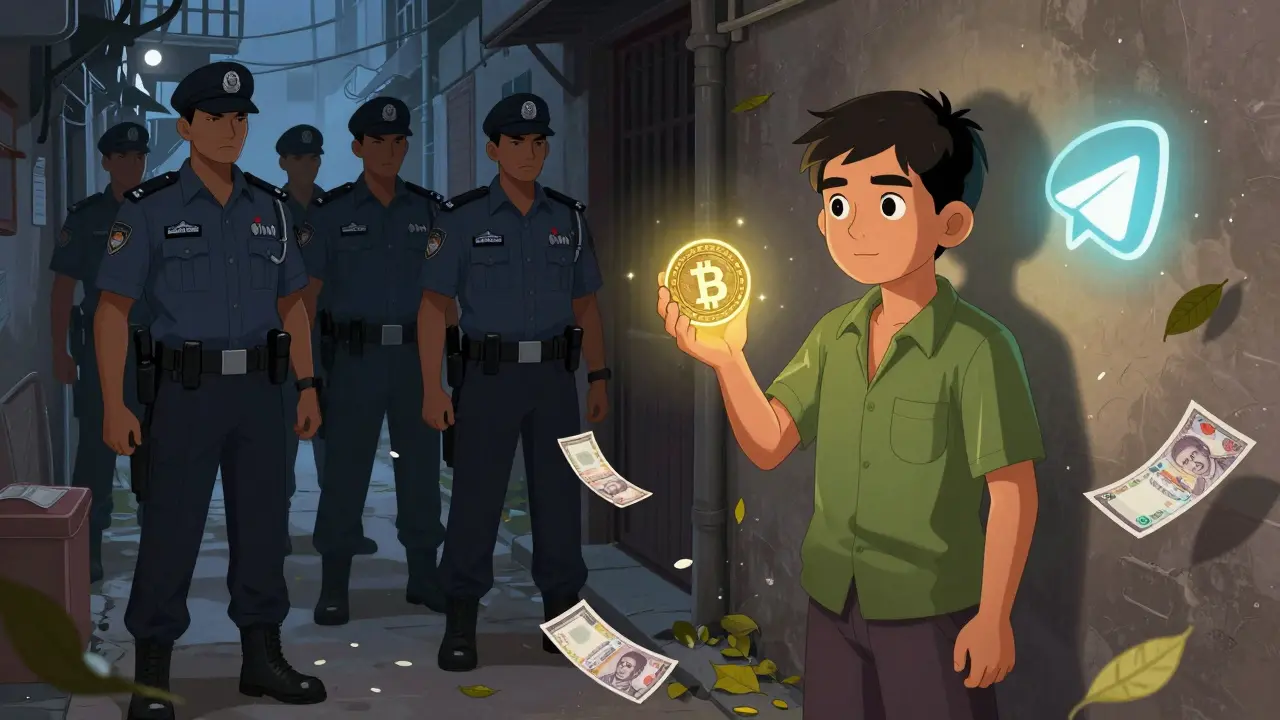
On May 15, 2020, Myanmar’s Central Bank issued a directive that didn’t just discourage cryptocurrency-it outlawed it. Central Bank Directive 9/2020 made it illegal for anyone in Myanmar to buy, sell, or trade Bitcoin, Ethereum, Litecoin, or even Tether (USDT). This wasn’t a warning. It was a full stop. And it came at a time when most countries were starting to figure out how to regulate digital assets, not ban them outright.
What Exactly Did Directive 9/2020 Say?
The directive didn’t leave room for interpretation. It declared that no digital currency could be used as legal tender in Myanmar. Only the kyat, issued by the Central Bank of Myanmar (CBM), had that status. Any transaction involving Bitcoin, Ethereum, or any other unregulated digital currency was now a violation of the law. The CBM pointed to two sections of its own founding law-Section 40(e) and Section 62-to back this up. Those sections give the bank exclusive power to issue currency. No exceptions.
The ban wasn’t just about banks. It targeted everyday people. If you used Facebook to send USDT to a friend in Thailand, or traded Bitcoin on a peer-to-peer app, you were breaking the law. The CBM even named specific platforms where these transactions were happening. They didn’t just want to stop banks from handling crypto-they wanted to stop people from using it at all.
Why Did Myanmar Do This?
The official reason was simple: control. The CBM argued that allowing cryptocurrencies would undermine its ability to manage the national economy. But the timing tells a deeper story. In 2020, Myanmar was already under economic stress. The kyat was weakening. By 2021, after the military coup, the currency collapsed. Inflation soared. People lost faith in the system. And that’s when crypto became a lifeline.
While the government was tightening its grip, citizens were turning to digital assets to survive. USDT, a stablecoin pegged to the U.S. dollar, became the go-to tool for sending money across borders, buying essentials, and even funding resistance efforts. The ban wasn’t just about financial control-it was about political control. If people couldn’t move money outside the system, they’d be easier to control.

How Is the Ban Enforced?
The CBM doesn’t have a crypto police force. But it has power over banks. If you’re caught using crypto, your bank account gets frozen. Your name gets flagged. And if you’re involved in large transfers-especially using USDT-you could face jail time. The Anti-Money Laundering Law and Financial Institutions Law give the government the tools to prosecute.
In May 2024, four years after the original ban, the CBM issued a public notice reminding everyone: this is still active. They didn’t just repeat the rules-they warned of account closures and legal action. That’s not a threat. That’s a pattern. They’ve already shut down accounts of people using hundi (informal money transfer networks) to move USDT. These aren’t faceless criminals. These are parents, small business owners, and workers trying to send money home.
The Underground Crypto Economy
Here’s the twist: the ban didn’t stop crypto. It just pushed it underground.
Telegram groups are now the new stock exchanges. Tron-based USDT is the most popular digital currency in use. People trade through encrypted channels, using cash-in-hand meetups or QR code transfers. A 2025 report from Coinfomania found that peer-to-peer crypto volume in Myanmar had grown by over 300% since 2022. Why? Because the kyat is worthless. A dollar used to buy 2,000 kyat. Now it buys 3,500-and falling.
Even the military government’s own actions backfire. After the opposition National Unity Government (NUG) declared USDT legal in areas it controls, the SAC responded by drafting new cybersecurity laws in early 2022 to criminalize crypto use even more. But those laws can’t reach people using Telegram. They can’t shut down the internet everywhere. And they can’t stop a population desperate for stability.

How Does This Compare to Other Countries?
Myanmar is an outlier. Most countries in Southeast Asia took a different path. Thailand allows regulated exchanges. Singapore has licensing rules. Even Vietnam has a framework for taxation. But Myanmar? No licenses. No oversight. Just a flat ban.
It’s the opposite of El Salvador, which made Bitcoin legal tender. Or the Central African Republic, which did the same. Myanmar’s ban isn’t about protecting citizens. It’s about protecting power. And it’s failing.
What’s Next?
The NUG is building its own digital currency-DMMK, or Digital Myanmar Kyats. It has a mobile wallet. It’s designed to work offline. If it takes off, it could become the real currency for millions, not the kyat.
Meanwhile, the CBM keeps tightening. Internet shutdowns are more frequent. Mobile data is cut during protests. But people still find ways. They use satellite phones. They trade in markets. They use friends in Thailand to cash out.
The truth is, no law can stop a currency people trust. The kyat is broken. Crypto isn’t perfect-but it’s working. And until the government fixes the economy, not just the rules, this ban will keep being ignored.
Is cryptocurrency illegal in Myanmar?
Yes. Under Central Bank Directive 9/2020, all cryptocurrency transactions-including buying, selling, trading, or transferring-are banned. This includes Bitcoin, Ethereum, Litecoin, and USDT. Violators risk having bank accounts frozen and facing criminal charges under the Anti-Money Laundering Law and Financial Institutions Law.
Can I use USDT in Myanmar legally?
No. USDT is explicitly banned under Directive 9/2020. The Central Bank of Myanmar has repeatedly warned that using USDT for payments or transfers is illegal. Despite this, many people still use it informally because it’s one of the few ways to preserve value when the kyat is collapsing.
What happens if I get caught trading crypto in Myanmar?
You could face bank account closure, fines, or imprisonment. The Central Bank has already frozen accounts linked to USDT transfers through hundi networks. Enforcement is selective but growing, especially for those involved in large-scale or cross-border transactions. Legal action is taken under the Anti-Money Laundering Law and Financial Institutions Law.
Why hasn’t the ban stopped crypto use in Myanmar?
Because the kyat has lost nearly 75% of its value since 2021. People need a way to save money, pay for imports, and send remittances. Crypto-especially USDT on the Tron network-offers stability and access to global markets. The ban can’t control encrypted apps like Telegram or offline peer-to-peer trades. Enforcement is limited to banking channels, not the underground network.
Is there a government-backed cryptocurrency in Myanmar?
The military government has not launched one. But the opposition National Unity Government (NUG), which controls parts of the country, has developed a digital currency called DMMK (Digital Myanmar Kyats) with a mobile wallet. It’s designed to function even without internet access, challenging the military’s ban and offering an alternative to the failing kyat.





Jesse VanDerPol
March 6, 2026 AT 17:23jay baravkar
March 8, 2026 AT 06:26Rachel Rowland
March 9, 2026 AT 08:11Jeffrey Dean
March 9, 2026 AT 19:40Eva Gupta
March 11, 2026 AT 17:50Christina Young
March 13, 2026 AT 09:03Leah Dallaire
March 14, 2026 AT 21:15prasanna tripathy
March 15, 2026 AT 09:30Issack Vaid
March 16, 2026 AT 12:32Shawn Warren
March 17, 2026 AT 00:09Jackson Dambz
March 18, 2026 AT 04:43Megan Lutz
March 18, 2026 AT 16:32Datta Yadav
March 20, 2026 AT 11:57Lydia Meier
March 21, 2026 AT 08:01