
The U.S. Securities and Exchange Commission (SEC) didn’t just tweak rules in 2024 and 2025-it rewrote the playbook for how Wall Street interacts with crypto. For over a decade, Bitcoin and Ethereum were treated like digital wildcards: too risky, too unregulated, too chaotic for mainstream finance. Then, in January 2024, everything shifted. The first spot Bitcoin ETFs launched, and six months later, Ethereum followed. These weren’t just new financial products. They were signals: the SEC was finally acknowledging these assets as legitimate, investable holdings-not speculative tokens.
Why the SEC Changed Its Mind
The SEC had rejected more than 13 Bitcoin ETF applications since 2013. Each time, they cited concerns about market manipulation, lack of custody, and the risk of fraud. But in August 2023, a federal court ruled that the SEC had been inconsistent. They approved Bitcoin futures ETFs but kept rejecting spot ones, even though both tracked the same asset. That ruling forced the SEC’s hand. By January 10, 2024, they approved eight spot Bitcoin ETFs, including BlackRock’s IBIT and Fidelity’s FBTC. No more waiting. No more excuses. The Ethereum approval came on July 23, 2024. It wasn’t just a copy-paste of Bitcoin’s path. Ethereum’s proof-of-stake consensus meant staking rewards were now part of the equation. Grayscale, Fidelity, and others had to decide: do we pass those rewards to investors? Most did. That made Ethereum ETFs more than price trackers-they became yield-generating tools.The Big Shift: In-Kind Creation (July 2025)
The first Bitcoin and Ethereum ETFs started with a major limitation: cash-only creation and redemption. If you wanted to create ETF shares, you had to buy Bitcoin or Ether on the open market, pay taxes on the gain, then hand over cash to the ETF provider. It was messy, expensive, and inefficient. That changed on July 29, 2025. The SEC approved in-kind processing for crypto ETFs. Now, authorized participants can deliver actual Bitcoin or Ether directly to create ETF shares-and receive the same crypto back when redeeming. No need to sell. No taxable event. Just swap the asset. The impact? Massive. By October 2025, BlackRock processed over $3 billion in Bitcoin conversions using in-kind mechanics. Whale holders, who previously avoided ETFs because selling meant paying capital gains, suddenly had a clean way to move large amounts into regulated vehicles. Bitwise and Galaxy Digital saw 47% and 63% quarter-over-quarter growth in client requests for in-kind conversions. This wasn’t just convenience-it was institutional adoption on steroids.Bitcoin vs. Ethereum ETFs: Key Differences
People treat Bitcoin and Ethereum like twins. They’re not. Their ETFs reflect that. Bitcoin ETFs are simple. All 11 approved funds track the price of Bitcoin. No staking. No rewards. Just buy, hold, and track the market. Their fees are low: average 0.25%. Fidelity’s FBTC charges 0.00%. BlackRock’s IBIT is 0.25%. Even Grayscale’s GBTC, which started as a trust with a 2% fee, dropped to 0.50% after converting to an ETF. Ethereum ETFs are more complex. Because Ethereum generates staking rewards, ETF providers had to choose: do we stake the ETH we hold? If yes, do we pay out the rewards to shareholders? Only five of the 11 Ethereum ETFs (45.5%) opted in. Grayscale’s ETHE does-and it’s the biggest. As of September 2025, ETHE held 3.1 million ETH, with 4.2% staked. That generated $127 million in quarterly rewards, distributed to investors. Fees for Ethereum ETFs are higher, averaging 0.35%. VanEck’s EETH charges just 0.15%. Grayscale’s ETHE still charges 1.50%. That’s a premium for brand recognition and the complexity of managing staking. Investors pay more for the yield, but they’re getting it.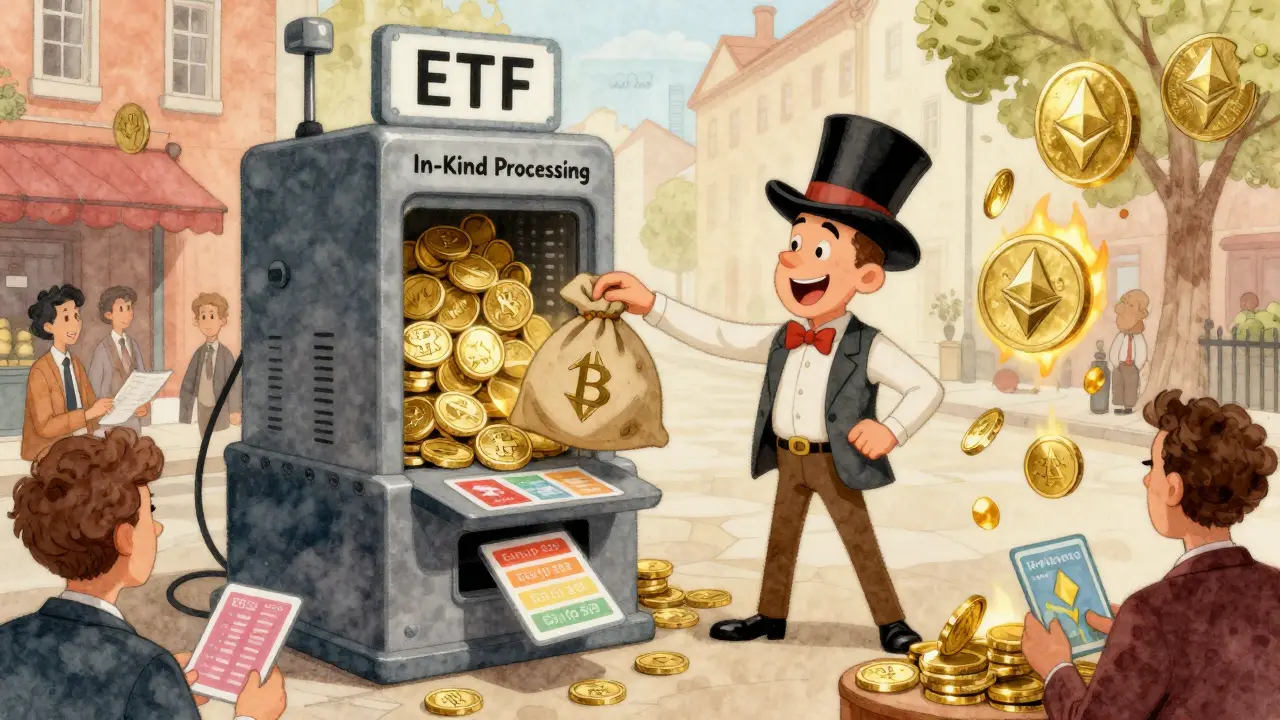
Market Performance: Who’s Winning?
As of September 30, 2025, spot Bitcoin ETFs held $54.3 billion in assets under management. BlackRock’s IBIT led with $16.9 billion-over 30% of the entire market. Fidelity’s FBTC was second at $10.1 billion. Together, the top three ETFs controlled nearly half the market. Ethereum ETFs totaled $18.7 billion. Grayscale’s ETHE was the clear leader at $5.1 billion (27.3% share). Fidelity’s FETH was second, with $3.4 billion. But here’s the twist: while Bitcoin ETFs saw $1.2 billion in net outflows during Q3 2025, Ethereum ETFs pulled in $478 million. Why? Investors saw Ethereum’s staking yield as a hedge against rising interest rates. Bitcoin’s price was flat. Ethereum’s yield made it more attractive. Even more telling: Bitcoin ETFs traded at a 0.08% premium to their net asset value (NAV). Ethereum ETFs traded at 0.23%. That’s a sign of stronger demand. People were willing to pay more for Ethereum exposure.What This Means for Regular Investors
You don’t need to be a whale to benefit. If you’ve held Bitcoin or Ethereum in a wallet, you can now move it into an ETF through your brokerage-Fidelity, Schwab, Robinhood, or Coinbase. No more worrying about private keys. No more exchange hacks. No more tax headaches if you use in-kind transfers. For small investors, the biggest win is access. You can now buy a share of a Bitcoin ETF for $50. You don’t need to buy a whole Bitcoin. You don’t need a crypto wallet. You don’t need to understand blockchain. You just need a brokerage account. But watch the fees. Grayscale’s ETHE at 1.50% is a trap for long-term holders. VanEck’s EETH at 0.15% is far better. Compare management fees like you would with mutual funds. A 1% difference over 10 years can cost you tens of thousands.
Global Ripple Effects
The U.S. didn’t act alone. On October 16, 2025, the UK’s Financial Conduct Authority lifted its four-year ban on crypto ETNs for retail investors. Now, British investors can hold physical Bitcoin and Ether in ISAs-tax-free retirement accounts. Hong Kong launched its first spot Solana ETF on October 23, 2025, charging 0.99% annual fees. Singapore and the EU are expected to follow by mid-2026. This isn’t just a U.S. trend. It’s a global shift. Countries are racing to offer regulated, secure access to crypto. The U.S. led. Now others are catching up.What’s Next?
The SEC’s October 2025 orders didn’t just open in-kind processing for Bitcoin and Ethereum. They said it applies to “a host of crypto asset ETPs.” That’s code for: more ETFs are coming. Solana? Already approved in Hong Kong. XRP? Evernorth announced a $1 billion deal to acquire XRP for yield strategies. Cardano? Polkadot? Don’t be surprised if they’re next. But the SEC isn’t handing out approvals like candy. Chairman Paul S. Atkins made it clear: “Not all crypto assets will qualify.” They’re still evaluating each one. Bitcoin and Ethereum passed because they’re liquid, decentralized, and have clear ownership structures. Coins with centralized teams or unclear governance? Probably not. The future? By December 2026, experts project combined Bitcoin and Ethereum ETF assets will hit $150 billion. In-kind processing will save the industry $500 million a year in operational costs. That’s money that goes back to investors.What to Watch Out For
Regulatory clarity is still evolving. The SEC hasn’t officially defined whether staking rewards are income or capital gains. Tax rules are still murky. If you receive staking rewards from an Ethereum ETF, you may owe taxes on them-even if you didn’t sell anything. Also, don’t assume ETFs eliminate risk. Bitcoin and Ethereum prices still swing. The ETF just changes how you hold them. If the market crashes, your ETF shares crash too. And don’t get fooled by hype. Just because an ETF exists doesn’t mean it’s a good investment. Look at fees, liquidity, and whether the fund actually stakes (for Ethereum). Read the prospectus. Don’t just follow the ticker.Are Bitcoin and Ethereum ETFs safe?
They’re safer than holding crypto on an exchange, but not risk-free. ETFs are regulated, held by custodians like Coinbase or Fidelity, and subject to SEC oversight. But the underlying assets-Bitcoin and Ethereum-still experience price volatility. If the market drops 30%, your ETF drops 30%. Also, if the ETF provider mismanages staking or custody, you could lose value. Always check the fund’s prospectus and custodian.
Can I buy Ethereum ETFs in the U.S. now?
Yes. Eleven spot Ethereum ETFs launched in July 2024 and are available on major brokerages like Fidelity, Schwab, Charles Schwab, and Robinhood. You can buy them just like any stock. The most popular are Grayscale’s ETHE, Fidelity’s FETH, and VanEck’s EETH. All trade under ticker symbols and settle in U.S. dollars.
Do Ethereum ETFs pay dividends?
They don’t pay dividends, but some pay staking rewards. Ethereum generates rewards from its proof-of-stake network. Five of the 11 Ethereum ETFs stake the ETH they hold and distribute those rewards quarterly to shareholders. Grayscale’s ETHE does this and paid $127 million in rewards in Q3 2025. Others, like Fidelity’s FETH, don’t stake at all. Check the fund’s documentation before buying if you want yield.
Is it better to buy Bitcoin ETF or Bitcoin directly?
It depends. If you want full control, self-custody, and plan to use Bitcoin for payments or DeFi, buy it directly. If you want simplicity, security, and easier tax handling, go with an ETF. ETFs are better for long-term investors who don’t want to manage private keys. For most people, especially those using retirement accounts, ETFs are the smarter choice.
Why are Ethereum ETF fees higher than Bitcoin ETFs?
Ethereum ETFs cost more because they’re more complex. Some stake ETH to generate rewards, which requires technical infrastructure, legal compliance, and ongoing management. Grayscale’s ETHE charges 1.50% because it converted from a high-fee trust structure and still carries legacy costs. VanEck’s EETH charges only 0.15% because it built the ETF from scratch with low overhead. The fee reflects the provider’s strategy, not the asset itself.
Will more cryptocurrencies get ETFs soon?
Yes. The SEC’s July and October 2025 approvals opened the door for other crypto assets. Solana already has an ETF in Hong Kong. XRP is being acquired by firms like Evernorth for yield strategies, hinting at a future U.S. ETF. Cardano, Polkadot, and Chainlink are likely next. But the SEC will evaluate each one individually. Assets with centralized control or unclear governance won’t pass.





Rishav Ranjan
December 21, 2025 AT 06:04ETFs are just middlemen taking a cut. Just buy BTC directly.
Jake Mepham
December 22, 2025 AT 04:27This is huge. For years we were told crypto was too risky for regular folks. Now you can buy Bitcoin through your 401(k) like you would Apple stock. No more worrying about losing your private key or getting hacked on some sketchy exchange. The real win? In-kind transfers. Whales can finally move their bags without getting taxed into oblivion. This isn’t just regulation-it’s institutional adoption on turbo mode. The market’s going to explode over the next two years.
Mmathapelo Ndlovu
December 22, 2025 AT 12:25So happy to see this finally happen 😊 I’ve been holding ETH since 2017 and it’s wild to think it’s now in mainstream portfolios. Staking rewards in ETFs? That’s like passive income without the tech headache. Honestly, this makes me believe crypto isn’t just a fad anymore. 🌱
vaibhav pushilkar
December 22, 2025 AT 22:33VanEck’s EETH at 0.15% is the real deal. Avoid Grayscale’s 1.5% trap unless you’re emotionally attached to the brand. Fees matter more than you think.
Lloyd Yang
December 22, 2025 AT 22:40Man, I remember when people called Bitcoin a pyramid scheme and the SEC laughed at every ETF application. Now we’ve got BlackRock managing over $16 billion in Bitcoin ETFs alone. It’s not just adoption-it’s normalization. The fact that in-kind transfers are live means the system finally caught up with the tech. No more selling your BTC to buy shares, then paying capital gains on the sale. Just swap the asset like you would shares of SPY. And Ethereum’s staking rewards? That’s the secret sauce. People aren’t just betting on price-they’re betting on yield, like bonds but without the central bank. It’s beautiful. The global ripple is even bigger: UK letting retail investors hold crypto in ISAs, Hong Kong launching Solana ETFs. This isn’t America’s party anymore. It’s a global financial reset, and the U.S. just handed out the keys. The next wave? XRP, Cardano, maybe even Chainlink. But the SEC’s still playing hardball-only assets with real decentralization and liquidity will pass. That’s actually good. It means we’re moving past the wild west and into something sustainable. The real winners? Long-term investors who didn’t panic sell in 2022. They didn’t need to be tech geniuses. Just patient. And now? They’ve got the safest, simplest way to hold the future.
Shubham Singh
December 24, 2025 AT 00:27How is this not a bubble dressed in compliance? The SEC approved these because they had no choice after the court ruling, not because they believe in crypto. This is regulatory capture disguised as progress.
Jacob Lawrenson
December 25, 2025 AT 11:20Finally! Took long enough. I’ve been buying EETH since July and the staking rewards alone have added 3% to my returns. No need to run around staking on Lido or Coinbase-just hold the ETF and chill 🙌
Charles Freitas
December 27, 2025 AT 08:18Oh great, now even grandma can buy Bitcoin through her Schwab account. And you wonder why prices are so volatile? Mass adoption doesn’t mean intelligence. People don’t understand what they’re buying. They just see ‘Bitcoin ETF’ and think it’s safe. Newsflash: it’s still crypto. If the market crashes, your ETF crashes. And don’t even get me started on staking rewards being taxed as income-IRS is gonna love this.
Earlene Dollie
December 27, 2025 AT 16:58My heart is literally racing right now 😭 I’ve been waiting for this since 2017. I cried when I saw ETHE’s staking payout. It’s not just money-it’s validation. Like the universe finally said ‘you were right’ 💫
Radha Reddy
December 29, 2025 AT 11:22As someone from India, seeing this shift is deeply encouraging. For years, we were told crypto was illegal or dangerous. Now, even global regulators are following the U.S. lead. This could be the moment that brings real financial inclusion to billions who’ve been locked out of traditional systems. The technology is here. The infrastructure is building. Let’s hope the human side catches up.
Sybille Wernheim
December 30, 2025 AT 16:33Just moved my entire Bitcoin stack into FBTC. No more private keys. No more wallet drama. And the fact that I can do in-kind transfers? Game changer. I’ve got friends who were scared to touch crypto-now they’re asking how to open a brokerage account. This is the quiet revolution.
Sophia Wade
January 1, 2026 AT 04:45The philosophical implications are profound. We are witnessing the commodification of decentralized trust. Bitcoin, once a radical act of financial sovereignty, is now a regulated asset class traded on ticker symbols. The tension between decentralization and institutionalization is not resolved-it is merely deferred. Yet, for the average investor, this is not betrayal-it is liberation. The system, flawed as it is, now offers a bridge between chaos and order. And perhaps, that is the most human thing of all.
Steve B
January 1, 2026 AT 16:45It is interesting to observe the regulatory evolution. However, one must question whether the underlying principles of decentralization are being compromised in the pursuit of institutional compliance.
Ashley Lewis
January 2, 2026 AT 21:371.5% fee on ETHE? That’s a joke. You’re paying for a legacy brand that refused to adapt. Dumb money.
Rebecca F
January 3, 2026 AT 07:03I’m not mad, I’m just disappointed. We could’ve had real decentralization. Instead we got Wall Street repackaging it with a fancy ETF label and calling it progress. It’s sad.
Craig Fraser
January 4, 2026 AT 07:00I suppose if you can’t be bothered to learn how to use a wallet, this is fine. But don’t call it innovation. It’s just convenience for people who don’t want to think.
Brian Martitsch
January 4, 2026 AT 08:00Only the top 3 ETFs matter. The rest are just noise. And ETHE at 1.5%? That’s for people who still think Grayscale is a brand and not a relic.
Vyas Koduvayur
January 6, 2026 AT 05:43Let’s be real-the staking rewards in Ethereum ETFs are a brilliant workaround for the yield-starved investor. But here’s the thing nobody’s talking about: the custodians are now running validators. That means they’re centralizing consensus. You’re not holding ETH anymore, you’re holding a claim on ETH that someone else is staking for you. And if the custodian gets hacked or gets subpoenaed? Your yield vanishes. The SEC didn’t solve the problem-they just moved the risk from your wallet to their balance sheet. And now you’re paying 1.5% to let them take it. This isn’t progress. It’s financial theater with a compliance badge.
SHEFFIN ANTONY
January 6, 2026 AT 10:18Bitcoin ETFs are flat? Ethereum’s up? That’s because people are finally realizing Bitcoin is digital gold and Ethereum is digital oil. One stores value. The other powers the future. Stop comparing them like they’re twins.
Zavier McGuire
January 7, 2026 AT 18:33ETFs are just for people who don't know how to hold their own keys. You're not owning crypto if you're buying an ETF. You're buying a promise.