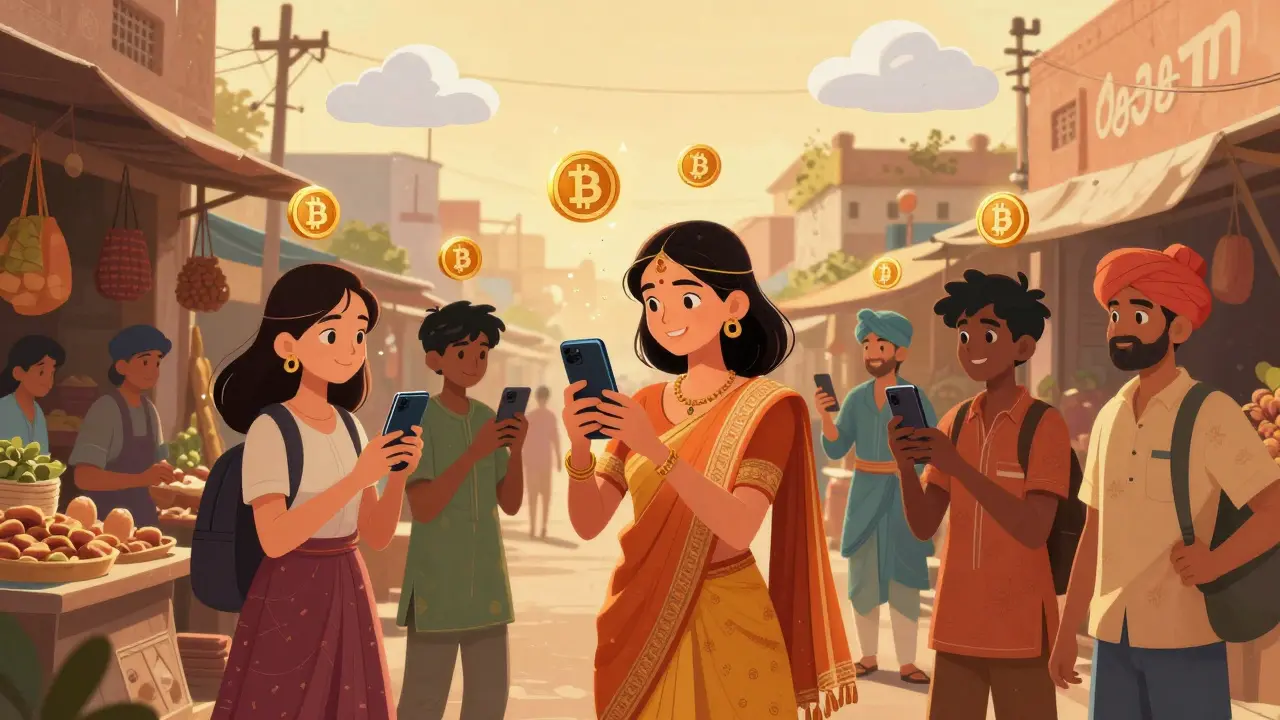
India doesn’t just use cryptocurrency - it leads the world in it. In 2025, Chainalysis ranked India #1 globally in crypto adoption, beating out the U.S., Japan, and even countries with far more relaxed regulations. That’s right - a nation that taxes crypto trades at 30% and slaps a 1% TDS on every transaction still has more people buying, trading, and building with digital assets than anywhere else on Earth.
How? Because adoption in India isn’t about permission. It’s about necessity, innovation, and a digital-first population that’s already used to moving money through apps. While governments debate whether crypto is legal, millions of Indians are already using it - and they’re not waiting for approval.
Why India Is #1 in Crypto Adoption
India topped every single category in Chainalysis’ 2025 Global Crypto Adoption Index: retail, centralized finance (CeFi), decentralized finance (DeFi), and even institutional use. That’s rare. Most countries lead in one area - like the U.S. with institutional ETFs - but India dominates all of them.
Between July 2024 and June 2025, India accounted for over $2.36 trillion in on-chain crypto transactions across the Asia-Pacific region. That’s a 69% jump from the year before. The U.S. and Europe saw growth too, but nothing close. Why? Because India’s crypto use isn’t limited to investors. It’s woven into daily life.
Bitcoin alone saw $4.6 trillion in fiat on-ramps during that period - more than double any other country. People aren’t just buying Bitcoin as a store of value. They’re using it to send money home, pay freelancers, buy goods online, and even tip content creators. Stablecoins like USDT and USDC are the real workhorses here, moving value fast and cheap across borders.
The Role of UPI and Digital Infrastructure
India didn’t become a crypto powerhouse by accident. It had the foundation already in place.
The Unified Payments Interface (UPI) - the system that lets you send money instantly between bank accounts using just a phone number - changed everything. Over 10 billion UPI transactions happen every month. People are already used to paying for groceries, bus tickets, and rickshaw rides with a single tap. Crypto? It’s just another app.
Platforms like CoinDCX, WazirX, and ZebPay didn’t have to teach Indians how to use digital wallets. They just had to connect crypto to UPI. Now, you can buy $10 worth of Ethereum with your phone number, no bank account needed. That’s why adoption exploded in rural towns, small cities, and among young people who never had access to traditional banking.
Even eRupi, the government’s digital voucher system for healthcare and education, proved that Indians trust digital value transfer. Crypto just took that trust and ran with it.
Grassroots Adoption: Students, Gig Workers, and Small Businesses
Forget hedge funds. The real story of crypto in India is in the classrooms, street markets, and home offices.
High school students in Jaipur and Coimbatore are learning Solidity and building their own smart contracts. College clubs run crypto trading competitions. In Bangalore, a freelance designer might get paid in USDT instead of INR because it clears faster and costs less than PayPal or Wise.
Small businesses are using crypto to avoid high credit card fees and currency conversion costs. A vendor in Ahmedabad selling handmade jewelry online might accept Bitcoin and convert it to INR via a local exchange within minutes. No international wire fees. No 30-day wait.
And in places like Varanasi or Patna, crypto isn’t about speculation - it’s about survival. People use it to receive remittances from relatives working abroad. Traditional remittance services charge 5-7%. Crypto transfers? Often under 1%.

Institutional Adoption: Banks, Startups, and the Quiet Shift
While retail adoption grabs headlines, the institutional side is quietly reshaping India’s financial landscape.
More than 50 Indian fintech startups now offer crypto-based lending, staking, and yield products. Some are backed by venture capital firms that also invest in traditional banks. Major payment processors like Razorpay and PayU now let users buy crypto directly through their apps.
Even banks are testing the waters. Kotak Mahindra Bank and HDFC Bank have filed patents for blockchain-based settlement systems. The Reserve Bank of India hasn’t launched a CBDC for retail yet, but it’s actively exploring how crypto infrastructure can improve cross-border payments.
And here’s the twist: India’s top crypto exchanges - which once feared crackdowns - now work closely with financial regulators. They’ve built KYC/AML systems that meet global standards. Some even help law enforcement track illicit flows. That’s not what you’d expect in a hostile regulatory environment.
The Tax Paradox: 30% Tax, But Still Growing
India has one of the strictest crypto tax regimes in the world. Every trade - even swapping Bitcoin for Ethereum - triggers a 30% capital gains tax. Plus, every transaction over ₹10,000 gets a 1% TDS (tax deducted at source). That’s more than double the tax burden in most developed nations.
And yet, adoption keeps climbing.
Why? Because for many, the cost of not using crypto is higher than the tax. Sending $1,000 to family in Nepal via Western Union costs $50 and takes 3 days. Sending it via USDT? $2 and 10 minutes.
People aren’t ignoring taxes - they’re just prioritizing access. The government hasn’t shut down exchanges. It hasn’t banned ownership. It just taxes everything. And Indians are saying: fine, we’ll pay the tax, but we’re not giving up the tool.
There are signs this might change. In early 2026, multiple government insiders confirmed India is exploring the creation of a national Bitcoin reserve. Not to trade it. Not to speculate. But to hold it as a strategic asset - like gold. That would be a seismic shift.

What’s Next for Crypto in India?
India’s crypto future won’t look like America’s. There won’t be a Wall Street crypto boom. Instead, expect:
- More DeFi apps built for Indian users - peer-to-peer lending, micro-insurance, and crop-backed tokenization.
- Integration of crypto with India’s digital public infrastructure - think crypto-based Aadhaar verification or blockchain land records.
- Explosive growth in DeFi lending for small farmers and artisans, using crypto as collateral.
- Stablecoin adoption rising as INR-pegged tokens emerge from local exchanges.
India doesn’t need permission to innovate. It just needs access. And with over 900 million smartphone users, a thriving tech workforce, and a population that’s already fluent in digital money, the next wave of crypto adoption won’t come from a policy change - it’ll come from the next generation of users who don’t even remember a time when crypto was controversial.
Why This Matters Globally
India proves that regulation doesn’t stop adoption - it just changes how it happens. When a country taxes crypto heavily but still becomes the world’s largest market, it shows that people will find a way to use what works for them.
The U.S. leads in institutional crypto because of ETFs. Europe leads in privacy coins. India leads because it’s the most democratic crypto market on Earth - driven by students, farmers, gig workers, and small businesses. Not Wall Street. Not Silicon Valley. Just real people using technology to solve real problems.
If you want to understand where crypto is really going, stop watching the U.S. Senate hearings. Watch the 19-year-old in Lucknow who just sent her first $50 in USDT to her cousin in Dubai.
Is cryptocurrency legal in India?
Yes, cryptocurrency is legal in India. You can buy, sell, hold, and trade digital assets without breaking any law. The Supreme Court overturned a 2018 banking ban in 2020, and since then, the government has focused on taxation rather than prohibition. Exchanges operate openly, and millions of Indians use crypto daily.
Why does India tax crypto so heavily?
The 30% tax and 1% TDS were introduced in 2022 to bring crypto into the formal tax net and discourage speculative trading. The government wanted to treat crypto like gambling or lottery winnings - high-risk, high-reward activities. But the tax hasn’t stopped adoption; it’s just made users more careful. Many now hold for longer periods to reduce tax impact, and some use decentralized exchanges to avoid TDS.
Can I use crypto to send money abroad from India?
Yes, but with limits. The Reserve Bank of India allows individuals to send up to $250,000 per year abroad under the Liberalized Remittance Scheme (LRS). Crypto transfers fall under this rule. You can buy USDT on an Indian exchange, send it overseas, and cash out in another country. Many use this to pay for education, medical bills, or freelance work. It’s faster and cheaper than traditional wire transfers.
Are Indian crypto exchanges safe?
Top Indian exchanges like CoinDCX, ZebPay, and Upbit India are among the most secure globally. They store over 95% of assets in cold wallets, use multi-sig security, and undergo regular audits. Many are registered with India’s Financial Intelligence Unit (FIU) and follow strict KYC/AML rules. While no platform is 100% hack-proof, these exchanges have never suffered a major breach.
What’s the future of Bitcoin in India?
Bitcoin is likely to become a strategic asset for India, not just a speculative one. Reports from early 2026 suggest the government is considering creating a national Bitcoin reserve - similar to how countries hold gold. This wouldn’t mean making Bitcoin legal tender, but rather holding it as a long-term hedge against currency volatility. If this happens, it would be the first time a major economy officially recognizes Bitcoin as a reserve asset - and it would reshape global crypto policy.



Dominic Taylor
March 24, 2026 AT 14:39Andy Green
March 24, 2026 AT 23:05Annette Gilbert
March 25, 2026 AT 10:24John Alde
March 26, 2026 AT 05:03Lorna Gornik
March 28, 2026 AT 04:03Joshua T Berglan
March 29, 2026 AT 07:29Kevin Da silva
March 30, 2026 AT 18:35Andrew Midwood
March 31, 2026 AT 04:16Kevion Daley
March 31, 2026 AT 23:58Jeannie LaCroix
April 2, 2026 AT 16:49Domenic Dawson
April 4, 2026 AT 07:03Marie Mapilar
April 5, 2026 AT 15:36Neil MacLeod
April 6, 2026 AT 10:55Misty Williams
April 7, 2026 AT 11:05Anand Makawana
April 8, 2026 AT 17:06Mohammed Tahseen Shaikh
April 10, 2026 AT 07:32Sarah Terry
April 11, 2026 AT 23:03