
Understanding Wrapped CRO
If you are scrolling through your wallet and see WCRO alongside your usual CRO balance, you aren’t alone. This token represents one of the most practical yet misunderstood utilities in modern blockchain infrastructure. Wrapped CRO (WCRO) is a tokenized version of Crypto.com’s native CRO coin designed to work on the Ethereum network. While the base CRO cryptocurrency lives on its own dedicated chain, WCRO bridges that gap, allowing users to access CRO benefits while staying within the Ethereum ecosystem.
The market for WCRO has seen wild fluctuations heading into mid-2026. If you rely on a single tracker for pricing, you might get the wrong picture entirely. Some platforms show a price near $0.07, while others claim values closer to $0.23. These discrepancies highlight a critical aspect of wrapped tokens: their value depends heavily on where you look and which exchange feeds data. Despite these variances, the fundamental purpose remains the same-it acts as a proxy for CRO, pegged 1:1 in value, allowing for cross-chain flexibility without selling your underlying assets.
How the Wrapping Process Works
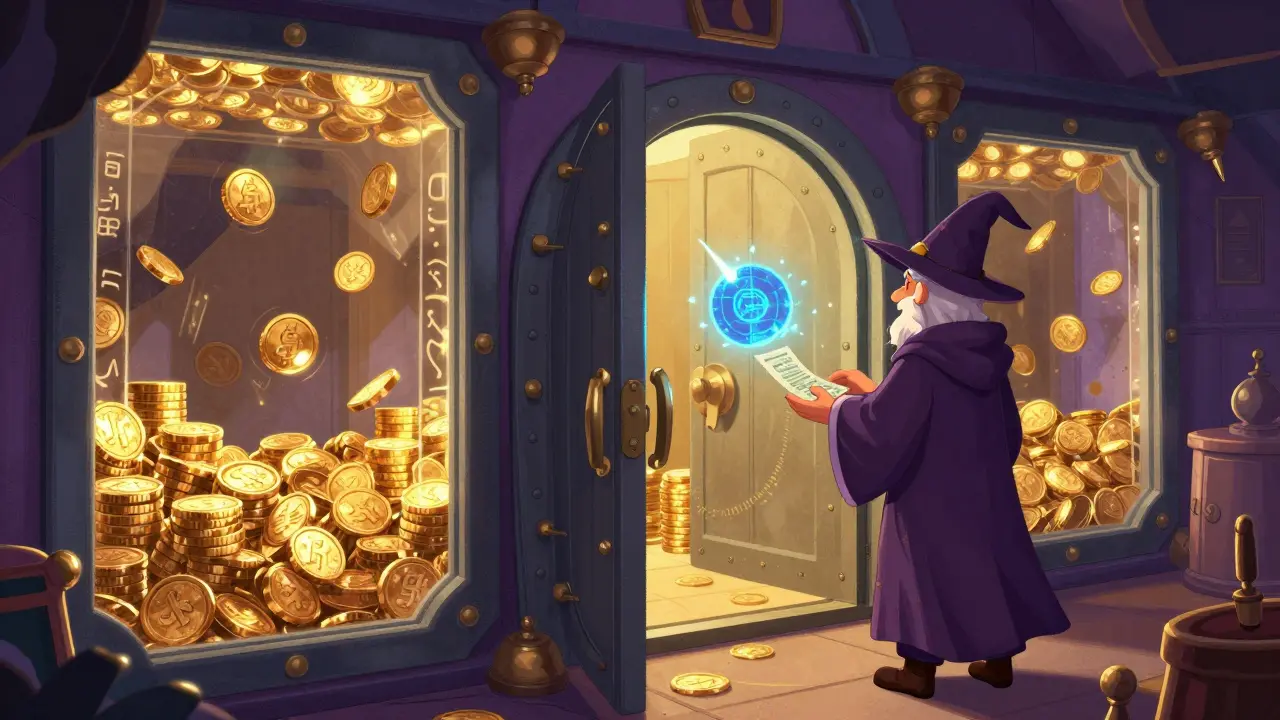
To understand WCRO, you have to grasp the concept of a "wrapped" asset. Think of it like putting money into a secure vault to receive a receipt that can be traded elsewhere. In the world of Ethereumis a decentralized platform for smart contracts, native assets don’t always play well together. CRO is built for speed and low costs on the Crypto.com Chain. However, Ethereum hosts thousands of decentralized finance (DeFi) protocols that expect a specific format known as ERC-20.
When you hold WCRO, you are actually holding a claim backed by real CRO tokens locked in custody. Crypto.com or authorized partners lock up the original CRO tokens. They then mint an equal amount of WCRO on the Ethereum blockchain. This new token follows the ERC-20 standard, making it compatible with wallets like MetaMask and platforms like Uniswap.
- Liquidity: The original CRO remains safe in a reserve vault.
- Minting: New WCRO is created based on the amount of CRO deposited.
- Burning: When you want to switch back to CRO, you burn the WCRO, and the system releases the locked CRO.
This mechanism enables interoperability. It allows traders to move assets freely between chains without needing to liquidate their position first. However, this trust relies entirely on the integrity of the entity managing the vault.
CRO Versus WCRO: Key Differences
Many investors confuse the two symbols, treating them as interchangeable coins. They share the same underlying economic value, but their technical environments differ drastically. Feature Crypto.com Coin (CRO) Wrapped CRO (WCRO) Native Chain Crypto.com Chain Ethereum Token Standard CRO Token Standard ERC-20 Primary Use Governance, Network Fees, Staking on CRO chain DeFi protocols, DApps, ETH-based staking Speed High TPS (Transactions Per Second) Dependent on Ethereum congestion Gas Fees Paid in CRO (Low cost) Paid in ETH (Can be volatile/expensive)
You would choose native CRO if you are buying goods directly from Crypto.com merchants or staking for rewards on the Crypto.com platform. WCRO, however, opens doors to the broader Ethereum universe. If you want to lend your assets on Aave or provide liquidity on Curve Finance, those platforms generally only accept ERC-20 tokens. You cannot deposit a native CRO there; you must hold WCRO.
Market Reality: Tracking the Numbers in 2026
By April 2026, the reality of trading WCRO has stabilized somewhat, yet inconsistencies remain. Unlike major assets like Bitcoin, smaller altcoins often suffer from fragmented data reporting. One aggregator shows a price of $0.15, citing a 5% gain, while another displays a figure closer to $0.07 with a slight decline. These numbers aren't necessarily errors; they reflect differences in the order books of various exchanges and the latency of data feeds.
Historical context matters here. WCRO reached its peak performance back in late 2021, hitting nearly $0.93. As of our current timeline, the asset trades significantly below that level, recovering from a low point recorded in October 2023 where it dipped under five cents. This recovery suggests resilience, even if the hype cycle has settled.
| Data Metric | Source A (Estimate) | Source B (Estimate) |
|---|---|---|
| Circulating Supply | 570 Million WCRO | 742 Million WCRO |
| All-Time High | $0.9328 (Nov 2021) | $0.9328 (Consistent across sources) |
| 24-Hour Volume | $442k - $1.6M USD | Varies widely by exchange liquidity |
These variations serve as a reminder to never rely on a single dashboard for financial decisions. Always check the specific order book on the exchange where you intend to execute a trade. The ranking on aggregators like CoinMarketCap (#82 as per some records) gives a general idea of interest but does not guarantee instant liquidity for large orders.
Practical Uses for WCRO Holders
Why would someone bother wrapping their CRO in the first place? Simply put, it creates opportunity. The primary advantage lies in DeFi integration. By converting CRO to WCRO, you gain access to yield farming strategies available only on the Ethereum mainnet. Users can stake WCRO in pools to earn fees from other users borrowing that asset.
Beyond speculation, WCRO serves utility in peer-to-peer transfers on Layer 2 networks that bridge to Ethereum. It also facilitates fee settlement for services that utilize Ethereum smart contracts but prefer the exposure of the CRO brand. For example, developers building apps on Polygon or Arbitrum often require ERC-20 compatibility, making WCRO the preferred choice over holding raw CRO.

Risks and Considerations
No blockchain strategy is without friction. Wrapping introduces counterparty risk. Since WCRO is backed by a custodial pool of real CRO, you must trust that the issuer maintains sufficient reserves to redeem your tokens later. This centralization stands in contrast to fully non-custodial solutions. Additionally, because WCRO is an ERC-20 token, sending it incurs Ethereum gas fees. On days when the Ethereum network is congested, transfer costs could eat significantly into your profits compared to using the native CRO chain where fees are fractions of a cent.
Another subtle risk involves the spread between the actual spot price of CRO and the trading price of WCRO. Occasionally, arbitrage gaps widen due to delayed updates in the minting algorithm or withdrawal queues, potentially causing the WCRO to trade at a slight premium or discount relative to the base asset.
Frequently Asked Questions
Can I convert WCRO back to CRO?
Yes, the process is called unwrapping. You send the WCRO back to the issuing address, and the protocol locks your WCRO and releases an equivalent amount of native CRO to your address.
Is WCRO the same as CRO?
They represent the same value, but they exist on different blockchains. CRO is native to the Crypto.com Chain, while WCRO is an ERC-20 token on Ethereum.
Does WCRO generate passive income?
WCRO can generate income through staking in DeFi protocols or providing liquidity on decentralized exchanges, unlike standard cash-in-wallet holdings.
Where is WCRO most accurately tracked?
Major aggregators like CoinMarketCap or CoinGecko provide averages, but for execution, checking the specific liquidity on centralized exchanges (like Coinbase or Binance) is more reliable for accurate entry pricing.
Is WCRO available on all wallets?
Only wallets that support ERC-20 tokens and the Ethereum network (like MetaMask or Trust Wallet in Ethereum mode) can store WCRO safely.








Lauren Gilbert
April 2, 2026 AT 17:39I remember when wrapping first became a thing because everyone was scared to put assets into a vault that isn't yours.
Back then we worried if the custodian would vanish overnight and leave us holding worthless paper receipts instead of actual coins.
Now it feels mundane to swap CRO for WCRO just to get into a DeFi pool on Ethereum mainnet.
The gas fees are higher but the utility makes up for the cost when liquidity is deep enough.
You really have to trust the bridge though since they hold the backing assets off-chain mostly.
People forget that counterparty risk is the biggest hidden danger here compared to just selling native assets.
If the issuer goes insolvent your token doesn't mean anything anymore regardless of what the contract says.
It is fascinating how many protocols now require ERC twenty standards even for stablecoin equivalents.
We need better audits on these minting algorithms before things go south again in the next cycle.
Most of us ignore the redemption queue times until we actually want to unwrap everything back to the native chain.
This whole system works well while the market is calm but panic selling might clog the exit doors instantly.
I still keep a significant portion in native form just in case the bridge logic fails during a crash.
The transparency reports help but I prefer self-custody whenever possible despite the inconvenience.
Understanding these mechanisms is key for anyone planning long term yield strategies involving cross-chain assets.
We just hope the regulators don't step in and shut down the wrapped variants suddenly.
It changes so much faster than I expected when I first started tracking these balances manually.
Emma Pease-Byron
April 3, 2026 AT 00:51Oh wonderful another guide telling retail investors to embrace centralized bridging solutions as if custody isn't a known vulnerability vector in every blockchain audit ever published.
The suggestion to rely on order books implies liquidity is guaranteed which is demonstrably false during stress events.
Sharhonda Walker
April 4, 2026 AT 02:46yeh u r right about the custodual risk being big lol
i trid wrapping last month and the slippage was crazy bad on some exchanges
alwyz check deep liquidity pools before swapping cuz ur funds get stuck in pending status forever
dont trust random sites that promise auto swaps without verifying addresses first
security is key folks!
Carol Prates
April 4, 2026 AT 03:42I am honestly terrified thinking about how many people left their tokens wrapped during the last crash event.
It was so stressful watching values decouple from the base asset price temporarily.
Please please double check your reserve proofs before trusting any platform blindly.
Safety has to come first in this chaotic environment we inhabit daily.
Arwyn Keast
April 5, 2026 AT 15:57Interoperability protocols often prioritize convenience over sovereign asset control which presents unacceptable systemic risk for domestic holders.
Cross-chain atomic swaps lack sufficient regulatory oversight frameworks currently existing in major jurisdictions.
Liquidity fragmentation exacerbates volatility exposure significantly beyond standard market conditions observed historically.
Sonya Bowen
April 5, 2026 AT 23:54Always verify contract addresses independently before interacting with any bridge interface.
Small verification steps prevent large financial mistakes later on.
Stay safe out there.
david head
April 6, 2026 AT 00:03lol i totally forgot about the gas fees issue tbh 😅 sometimes the eth network moves so slow you lose money before the tx confirms 🤦♂️ also nice to know the supply variance exists but i just check uniswap directly now 🫡
Earnest Mudzengi
April 6, 2026 AT 07:26They always tell you to trust the reserve but where is the proof of reserves actually audited by a third party who isnt paying for the listing fee.
The volume discrepancies shown in the table indicate wash trading to manipulate perceived adoption metrics artificially.
Big tech firms want you locked into ethereum so they can monitor transaction patterns easily.
Deepak Prusty
April 8, 2026 AT 05:51The underlying mathematics of peg maintenance involves arbitrage bots rather than manual intervention by issuers.
Deviations occur due to latency in oracle updates feeding price data to smart contracts automatically.
Understanding this mechanism prevents panic during minor slippage events in secondary markets.
Krystal Moore
April 9, 2026 AT 00:31Investors who neglect proper research on custodial liabilities deserve whatever losses they incur subsequently.
Financial prudence demands rigorous vetting of any intermediary involved in asset transformation processes.
Negligence leads to catastrophic outcomes that cannot be reversed after the fact.
Carmelita Gonzales
April 10, 2026 AT 14:35i hear you on the fear factor it is really valid to worry about trust
we all learned hard lessons during previous cycles so being cautious helps protect capital
let us all share information openly so nobody gets left behind by technical details
Matthew Wright
April 11, 2026 AT 12:55Yes!!!! That is exactly what I mean!! The fees are SO high sometimes!!! 😱 But the liquidity IS worth it!!! Just watch out for scams!!! ALWAYS verify!!! Thanks for sharing!!! 🙂🙂🙂
Erica Mahmood
April 12, 2026 AT 08:49Liquidity provider incentives skew APY figures upwards temporarily.
Impermanent loss calculation requires dynamic delta hedging strategies.
Slippage tolerance should be set conservatively on DEX interfaces to prevent partial execution failures.
akash temgire
April 14, 2026 AT 01:11Your analysis overlooks the critical necessity of regulatory compliance in custodial arrangements.
Institutional participation will depend heavily on verified proof of reserves moving forward.
Ignoring these requirements invites severe legal repercussions for early adopters.
Siddharth Bhandari
April 15, 2026 AT 09:35Actually, looking at recent audits shows some improvement in transparency measures taken by major providers.
It's not perfect but definitely better than year ago scenarios.
Still keep some dry powder in cold storage just in case systems fail unexpectedly.
Hugo Lopez
April 16, 2026 AT 23:51Exactly! The distinction between native and wrapped tokens is crucial for accurate accounting. 💰 Gas costs can erode profits if not calculated beforehand. ⚠️ Make sure your wallet supports ERC-20 before initiating transfers. 🔐 Security is paramount when dealing with bridge contracts. 👍
Susan Payne
April 18, 2026 AT 17:42The risk assessment regarding custodial vaults remains insufficiently detailed for prudent investors.