
Imagine buying a ticket to a concert, paying your money, and then finding out the venue doesn't exist, the band retired a decade ago, and the ticket itself is just a piece of blank paper. That is essentially the experience of interacting with Intexcoin is a cryptocurrency token launched in 2016 that claims to provide privacy and fast settlements on the Ethereum blockchain. Also known as INTX, it promised to be a revolution in financial confidentiality, but today it serves as a cautionary tale for anyone venturing into the wild west of altcoins.
The Quick Truth About INTX
Before we get into the technical weeds, here is the bottom line: Intexcoin is effectively a "zombie token." While you might still see it listed on a few obscure exchanges, it has no active development, no real-world usage, and a price that has crashed by over 99.9%. Most importantly, major tracking platforms report it has zero circulating supply, which is a massive red flag in the crypto world.
| Attribute | Value / Status |
|---|---|
| Blockchain Standard | ERC-20 (Ethereum) |
| Total Fixed Supply | 600,000,000 INTX |
| Circulating Supply | 0 (Reported by major trackers) |
| All-Time High | $0.0155 (approx. 2017-2018) |
| Current Status | Inactive / Dead Project |
What Was Intexcoin Supposed to Do?
Back in 2016, the project launched with a whitepaper claiming it would solve the biggest problems with traditional banking: high fees and slow cross-border payments. It positioned itself as a privacy-focused tool, utilizing "advanced cryptographic techniques" to make transactions untraceable. In a market where privacy is a huge selling point, this sounded great on paper.
To achieve this, it leveraged the Ethereum network, meaning it didn't build its own blockchain from scratch but rather existed as a token on top of the most popular smart contract platform. This is a common move for new coins, but for a coin claiming "advanced privacy," relying on the fully transparent and public ledger of Ethereum is a bit of a contradiction.
The Red Flags: Why You Should Be Cautious
If you are looking at Intexcoin as an investment, you need to look at the evidence. First, the development has completely stopped. Their GitHub repository-the place where developers actually write the code-hasn't seen a single update since 2017. In the tech world, a seven-year silence is a death sentence.
Then there is the "Zero Supply" paradox. How can a coin be traded on exchanges if the reported circulating supply is zero? Experts, including blockchain specialists from Stanford University, have pointed out that this usually signals either a catastrophic data error or a market manipulation scheme. When the data doesn't add up, the risk is almost always too high.
Comparing INTX to Real Privacy Coins
To understand how poorly Intexcoin has performed, let's look at actual privacy leaders. Monero (XMR) and Zcash (ZEC) handle millions of dollars in volume daily and have active communities. Meanwhile, Intexcoin's 24-hour trading volume has been spotted as low as $6. That's not a market; it's a ghost town.
| Feature | Intexcoin (INTX) | Monero (XMR) | Zcash (ZEC) |
|---|---|---|---|
| Daily Volume | ~$6 - $54 | ~$1.2 Billion | ~$45 Million |
| Dev Activity | None since 2017 | Very High | High |
| Utility | None verified | Global Privacy Standard | Selective Disclosure |

User Nightmares: The Withdrawal Trap
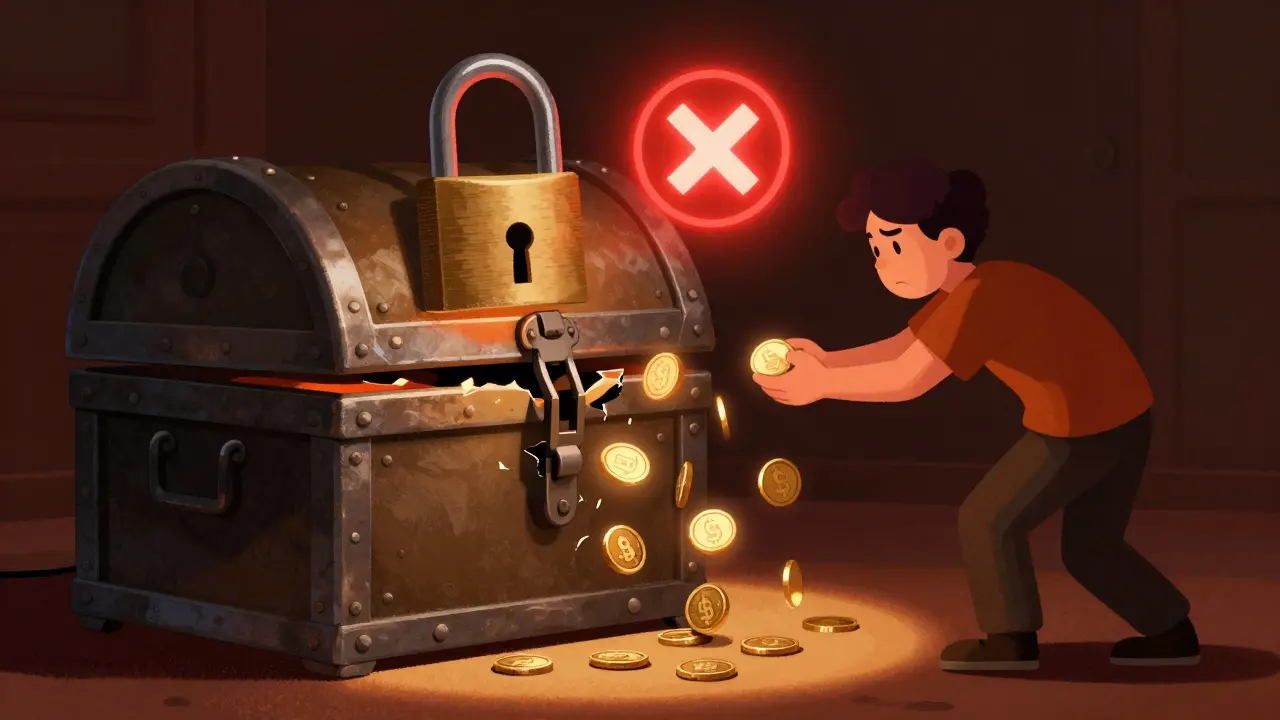
The most frightening part of the Intexcoin story comes from the people who actually tried to use it. Across Reddit and Trustpilot, users have reported a recurring nightmare: they buy the token on an exchange, but they can't actually move it. Many have tried to withdraw their INTX to a MetaMask wallet only to find that the tokens never arrive or the balance shows as zero.
This happens because the token's smart contract is likely broken or intentionally restrictive. When users try to interact with the contract, it often returns a "revert" error, which is basically the blockchain's way of saying "this action is not allowed." You end up with money locked in an exchange account with no way to get it back into your own digital custody.
Is There Any Hope for a Recovery?
In the crypto world, we often talk about "bottoming out" and "moon shots." However, the probability of Intexcoin recovering is near zero. For a coin to revive, it needs a team, a new use case, and a community. Intexcoin has none of these. Their official website's contact forms are broken, and their Twitter account has been silent for years.
Even algorithmic price predictors have given up on it. Because there isn't enough consistent trading data, most AI-driven analysis tools simply refuse to provide a price prediction for INTX. It has moved beyond being a "bad investment" and has entered the category of a dead asset.
Can I still buy Intexcoin (INTX)?
While some small exchanges might still list it, doing so is extremely risky. Many users report being unable to withdraw the coins once purchased, meaning your money could be permanently trapped on the exchange.
Is Intexcoin a scam?
While it may have started as a legitimate attempt at a privacy coin, the total lack of development since 2017, the disappearing funds, and the reported zero circulating supply are classic signs of a project that has been abandoned or was designed to fail.
What is the current price of INTX?
The price is nearly nonexistent, typically hovering around $0.000004. It has lost over 99.9% of its value since its peak in the 2017-2018 cycle.
Does Intexcoin actually provide privacy?
No. Despite the claims in its whitepaper, blockchain analysis by firms like Chainalysis has found no evidence of the obfuscated transaction patterns that actual privacy coins use.
Where can I find the official Intexcoin support?
There is effectively no active support. Their website contact forms are non-functional (404 errors), and their social media channels have been dormant for years.
Next Steps for Investors
If you currently hold INTX, your first priority should be attempting to move it to a private wallet-though, as mentioned, this may not work. If you are considering buying it because it looks "cheap," remember that cheap does not mean a bargain if the asset has no value and no future. If you are looking for privacy, stick to projects with verified audits, active GitHub commits, and high liquidity on reputable exchanges.



Erica Mahmood
April 5, 2026 AT 00:58basically a honeypot for retail traders who dont check the smart contract logic... zero circulating supply usually means the mint function was abused or the liquidity is just completely drained from the pair
Krystal Moore
April 5, 2026 AT 02:18This is absolutely heartbreaking! Imagine the people who put their life savings into this just to find out it was a ghost town. It is an absolute travesty that these developers get away with this while innocent people suffer!
Sharhonda Walker
April 6, 2026 AT 21:12Hve seen this a ton with old ERC-20s. The smart contract is often incompatable with modern wallets like metamask which is why you see that revert error when trying to mov the funds
Nicholas Whooley
April 7, 2026 AT 13:21It is indeed unfortunate that this project did not reach its potential. However, I believe this serves as a wonderful learning opportunity for everyone to perform more diligent research before investing in emerging technologies.
Joshua Aldrich
April 9, 2026 AT 00:10Man, this just shows how the hype cycle can blind us to the basics. Its kind of deep if you think about it... we trust these digital strings of code with our wealth but the actual human element-the dev team-just vanishes into the void. Typical a bit of a tragedy realy
alex rodea
April 9, 2026 AT 23:09Just stay safe and keep learning guys
Susan Wright
April 11, 2026 AT 13:02The red flag here isn't just the dead GitHub, it's the fact that it's on Ethereum but claims privacy. You can't actually hide stuff on a public ledger unless you're using zero-knowledge proofs, which this definitely wasn't doing.
Earnest Mudzengi
April 12, 2026 AT 20:36Wake up people!! This is clearly a coordinated hit by the central banks to make altcoins look like scams so we all crawl back to the USD. The zero supply is a glitch in the tracking API probably caused by a state-level actor to manipulate the sentiment analysis of the retail crowd. Follow the money!!
Deepak Prusty
April 13, 2026 AT 03:19The mention of Stanford specialists is irrelevant here because the technical failure of an ERC-20 contract is a basic auditing issue, not a theoretical academic problem. Anyone with a basic understanding of Solidity would have seen the lack of liquidity immediately.
Susan Payne
April 14, 2026 AT 09:51It is utterly disgraceful that individuals would dare to invest in such an obviously derelict asset. The sheer lack of intellectual rigor exhibited by those who held this token for seven years is simply beyond my comprehension.
Siddharth Bhandari
April 15, 2026 AT 05:01The revert error mentioned is likely due to the token lacking an 'approve' function or having a non-standard transfer method that modern DeFi protocols cannot interact with.
akash temgire
April 15, 2026 AT 10:32The data is clear. The project is dead.
Matthew Wright
April 15, 2026 AT 14:48I wonder if there's any way to recover the funds via a direct contract call??? Maybe some script could bypass the exchange UI... but probably not worth the gas fees at this point!!!
Arwyn Keast
April 17, 2026 AT 08:18Typical trash altcoin. British investors were warned about this kind of volatility years ago, but some idiots still fall for the jargon of 'cryptographic techniques' without understanding the underlying protocol. Absolute waste of bandwidth.
Evan Borisoff
April 18, 2026 AT 09:43The sheer audacity of claiming privacy on an ERC-20 token while the domestic financial infrastructure of the US is being systematically undermined by these offshore unregulated entities is a national security concern and the total lack of an audit trail for these specific tokens just proves the fragility of the current DeFi narrative
Emma Pease-Byron
April 19, 2026 AT 16:28Oh, look, another revelation that a coin with zero development is actually dead. Truly groundbreaking analysis here. I'm sure the few remaining holders are simply devastated by this shocking news.
gladys christine
April 21, 2026 AT 00:46Omg just stay positive and find a better project!! its a lesson for us all to be more careful out there
Manisha Sharma
April 22, 2026 AT 20:20Only lafable that people believe in these western tokens when the real power is shifting east... its just law of nature that these fake coins crash while the true visionaries build real wealth
Bruce Micciulla Agency
April 23, 2026 AT 21:59the lack of a functional api and the fragmented nature of the liquidity pools across these C-tier exchanges makes the price discovery mechanism completely irrelevant in this instance since there is no actual buy pressure and the sell wall is essentially an infinite void of abandoned bags
Adriana Gurau
April 24, 2026 AT 00:25Imagine actually believing in a 2016 token in 2024 🙄. The delusion is real. Just a total joke of a project 💅
June Coleman
April 25, 2026 AT 05:03I'm sure the developers are just on a very long vacation, right? Totally believable. Let's all just pretend the money isn't gone!
Emily 2231
April 25, 2026 AT 18:17The government probably shut it down because it actually WAS too private and they couldn't track the movements of the elites. Notice how the website just vanishes. It's all a play to keep us in the CBDC trap
Robert Coskrey
April 26, 2026 AT 12:21I completely agree with the assessment provided here. It is most prudent to avoid such assets entirely, and I appreciate the thoroughness of the data presentation.
Suvoranjan Mukherjee
April 26, 2026 AT 22:18Exactly! Always check the GitHub activity and the liquidity depth before jumping in! For those still in the game, focus on projects with real TVL and active community governance. Let's turn this bad experience into a roadmap for success! Keep grinding and keep learning, friends!