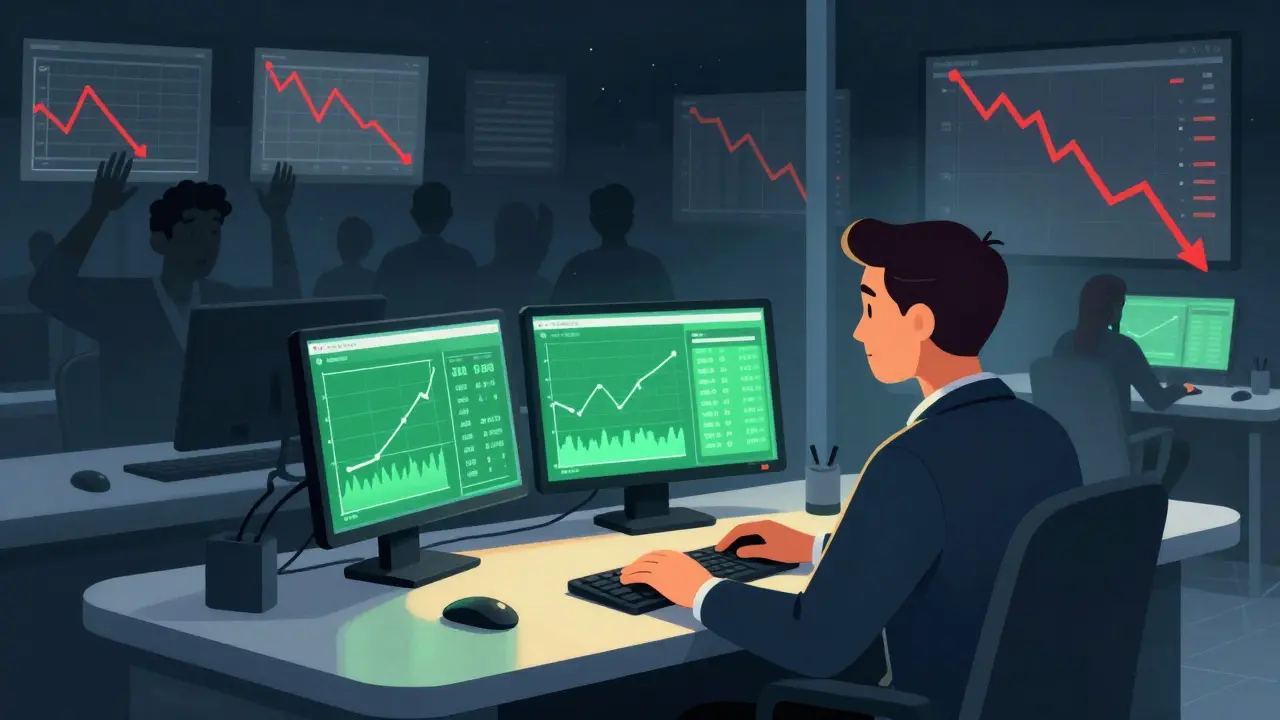
Imagine logging into your trading platform during a market crash. Prices are plummeting, panic is setting in, and you need to execute a trade instantly. On most exchanges, your screen freezes. The order button turns gray. You watch helplessly as your portfolio shrinks. This was the reality for many traders on other platforms during the May 2025 market volatility. But on Bybit, a global cryptocurrency exchange founded in 2018, the orders went through. Sub-millisecond latency kept the engine running while competitors stuttered.
This isn't just marketing hype. It’s the core reason why over 25 million users have flocked to Bybit since its inception. However, choosing an exchange isn’t just about speed. It’s about security, fees, accessibility, and whether the platform actually fits your trading style. With daily trading volumes averaging $18.7 billion, Bybit has positioned itself as a heavyweight contender against giants like Binance and Coinbase. But does it live up to the reputation? Let’s break down exactly what you get when you sign up, where the pitfalls lie, and who should-and shouldn’t-use this platform in 2026.
The Core Trading Experience: Speed Meets Complexity
At its heart, Bybit is built for action. If you are looking for a simple "buy and hold" interface where you deposit dollars and forget about them, Bybit might feel overwhelming at first glance. It is designed for traders who want control. The platform offers three main avenues for engagement: spot trading, derivatives (futures and perpetual contracts), and P2P fiat-to-crypto transactions.
For spot trading, you can access over 500 cryptocurrency pairs. This includes major assets like Bitcoin and Ethereum, as well as smaller altcoins. The base fees here are standard for the industry: 0.10% for both makers (those who provide liquidity) and takers (those who remove it). While not the cheapest on the market, it is competitive enough that most casual traders won’t lose sleep over it. The real advantage comes if you hold MNT, Bybit’s native token. Holding MNT can reduce these spot fees by up to 25%, which adds up significantly if you are moving large volumes.
Where Bybit truly shines, however, is in derivatives. This is the domain of futures and perpetual contracts. Here, you can leverage your position, borrowing funds from the exchange to amplify your potential gains (and losses). Leverage options go up to 100x for select pairs, with some sources even citing up to 200x for specific instruments. The matching engine here is a beast, capable of processing 100,000 orders per second with an average execution time of 0.8 milliseconds during volatile periods. Compare that to the industry average of 2.3 milliseconds, and you understand why professional traders prefer this environment. When Bitcoin swung 30% in a single day in August 2025, Bybit maintained minimal downtime, allowing traders to adjust their positions without getting stuck.
| Feature | Bybit | Bitget | Binance |
|---|---|---|---|
| Spot Maker/Taker Fee | 0.10% / 0.10% | 0.10% / 0.10% | 0.10% / 0.10% |
| Futures Maker Fee | 0.01% | 0.02% | 0.02% |
| Futures Taker Fee | 0.055% | 0.06% | 0.04% |
| Max Token Discount | 25% (MNT) | 20% (BGB) | 25% (BNB) |
| Max Leverage | Up to 100x-200x | Up to 125x | Up to 125x |
If you are a high-frequency trader or someone who uses leverage regularly, those fraction-of-a-percent differences in futures fees matter. Bybit’s taker fee of 0.055% is slightly better than Bitget’s 0.06%, making it a marginally more cost-effective choice for aggressive strategies. However, Binance still edges out on raw taker fees for futures at 0.04%, so if volume is your only metric, Binance remains strong. But remember, Binance faces heavier regulatory scrutiny, which brings us to the next critical point.
Security and Trust: Learning from Hard Lessons
No discussion of crypto exchanges is complete without addressing security. In February 2025, Bybit experienced what Coin Bureau described as "the largest hack in crypto history" at that time. It was a sobering moment for the entire industry. Hackers exploited a vulnerability, but here is the crucial part: Bybit recovered all user funds within 72 hours. They did not use user money to cover the loss; they used their own reserves.
This incident forced a massive overhaul of their security protocols. Today, Bybit maintains a public Proof-of-Reserves (PoR) system using Merkle Trees. While critics note these reports are not independently verified by third-party auditors in the same way traditional banks are, the transparency is a step forward. Furthermore, 95% of user assets are now stored in cold storage-offline wallets that are immune to online hacks. Multi-signature technology ensures that no single employee can move funds without multiple approvals.
Is it safe? For the vast majority of users, yes. The risk of losing funds due to exchange insolvency is mitigated by their robust reserve management and the $100 million SAFU (Secure Asset Fund for Users) enhancement implemented after the 2025 incident. However, "safe" in crypto always carries a caveat. Always enable two-factor authentication (2FA) and anti-phishing codes. These features are free and take seconds to set up, yet they prevent the majority of account compromises.

Accessibility and Regulatory Realities
Here is where things get tricky. Bybit is not available everywhere. If you live in the United States, United Kingdom, Canada, Singapore, or several other jurisdictions, you will face restrictions. In the US, Bybit operates a separate entity called Bybit US, which offers limited services and excludes derivatives trading entirely due to CFTC regulations. This is a significant drawback for American traders who want the full experience.
In contrast, Coinbase is available in over 100 countries, making it the go-to for beginners in restricted regions. Bybit holds licenses in Dubai’s VARA, Estonia’s Financial Intelligence Unit, and Abu Dhabi Global Market (ADGM). This allows them to operate legally in many parts of Europe, Asia, and the Middle East. If you are in one of these supported regions, you have access to the full suite of tools. If you are in a restricted region, you might find yourself frustrated by sudden account limitations or blocked deposits.
For those who can access it, the onboarding process is straightforward. Verification happens in three tiers:
- Level 1: Email verification only. Daily withdrawal limit of $50. Good for testing the waters.
- Level 2: ID verification. Daily withdrawal limit jumps to $20,000. Most users complete this within 24 hours.
- Level 3: Advanced verification. Daily withdrawal limit of $100,000. Required for institutional clients or high-volume traders.
This tiered system balances security with convenience. You don’t need to upload passports immediately if you’re just starting out, but serious trading requires identity confirmation.
User Interface and Learning Curve
Let’s be honest: Bybit is not the friendliest interface for absolute beginners. It looks like a cockpit. There are charts, order books, depth graphs, and dozens of buttons. If you’ve never traded before, this can induce anxiety. MindMathMoney’s usability testing suggests beginners need 3-5 hours to become proficient with basic spot trading functions.
However, there is a silver lining. Bybit offers a "Demo Trading" feature. You get $50,000 in virtual funds to practice with. This is invaluable. You can test leverage, try out stop-losses, and familiarize yourself with the layout without risking a single cent. Data shows this reduces the learning curve by approximately 40% for new derivatives traders.
Once you get past the initial shock, the interface becomes a powerful ally. TradingView charts are integrated directly into the platform, meaning you don’t need to switch tabs to analyze price action. MetaTrader-5 integration is also available for those who prefer that ecosystem. The mobile app, rated 4.7/5 on both iOS and Android, mirrors much of this functionality. It’s not as cluttered as the desktop version and receives consistent praise for its intuitive design for derivatives trading.

Customer Support and Community Sentiment
When things go wrong, support matters. Bybit offers 24/7 live chat, with an average response time of 1.7 minutes during peak hours. That is fast. However, phone support is unavailable. If you prefer talking to a human voice, this might be a dealbreaker. Email support exists but is slower.
User sentiment on platforms like Trustpilot reflects a mixed but generally positive picture. With a 4.3/5 rating based on nearly 3,000 reviews, common praises include "fast order execution" and "excellent customer support response times." Negative reviews often cite limited fiat on-ramp options. While Bybit supports P2P trading with over 75 fiat currencies, direct bank transfers can be cumbersome depending on your location. Reddit discussions frequently highlight frustration among Canadian users facing account restrictions following regulatory changes, a reminder that geo-blocking is a persistent issue.
Who Should Use Bybit?
Bybit is ideal for traders who have some experience with cryptocurrency and understand derivatives. It is not the best place for someone buying their first $100 of Bitcoin to hold for ten years. For that, Coinbase or Kraken offer simpler, more compliant experiences in many regions.
However, if you are active, if you trade futures, if you care about execution speed during volatility, and if you are located in a supported jurisdiction, Bybit is a top-tier choice. Its combination of low futures fees, robust infrastructure, and deep liquidity makes it a serious competitor to Binance and OKX. Just remember to start with the demo account, verify your identity early to avoid withdrawal limits, and keep your security settings tight.
Is Bybit safe to use in 2026?
Yes, Bybit is considered safe for most users. Following a significant security incident in February 2025, the exchange enhanced its protocols, including storing 95% of assets in cold storage and implementing a public Proof-of-Reserves system. All user funds were recovered within 72 hours of the incident. However, always enable two-factor authentication and anti-phishing codes for maximum protection.
Can I use Bybit in the United States?
US residents cannot access the main Bybit platform. Instead, they must use Bybit US, a separate entity that offers limited services and does not support derivatives trading due to CFTC regulations. Features like high-leverage futures are unavailable to US users.
What are the fees on Bybit?
Base spot trading fees are 0.10% for both makers and takers. Futures trading fees are lower, with maker fees as low as 0.01% and taker fees at 0.055%. Holding MNT tokens can reduce spot fees by up to 25%. Fees may vary based on your 30-day trading volume and VIP tier.
Is Bybit good for beginners?
Bybit has a steeper learning curve than beginner-friendly exchanges like Coinbase. However, it offers a Demo Trading feature with $50,000 in virtual funds, allowing new users to practice without risk. Beginners should spend 3-5 hours familiarizing themselves with the interface before trading real money.
How do I withdraw funds from Bybit?
Withdrawal limits depend on your verification level. Level 1 allows $50/day, Level 2 allows $20,000/day, and Level 3 allows $100,000/day. Most users complete Level 2 ID verification within 24 hours. Withdrawals are processed via blockchain networks, and fees vary by cryptocurrency.