
Buying Bitcoin or Ethereum with Thai Baht (THB) feels like a different game than trading on global platforms. If you live in Thailand, Bitkub is the dominant cryptocurrency exchange platform serving the Thai market with seamless fiat-to-crypto conversion and local banking integrations. Founded in 2018 by Bitkub Capital Group Holdings, it operates under strict supervision from Thailand's Securities and Exchange Commission (SEC). For many locals, it’s not just an option; it’s the default gateway into digital assets.
But does being the biggest player automatically make it the best choice? Not necessarily. While Bitkub boasts over 6 million registered users and massive daily trading volumes, it comes with specific limitations that might frustrate international traders or advanced investors looking for leverage. This review cuts through the marketing noise to tell you exactly what works, what doesn’t, and whether this platform fits your financial goals in 2026.
Regulatory Compliance and Trustworthiness
In the world of crypto, trust isn't given; it's earned through regulation. Bitkub stands out because it doesn't hide offshore. It holds license number 310180020007 issued by Thailand's SEC and is fully registered under the Ministry of Finance. This legal framework means your funds are protected by local laws, which is a huge relief compared to unregulated exchanges that have vanished overnight elsewhere.
The platform has raised over $10 million in funding and maintains a legally registered capital of 450 million THB. According to the SEC's June 2023 report, Bitkub consistently records the highest cryptocurrency trading volume in Thailand. In October 2025, TradingFinder.com reported daily volumes reaching up to $180 million. These numbers aren't just vanity metrics; they indicate liquidity. When you want to sell, there’s someone ready to buy, and vice versa.
However, compliance comes with strings attached. The most significant restriction? Bitkub is legally prohibited from serving US citizens. If you hold a US passport or reside in the United States, this platform is off-limits. For everyone else, particularly Thai residents, this regulatory shield provides a layer of security that many decentralized exchanges simply cannot offer.
Trading Experience: What Can You Actually Trade?
Let’s talk about the core product. Bitkub supports between 80 and 163 cryptocurrencies, depending on how you count stablecoins and newer listings. Major assets like Bitcoin (BTC), Ethereum (ETH), Solana (SOL), and Dogecoin (DOGE) are all available. You’ll also find their native token, Bitkub Coin (KUB).
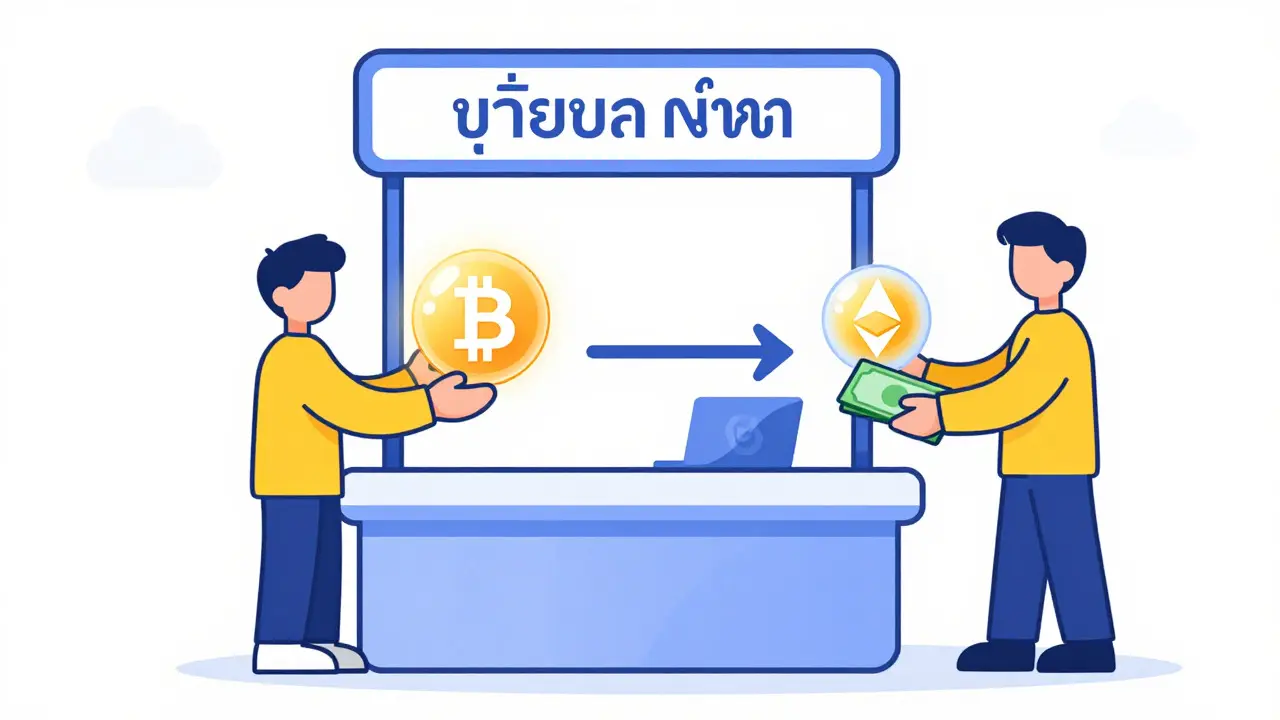
Here is where things get tricky for some traders. Bitkub exclusively offers crypto-to-THB trading pairs. There are no crypto-to-crypto markets. This means if you want to swap Ethereum for Solana, you can’t do it directly on Bitkub. You have to sell ETH for THB, then use those THB to buy SOL. This extra step incurs two sets of fees and takes more time.
| Feature | Details |
|---|---|
| Currency Pairs | Crypto to THB only (No Crypto-to-Crypto) |
| Leverage/Margin | Not Available |
| Supported Assets | 80-163 Cryptocurrencies including BTC, ETH, KUB |
| Minimum Deposit | No minimum requirement |
| Trading Interface | Web Terminal (TradingView) & Mobile App |
If you are a beginner who just wants to buy Bitcoin with your salary, this simplicity is actually a benefit. You don’t need to understand complex order books or cross-margin risks. But if you’re an active trader used to swapping altcoins instantly without touching fiat currency, Bitkub will feel restrictive.
Fees and Costs: How Much Does It Cost?
Everyone hates paying fees, but exchanges need them to survive. Bitkub charges a standard 0.25% trading fee for both makers and takers. Let’s break that down. If you trade $1,000 worth of Bitcoin, you pay $2.50. That’s straightforward.
Traders Union gave Bitkub a 5.2/10 score for fees, noting they are "reasonable" but not the cheapest in the industry. Global giants like Binance often charge less, especially if you hold their native token. However, comparing Bitkub to Binance ignores the real cost factor for Thai users: withdrawal fees and bank transfer delays.
Bitkub integrates deeply with Thailand’s banking system. You can deposit via Thai QR payment (PromptPay) or direct bank transfers. These deposits are usually instant and free. Withdrawals to your Thai bank account are also generally fast. For a local user, the convenience of moving money in and out of your existing bank account without dealing with SWIFT codes or international wire fees often outweighs the slight difference in trading commissions.
There are no fees for depositing cryptocurrency from external wallets, which is a nice touch for those managing multiple portfolios.
Security Measures: Are Your Coins Safe?
Security is non-negotiable. Bitkub employs several industry-standard protections:
- Cold Storage: The majority of user funds are kept offline in cold storage wallets, making them inaccessible to online hackers.
- Data Encryption: AES-256 encryption protects your personal data and transaction history.
- Two-Factor Authentication (2FA): Mandatory 2FA adds a critical second layer of login security.
- DDoS Protection: Cloudflare services help keep the site running during traffic spikes or attacks.
- Bug Bounty Program: They incentivize ethical hackers to find vulnerabilities before malicious actors do.
For enterprise-level custody, Bitkub partners with BitGo Trust Company and Coinbase Custody Trust Company. CER.live awarded Bitkub a 94/100 for Server Security and 88/100 for User Security in late 2025, which are strong scores.
However, there are gaps. Bitkub lacks Tier-1 investor protection mechanisms like insurance funds or fraud protection guarantees. If you lose your password and fail KYC recovery, getting your funds back can be difficult. Additionally, unlike some newer apps, Bitkub does not currently implement facial recognition technology for enhanced login security, relying instead on traditional SMS or app-based 2FA.
User Experience and Mobile App
You likely won’t spend much time on the desktop version unless you’re analyzing charts. Most users trade via the mobile app. Bitkub’s iOS and Android apps have been downloaded over 10 million times globally, with a 4.1-star rating on Google Play based on over 35,000 reviews.
The interface is clean and intuitive. New users appreciate the minimal learning curve. You can buy or sell crypto in three taps. The web platform features a TradingView terminal, which is excellent for technical analysis if you prefer charting on a larger screen.
Customer support is available 24/7 via chat, email, phone, and even LINE (@bitkubconnect), a messaging app ubiquitous in Thailand. However, user feedback reveals a split opinion. While many praise the responsiveness, others complain about generic answers during high-stress situations. TrustPilot shows a lower score of 2.5, indicating that while the tech works, the human side of support sometimes struggles to meet expectations during peak volatility.
Pros and Cons Summary
To help you decide quickly, here is the bottom line:
Why Choose Bitkub:
- Local Integration: Unbeatable ease of depositing and withdrawing THB via PromptPay.
- Regulatory Safety: Fully licensed by Thai SEC, reducing the risk of sudden shutdowns.
- Simplicity: Perfect for beginners who just want to buy major coins without complex features.
- Educational Resources: Bitkub Academy offers helpful guides for new investors.
Why Look Elsewhere:
- Limited Trading Pairs: No crypto-to-crypto swaps mean higher costs for altcoin traders.
- No Leverage: Advanced traders miss out on margin trading options.
- Geographic Restrictions: Useless for US citizens and limited utility for non-Thai residents wanting fiat withdrawals.
- Past Outages: The platform has experienced downtime during extreme market volatility, though this has improved.
Who Is Bitkub For?
If you are a Thai resident looking to dip your toes into cryptocurrency, Bitkub is arguably the safest and easiest starting point. The friction of converting THB to crypto is nearly zero. It’s ideal for salarymen buying monthly Bitcoin savings plans or small business owners accepting crypto payments locally.
If you are an international trader, a day trader needing leverage, or someone who frequently swaps between obscure altcoins, Bitkub will frustrate you. In that case, you might prefer global exchanges like Binance or Kraken, despite the hassle of connecting bank accounts.
Ultimately, Bitkub isn’t trying to be everything to everyone. It’s built to be the reliable, compliant bridge between the Thai economy and the global crypto market. For its target audience, it delivers exactly that.
Is Bitkub safe for beginners?
Yes, Bitkub is considered very safe for beginners due to its strict regulatory compliance with Thailand's SEC and user-friendly interface. It eliminates many of the complex risks associated with unregulated offshore exchanges. However, always enable Two-Factor Authentication (2FA) to protect your account.
Can I trade crypto-to-crypto on Bitkub?
No, Bitkub only supports trading pairs involving Thai Baht (THB). To swap one cryptocurrency for another, you must first sell your current coin for THB and then use those baht to buy the desired cryptocurrency. This results in two separate transactions and fees.
What are the trading fees on Bitkub?
Bitkub charges a flat 0.25% fee for both makers and takers on all trades. There are no hidden fees for deposits via Thai QR code or bank transfers, and cryptocurrency deposits from external wallets are free.
Is Bitkub available for US citizens?
No, Bitkub is legally prohibited from serving US citizens due to regulatory restrictions. The platform is primarily designed for Thai residents and other eligible international users who are not subject to US sanctions or bans.
How do I deposit money into Bitkub?
The easiest way to deposit is using Thai QR Payment (PromptPay) or direct bank transfer from major Thai banks. These methods are typically instant and free. International users can deposit cryptocurrency from other wallets, but fiat deposits for non-Thais are limited.
Does Bitkub offer leverage or margin trading?
Currently, Bitkub does not offer leverage or margin trading. It focuses on spot trading only, which makes it safer for beginners but less attractive for advanced traders seeking amplified returns.






Nick Darring
August 12, 2026 AT 05:11Look, everyone is so quick to praise the regulatory compliance here, but let's be real for a second. Just because it's licensed by the SEC in Thailand doesn't mean your money is actually safe from market crashes or internal mismanagement. I've seen plenty of 'regulated' entities go under when the music stopped playing. The fact that they don't allow crypto-to-crypto trading is a massive red flag for anyone who actually understands liquidity dynamics. It forces you into fiat, which introduces bank delays and potential freeze risks during high volatility. It's not about being difficult; it's about recognizing that convenience often masks structural inefficiencies. You're paying double fees to swap assets because their tech stack is probably legacy code held together by duct tape and hopes. Don't let the shiny marketing fool you into thinking this is the pinnacle of innovation.
Eden Tadesse
August 12, 2026 AT 07:04i thnik this is a good point nick but i also think thai people just want easy access to btc without dealing with binance bans. its hard enough as it is.
Eric Zehr
August 12, 2026 AT 22:32Absolutely true, Eden. For many users, the primary barrier isn't advanced trading features but rather the friction of onboarding. Bitkub solves the KYC and fiat on-ramp problem elegantly for locals. That is a significant value proposition that shouldn't be dismissed lightly. Accessibility drives adoption more than any margin trading feature ever could.
Namrata Mapgaonkar
August 14, 2026 AT 16:34hehe yeah true :D in india we have similar issues with p2p stuff so i get it. local exchanges are like home sweet home even if they are slow sometimes lol
Rita Dutta
August 15, 2026 AT 19:10The essence of commerce is trust, yet we place our faith in digital ledgers while ignoring the human element of greed. Bitkub is merely a vessel, a hollow shell filled with the aspirations of those seeking financial freedom through speculative means. To criticize its limitations is to misunderstand the nature of the beast itself. It is not designed for the philosopher-trader but for the masses who seek simplicity over complexity. We are all just dancing in the matrix of currency, exchanging one form of illusion for another. The THB pair is simply the anchor that keeps us grounded in reality, however fleeting that reality may be.
Paul Smith
August 16, 2026 AT 12:56I totally vibe with the simplicity angle! 🙌 If you're just trying to HODL some BTC for retirement, why complicate things with leverage? Bitkub feels like a cozy little shop compared to the chaotic marketplace of global exchanges. Plus, the PromptPay integration is a game-changer for daily life usage. 🇹🇭💸
Rodmun Tarnowski
August 17, 2026 AT 21:13Indeed!; The regulatory framework provides a sense of stability.; However, one must consider the long-term implications of such restrictions.; Is it truly sustainable?;
Prudence Flemming
August 18, 2026 AT 07:24liquidity traps are real tho. no c2c means slippage eats you alive if you move big size. keep it small or use offshore if you can handle the risk.
Carl Michaud
August 19, 2026 AT 03:34They are watching you. Every transaction is logged, every IP tracked. The SEC license is just a leash to ensure you comply with state interests before the inevitable collapse of the fiat system. Bitkub is a honeypot for data harvesting. Wake up sheeple. Your 'secure' cold storage is only secure until the government decides to seize it for 'national security.' Trust no one. Use cash. Use P2P. Or better yet, burn your devices and live off-grid.
Matt Kay
August 19, 2026 AT 05:19too much drama man. works fine for me.
Dave Kjendal
August 20, 2026 AT 23:01You're missing the point entirely. It's not about drama, it's about control. But sure, keep buying your way into debt.
Kat Bennett
August 22, 2026 AT 05:47I've been using Bitkub for a few years now and honestly, it has never failed me when I needed to sell quickly during a dip. The interface is clean, the support usually responds within an hour via LINE, and the fact that I can see my Thai Baht balance alongside my crypto makes budgeting so much easier. I know some people complain about the lack of altcoin pairs, but for someone like me who just wants to diversify between BTC, ETH, and SOL without getting lost in hundreds of meme coins, it's perfect. It feels safer knowing there's a local authority overseeing them.
Candice Cornett
August 23, 2026 AT 10:23Safety is an illusion. You pay higher fees for the privilege of feeling secure. Typical.
Lance Jantz
August 23, 2026 AT 14:37Oh, darling, do tell! 😂 But seriously, the cultural nuance here is fascinating. In Thailand, trust is built through community and visible regulation. Bitkub taps into that perfectly. It’s not just an exchange; it’s a social contract. The lack of crypto-to-crypto isn’t a bug; it’s a feature that forces mindfulness. You pause, you think, you convert. It slows down the gambling impulse. Beautiful, really. A symphony of bureaucratic efficiency!
Don Fizy
August 24, 2026 AT 18:49Hey folks! 👋 Just wanted to chime in as someone who helps friends set up their accounts. The biggest tip I give is to enable 2FA immediately. Not optional! And yes, the fees are 0.25%, but remember, if you're holding KUB token, you might get discounts sometimes (check current promos). It's great for beginners. Don't overthink it!
Phil Babb
August 26, 2026 AT 01:02EXCELLENT POINT DON!!!; Everyone needs to hear this!; Security first!; Always!;
Dominic Greco
August 26, 2026 AT 12:28They will steal your keys eventually. 🔑🔥 The 2FA is just a delay tactic. Prepare for the end times. 📉💀
Sus Sawyer
August 27, 2026 AT 00:25Yo, look at the bright side! At least you aren't dealing with Binance freezing your account for no reason. Bitkub is chill. Sure, you can't swap ETH to SOL directly, but hey, that extra step keeps you humble. Plus, the app is super smooth on my phone. No lag. I love it. Keep stacking sats! 🚀
Aryan MISHRA
August 27, 2026 AT 07:07Arbitrage opportunities are non-existent due to single-pair structure.; High spread costs.; Not for pros.;
Ryan Robinson
August 28, 2026 AT 11:47nah aryan u sound like a robot lol. most ppl here just want to buy btc with baht easily. dont overcomplicate it dude.
Earl Kott65
August 29, 2026 AT 01:24Oh wow, what a groundbreaking observation! 🤯 I never realized that wanting ease of use was so controversial. Thanks for sharing your profound wisdom, Ryan. Truly inspiring. 🙄✨
Ethan Yuwono
August 29, 2026 AT 03:53It's interesting how different cultures approach financial tools. In the US, we prioritize choice and leverage. In Thailand, stability and ease seem to win out. Neither is wrong. It just reflects the values of the society. Respect the process.