Ever wondered why you see two versions of the same coin on a trading platform? That’s exactly what Wrapped THETA is. It’s not a new project or a separate company; it’s simply the native Theta Token locked in a smart contract so it can move freely across different blockchains. If you’ve been staring at the ticker WTHETA and feeling confused, you’re in the right place. This guide breaks down how the wrapping process works, why it matters for decentralized finance (DeFi), and where this token fits within the broader Theta Network ecosystem.
What Exactly Is Wrapped THETA?
Wrapped THETA (WTHETA) is a tokenized version of the native THETA cryptocurrency designed to enable cross-chain compatibility and participation in DeFi protocols on other networks. Think of it like putting cash into a universal adapter. Your original THETA stays safe in a vault (a smart contract), and in exchange, you receive WTHETA that behaves just like the original but can operate on platforms that don’t natively support Theta. The value is pegged 1:1, meaning one WTHETA always equals one THETA. As of recent market data, WTHETA ranks around #164 by market capitalization, reflecting its role as a bridge asset rather than a standalone speculative play.
The core reason this exists is interoperability. Blockchains are often silos. Ethereum has its own rules, Solana has its own, and Theta has its own. Without wrapped tokens, moving value between these systems would require complex swaps or centralized exchanges. WTHETA solves this by allowing Theta holders to interact with liquidity pools, lending markets, and NFT marketplaces on EVM-compatible chains without leaving their preferred ecosystem entirely.
The Underlying Technology: Theta Network
To understand WTHETA, you have to understand what it represents. The Theta Network is a blockchain built specifically for video streaming infrastructure. Launched in March 2019, it was developed with guidance from tech heavyweights like Steve Chen (YouTube co-founder) and Justin Kan (Twitch co-founder). The network aims to fix three major problems in the current streaming industry: high costs, poor infrastructure reliability, and extreme centralization.
The architecture consists of three main parts:
- Theta Blockchain: An EVM-compatible Layer 1 chain that handles consensus and rewards. It uses an aggregated signature scheme to speed up transaction processing, similar to how information spreads virally in a network.
- Theta Metachain: A structure featuring one main chain and unlimited sub-chains. This allows for horizontal scaling, meaning the network can handle more transactions without slowing down. Block finalization times can be as low as 1-2 seconds.
- Theta Edge Network: A decentralized cloud computing platform. It connects over 10,000 global nodes, providing 80 petaFLOPS of GPU power. This distributed setup offers redundancy that centralized data centers struggle to match.
Crucially, video files themselves aren’t stored on the blockchain. The blockchain acts as the payment and reward layer, while the actual media delivery happens through the peer-to-peer node network. This separation keeps the chain lightweight and fast.
How the Wrapping Process Works
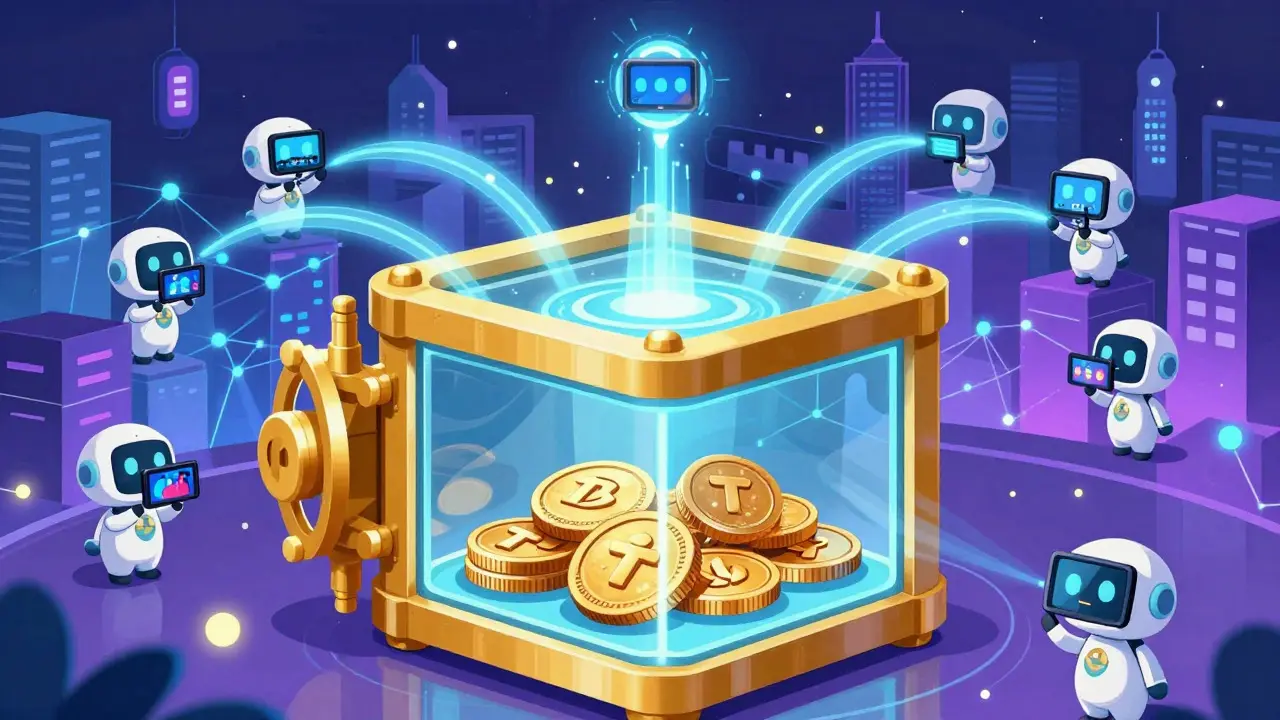
So, how does THETA become WTHETA? It’s a mechanical process involving smart contracts. When you wrap your tokens, they are locked in a contract on the Theta chain. In return, an equivalent amount of WTHETA is minted on the target chain (usually an EVM-compatible one). To get your original THETA back, you burn the WTHETA, which unlocks the locked assets on the Theta side.
This 1:1 peg is critical. It ensures that the wrapped token doesn’t drift in value independently of the native asset. However, it also introduces a dependency: if the smart contract holding your THETA gets hacked, your WTHETA could lose its backing. This is a standard risk in all wrapped assets, known as "bridge risk."
Why Use WTHETA Instead of Native THETA?
You might ask, "If it’s the same value, why bother?" The answer lies in access. Many popular DeFi applications run on Ethereum or BNB Chain. If you hold native THETA, you can’t directly use those apps. By converting to WTHETA, you gain access to:
- Liquidity Pools: Provide liquidity in pairs like WTHETA/ETH to earn trading fees.
- Lending Protocols: Borrow stablecoins against your WTHETA collateral without selling your position.
- Cross-Chain Swaps: Move value seamlessly between ecosystems using decentralized exchanges (DEXs).
Essentially, WTHETA turns a governance token into a liquid asset that can work within the broader DeFi economy. It’s about utility expansion, not creating new value out of thin air.
Market Context and Price Predictions
Price forecasts for WTHETA mirror those of native THETA, since they are economically identical. Analysts vary widely in their predictions. For instance, some models suggest a conservative annual change, projecting prices in the range of $0.60 USD by 2026. Other long-term analyses point to much higher potential values if the Theta Network achieves mass adoption in AI video rendering and decentralized media distribution.
The global video streaming market is projected to exceed $180 billion by 2027. Theta’s partnerships with entities like Google Cloud, Sony, and Samsung suggest institutional interest in solving the infrastructure bottlenecks of this growing market. These collaborations serve as bullish indicators, potentially driving demand for both THETA and its wrapped counterpart.
Risks and Security Considerations
No asset is risk-free, and WTHETA carries specific vulnerabilities:
- Smart Contract Risk: Bugs in the wrapping contract could lead to loss of funds or de-pegging.
- Bridge Vulnerabilities: Cross-chain bridges are frequent targets for hackers due to their complexity.
- Network Adoption: If the Theta Edge Network fails to attract enough nodes, the underlying utility of the token may stagnate.
Always check the latest security audits before interacting with any wrapped token protocol. Reputable exchanges like HTX and Binance list WTHETA, which adds a layer of vetting, but self-custody users should verify the contract addresses themselves.
| Feature | Native THETA | Wrapped THETA (WTHETA) |
|---|---|---|
| Primary Function | Governance & Staking on Theta Chain | DeFi Interoperability & Cross-Chain Trading |
| Blockchain Compatibility | Theta Mainnet Only | EVM-Compatible Chains (Ethereum, BSC, etc.) |
| Value Peg | Market Determined | 1:1 Pegged to Native THETA |
| Security Dependency | Theta Network Consensus | Theta Network + Smart Contract + Target Chain |
| Use Case Example | Voting on Protocol Upgrades | Providing Liquidity on Uniswap |
Frequently Asked Questions
Is WTHETA the same as THETA?
Economically, yes. They are pegged 1:1. Technically, no. WTHETA is a representation of THETA on a different blockchain, enabling it to function in environments where native THETA cannot be used directly.
Where can I buy Wrapped THETA?
You can acquire WTHETA through centralized exchanges like HTX or by swapping native THETA via decentralized exchanges (DEXs) on EVM-compatible chains. Some wallets, like the Binance Web3 Wallet, facilitate direct connection to these DEXs for easy conversion.
Does holding WTHETA give me voting rights on Theta Network?
Generally, no. Governance votes typically require holding the native THETA token on the Theta mainnet. While this can change with protocol updates, the wrapped token is primarily designed for financial utility, not governance participation.
What happens if the Theta Network fails?
If the underlying network collapses, the value of both THETA and WTHETA would likely drop significantly. Since WTHETA is backed by locked THETA, its value is intrinsically linked to the health and adoption of the Theta ecosystem.
Is there a fee to wrap or unwrap THETA?
Yes. You will pay gas fees on both the source chain (Theta) and the target chain (e.g., Ethereum) during the wrapping and unwrapping processes. Additionally, some DEXs charge a small swap fee when converting between the two forms.




Calliope Clio
August 17, 2026 AT 19:29Oh my god, another 'wrapper' token? 🙄 I mean, we all know it's just the same old THETA in a fancy dress, right? 💅 It’s so exhausting pretending that moving assets between chains is some kind of revolutionary tech when it’s literally just locking tokens in a contract. 😒 The real question is, who actually needs this? Not me. I’d rather hold my gold or just do nothing at all. 📉
Leah Humphrey
August 17, 2026 AT 20:28The interoperability narrative is still the strongest driver for mid-cap alts, but the liquidity fragmentation remains a significant hurdle for sustained price discovery.
Jay Johhnston
August 18, 2026 AT 17:37Nice breakdown. It’s interesting how Theta tries to solve the video streaming infrastructure problem while also dealing with the usual DeFi mechanics. I think the edge network part is what makes it distinct from other L1s, even if the wrapped token itself is pretty standard fare.
Niall O'Rourke
August 20, 2026 AT 01:31actually everyone knows bridges are just where money goes to die. why bother wrapping it when you could just trust the central exchange like the good citizen you are. the smart contract risk is basically a tax on your stupidity for trying to be decentralized
Jillian Groskreutz
August 20, 2026 AT 15:07You’re completely missing the point! The peg is 1:1, which means it’s not speculative in the traditional sense; it’s a utility bridge. If you don’t understand the difference between governance and financial utility, maybe read the whitepaper again before you post such shallow takes. It’s embarrassing, really!
Carmene Jackson
August 21, 2026 AT 08:32I feel like people forget that holding WTHETA doesn't give you voting rights, so you're basically renting out your stake for DeFi fees without any say in the protocol. It feels a bit like being a ghost in the machine, honestly. Just floating around with no real power.
Jennifer Ulmer
August 22, 2026 AT 17:40It’s a simple concept: you want to use Ethereum DEXes, so you wrap your Theta. That’s it. No need to overcomplicate it with philosophical debates about decentralization purity. If it works, it works. Keep it simple, keep it liquid.
Jade Brown
August 24, 2026 AT 12:59Let’s cut through the fog of war here. This isn't just a token swap; it's a liquidity injection into the EVM ecosystem for a non-EVM asset. The APY potential on these pools is where the real alpha hides, folks. Don't sleep on the yield farming opportunities just because you're scared of smart contract audits. The numbers don't lie, they scream.
Stephanie Millar
August 25, 2026 AT 15:02From a UK perspective, we see a lot of these cross-chain solutions popping up. It’s fascinating how the global market is forcing these smaller networks to adapt. The partnerships with Sony and Samsung are quite impressive, aren't they? It shows there is serious institutional interest behind the scenes.
Nikki keller
August 27, 2026 AT 12:23In many ways, this is a study in trade-offs. We gain access to a broader DeFi landscape, but we sacrifice direct governance participation. It’s a pragmatic choice for those who prioritize yield over control, which is a valid stance in today’s volatile markets.
miranda gamboa
August 29, 2026 AT 06:13This is exactly the kind of infrastructure we need to scale! By enabling cross-chain compatibility, we open up new avenues for capital efficiency. Imagine the possibilities for lending protocols that can now accept WTHETA as collateral. Let's build this future together!
Lance Konig
August 29, 2026 AT 07:36The article states that block finalization times can be as low as 1-2 seconds. In my experience with high-frequency trading on other L1s, that latency is acceptable for most DeFi interactions, provided the slippage on the target chain remains within reasonable bounds. It is a technical detail that often gets overlooked by retail investors, but it matters for execution quality.
Dina Lazarova
August 29, 2026 AT 18:56One must acknowledge the inherent fragility of relying on third-party smart contracts for asset security. While the 1:1 peg provides theoretical stability, the practical risk lies in the execution layer. A single vulnerability in the bridging mechanism could unravel the entire value proposition, rendering the wrapped token merely a digital receipt of uncertain worth.
Walker Perry
August 30, 2026 AT 00:02They are always pushing these foreign chains onto us. Why do we need to trust an Indian-based node network when we have our own solid US exchanges? It's just another way for the elites to siphon off our value through complex fee structures. Stay woke and check the audit reports yourself before you get burned by these offshore schemes.
alex fordy
August 30, 2026 AT 23:58I appreciate the clear explanation of the risks involved. It’s easy to get excited about the DeFi potential, but keeping an eye on the bridge vulnerabilities is crucial. Thanks for laying it out so clearly! 🚀
Mohamed Shoaeb
August 31, 2026 AT 16:59good writeup. i am from india and we have a lot of developers working on theta nodes. the edge network is growing fast. the wrapped token helps us connect with global defi easily. nice to see more info on this topic
Sonia Gomez Gomez
September 1, 2026 AT 08:54You really should stop buying into this hype train. It's just another way for whales to dump on retail. Look at the chart, it's going nowhere. Just save your money and buy something real like a house or a car. :P
SHIV SHANKAR KANTA
September 3, 2026 AT 08:20this is the essence of modern finance... we are just shadows of our own assets trapped in digital cages waiting for the next great awakening... the wrapped token is a metaphor for the human condition itself... don't you feel that weight?