
You’ve probably heard the advice: "Buy low, sell high." It sounds simple, but try doing it when Bitcoin swings 20% in a single day. One minute you’re up $500, the next you’re staring at a red screen wondering if you should panic-sell or double down. This emotional rollercoaster is exactly why most retail investors lose money in crypto. They wait for the "perfect" entry point, miss it, buy at the peak out of FOMO, and sell during the dip out of fear.
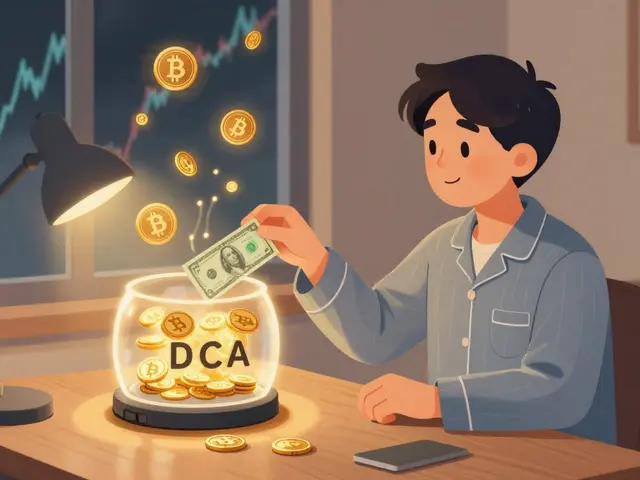
Enter Dollar-Cost Averaging, or DCA. It’s not a new invention-it’s been used by stock market veterans since the 1920s-but it has become the go-to strategy for navigating the chaos of digital assets. The concept is brutally simple: instead of trying to time the market, you invest a fixed amount of money at regular intervals, no matter what the price is doing. You buy when prices are high, you buy when they’re low, and over time, your average cost per coin smooths out. By September 2026, with major exchanges like Coinbase and Binance automating this process, DCA is arguably the most effective tool for beginners who want to build wealth without checking charts every five minutes.
The Math Behind the Magic
Why does spending the same amount every week work better than guessing? It comes down to unit accumulation. When the price of Bitcoin drops, your fixed dollar amount buys more coins. When the price spikes, it buys fewer. Over a long period, this naturally lowers your average entry price compared to putting all your cash in at one random moment.
Consider the formula: Average Purchase Price = Total Investment Value / Total Amount Purchased. If you invest $100 every month, you aren’t worried about whether today’s price is the "bottom." You’re simply accumulating units. In volatile markets, where annualized volatility can hit 80-90% (compared to 15-20% for traditional stocks), this smoothing effect is powerful. It turns a jagged, stressful price chart into a steady line of accumulation.
DCA vs. Lump Sum: Which Wins?
This is the million-dollar question. Should you dump $5,000 into Ethereum today, or drip-feed $100 weekly for a year? The answer depends on market direction, but data suggests DCA wins on risk management.
| Feature | Dollar-Cost Averaging (DCA) | Lump-Sum Investing |
|---|---|---|
| Risk Exposure | Low. Spreads risk over time; reduces impact of sudden crashes. | High. Entire capital exposed to immediate market conditions. |
| Psychological Stress | Minimal. Automated execution removes emotion. | High. Requires constant monitoring and timing decisions. |
| Bull Market Performance | Moderate. May underperform lump-sum if prices rise consistently. | Superior. Captures full upside from day one. |
| Bear Market Performance | Superior. Buys cheaper units during declines, lowering avg cost. | Poor. Immediate drawdown hits entire portfolio value. |
| Best For | Long-term holders, beginners, volatile assets. | Experienced traders with strong conviction and timing skills. |
A study analyzing Bitcoin performance from 2017 to 2021 showed that while lump-sum investors might get higher returns in a straight-line bull run, DCA reduced maximum drawdown by nearly 37%. During the massive crash from November 2021 to June 2022, those who kept DCAing ended up with an average entry price 43% lower than the starting peak. That buffer saved many portfolios from total wipeout.
How to Set Up Your DCA Strategy
You don’t need a finance degree to start. Most major exchanges have made this incredibly easy. Here is how you actually do it:
- Choose Your Asset: Stick to established projects like Bitcoin or Ethereum initially. DCA doesn’t fix bad fundamentals. As expert Nicholas Merten notes, "DCA only works if the asset ultimately appreciates long-term." Don’t DCA into a meme coin that might disappear.
- Determine Your Budget: Look at your disposable income. Financial advisors often suggest allocating 1-5% of your monthly savings to crypto. Start small-$50 or $100 is fine. Consistency matters more than size.
- Pick Your Interval: Weekly is the sweet spot for most people. Data shows 63% of users prefer weekly buys, while 29% choose monthly. Daily is too frequent for most (and fees can eat into small amounts), and quarterly is too infrequent to smooth out short-term volatility.
- Automate It: Use the recurring buy feature on platforms like Coinbase or Binance. Set it and forget it. The goal is to remove human error.

The Psychological Edge
Let’s be honest: trading is hard because we are terrible at handling loss. We feel pain twice as strongly as pleasure. If you see your portfolio drop 10%, you want to quit. If it rises 10%, you want to buy more. This behavior leads to buying high and selling low-the exact opposite of what makes money.
DCA hacks your brain. Because you are buying regularly, a price drop becomes good news. It means your next automatic purchase gets you more coins. Instead of panicking during a bear market, you stay calm because your plan is working. A survey of Coinbase users found that 78% of DCA users maintained their habits through downturns, compared to only 34% of those trying to time trades. You stop watching the ticker tape and start building wealth.
Common Pitfalls to Avoid
While DCA is robust, it isn’t magic. Here are the mistakes that trip people up:
- DCAing into Dead Projects: If you buy a token that goes to zero, averaging down just means you lose money slower. Always research the project first.
- Stopping When It Hurts: The biggest advantage of DCA is buying low. If you pause your purchases during a 30% drop, you defeat the purpose. Pre-commit to a multi-year plan.
- Ignoring Fees: If you’re investing tiny amounts daily, transaction fees can eat 5-10% of your capital. Check your exchange’s fee structure. Often, weekly or bi-weekly buys are more cost-effective than daily ones for small accounts.
- Tax Complexity: Every purchase creates a cost basis record. While exchanges help, keeping your own spreadsheet is wise. In Australia, for example, the ATO treats each crypto transaction as a taxable event, so accurate records save headaches later.

Real-World Example: The 2022 Bear Market Test
Imagine two investors in early 2022. Investor A has $10,000 and buys Bitcoin all at once at $40,000. Investor B has $10,000 and decides to DCA $500 weekly.
By June 2022, Bitcoin crashed to $15,000. Investor A’s portfolio is down 62%. They are sweating bullets, wondering if they should cut losses. Investor B, however, bought at $40k, then $35k, then $30k... all the way down to $15k. Their average cost might be around $25,000. They are still underwater, but significantly less so. More importantly, when the market eventually recovers, Investor B needs a smaller percentage gain to break even. This resilience is why DCA is favored for long-term holding.
Is DCA Right for You?
If you believe in the long-term future of blockchain technology but hate stress, DCA is likely your best friend. It won’t make you rich overnight, and it won’t catch the absolute bottom. But it protects you from your own worst enemy: yourself.
Start with an amount you can afford to lose entirely. Automate the process. Ignore the news headlines for six months. Let the math do the work. In a world of hype and speculation, boring consistency is often the smartest move you can make.
Can I change my DCA amount mid-strategy?
Yes, but it requires manual intervention on most platforms. You usually have to cancel the existing recurring order and create a new one with the updated amount. Some advanced tools allow dynamic adjustments based on price triggers, but standard setups require you to reset the schedule. It’s best to stick to your original plan unless your financial situation changes drastically.
Does DCA work for altcoins other than Bitcoin?
It can, but proceed with caution. DCA mitigates price volatility, not fundamental risk. If an altcoin has poor utility or declining adoption, its price may trend downward indefinitely. In such cases, DCA simply accumulates a losing position. It is generally safer to apply DCA to blue-chip assets like Bitcoin and Ethereum, which have stronger historical track records of recovery after crashes.
What happens if I stop DCAing during a crash?
You miss the opportunity to lower your average cost basis. The core benefit of DCA is acquiring more units when prices are depressed. Stopping during a significant dip means you fail to take advantage of the discount, potentially resulting in a higher overall entry price when the market recovers. Data shows that investors who pause during >30% drops often regret missing the cheapest accumulation phase.
Is there a minimum investment required for DCA?
It varies by exchange. Platforms like Coinbase allow investments as low as $1 or $2 per transaction, making it accessible for almost anyone. Other exchanges like Binance may have slightly higher minimums, often around $10. Always check the specific platform's terms, as very small amounts may be inefficient due to transaction fees outweighing the invested capital.
How does DCA affect taxes?
Each DCA purchase is typically treated as a separate acquisition event for tax purposes. This means you will have multiple cost bases to track. When you eventually sell, you may need to specify which lots you are selling (e.g., First-In-First-Out or Specific Identification). Keeping detailed records of each purchase date, amount, and price is crucial for accurate tax reporting, especially in jurisdictions with strict crypto regulations.


Bruce Percival
September 11, 2026 AT 11:32I've been using this strategy for about two years now and honestly it's the only thing that keeps me sane during those crazy volatility spikes.
It really does take the emotion out of it when you just set up an auto-buy on Coinbase every Friday. I used to stare at charts all day trying to guess the bottom but I always ended up buying right before a drop or selling right after a bounce. Now I just ignore the noise and let the math work its magic over time. The part about fees eating into small accounts is super important though because I started with daily buys and lost almost half my initial capital to transaction costs before switching to weekly.
Ervin Kery
September 13, 2026 AT 03:13OH MY GOD YES!!!
The stress relief alone is worth the money... seriously, I was losing sleep checking Binance at 3 AM like some kind of zombie!! It’s such a relief to just automate it and walk away from the screen... no more panic attacks when Bitcoin dips 5% in ten minutes!!!
Glenn Watts
September 14, 2026 AT 05:16While the logic holds, people forget that US exchanges are getting hammered by regulatory uncertainty which could freeze these automated systems overnight. You're betting your entire retirement plan on a platform that might not be there in five years due to SEC lawsuits. That's a massive risk factor they don't mention here.
Taylor Szalaiy
September 15, 2026 AT 09:30Total agreement on the psychological aspect. It’s like putting blinders on a horse so you don’t spook at every shadow. I’ve found that mixing BTC and ETH gives a nice balance while keeping the DCA simple enough to not overthink it. Plus, seeing those little green notifications pop up regularly feels like a tiny dopamine hit without the crash of a big trade going wrong.
Curtis Scott
September 17, 2026 AT 03:12Simple is better. Don't overcomplicate it.
Heather Butcher
September 17, 2026 AT 10:53I love this guide! It’s so encouraging for beginners who feel intimidated by the jargon.
I think the point about 'DCAing into dead projects' is crucial because I saw so many friends do that with random altcoins last cycle. They kept averaging down thinking it would come back, but some of those tokens just went to zero and stayed there. So yeah, picking the right asset first is definitely step one before setting up the automation!
Tish Dalton
September 18, 2026 AT 03:54Exactly Heather! It’s about building confidence too. Once you see the process working, you stop second-guessing yourself. I usually tell newbies to start with $50 a month so it doesn’t feel like a huge commitment. If you can stick to that for six months, you’re already ahead of 90% of people who try to trade actively.
Manoj Ramachandran
September 20, 2026 AT 01:07One must consider the tax implications carefully, especially if residing outside the United States. In India, for instance, the taxation rules regarding crypto assets have undergone significant changes recently, including a flat tax rate and TDS deductions. Maintaining accurate records of each DCA purchase becomes imperative for compliance. It is advisable to consult a local tax professional to ensure that the cost basis calculations align with current jurisdictional requirements.
Lakshmi Sailaja Devarakonda
September 21, 2026 AT 04:08Oh please, spare us the lecture on taxes from someone who probably hasn't even read the fine print on their exchange agreement. While we are all busy worrying about the IRS, the real issue is that most retail investors are still holding bags from 2021 because they thought DCA was a magic bullet rather than a risk management tool. You can average down all you want, but if the underlying technology fails to deliver adoption, you are just funding a slow bleed until your portfolio looks like a graveyard of good intentions and bad fundamentals. It is truly amusing how everyone acts like they discovered fire when this concept has been taught in basic finance courses for decades, yet nobody seems to apply the discipline required to actually stick with it through the boring parts.
Gary Schneeberger
September 21, 2026 AT 18:56Sarcastic or not, she has a point about the 'magic bullet' mindset. People treat DCA like a get-rich-quick scheme disguised as long-term investing. If you're expecting 10x returns via DCA in a bear market, you're delusional. It preserves capital, it doesn't multiply it instantly. Know the difference.
Kelsey Hartwig
September 22, 2026 AT 01:42Thе philosophical underpinning of Dollar-Cost Averaging lies in the acceptance of uncertainty. By relinquishing control over timing, one embraces the stochastic nature of markets. It is an act of humility against the hubris of prediction. Furthermore, thе accumulation of units serves as a tangible manifestation of patience, a virtue increasingly rare in our instant-gratification society. One must also note the orthographic irregularities in common discourse, which often obscure precise meaning; clarity of intent is paramount.
Adam Barrett
September 22, 2026 AT 20:42Love this perspective! It really helps to frame it as letting go of control. I find that once I accept I can't predict the future, I enjoy the journey way more. Keep spreading that positive energy!
Jennifer Phipps
September 24, 2026 AT 09:32Super helpful tips! 🚀 Just remember to check your wallet addresses carefully before setting up recurring buys. A typo there can send your funds to nowhere land! 💸 Also, make sure your bank account has enough buffer so the auto-debit doesn't fail and cause overdraft fees. Consistency is key! ✅
Elizabeth Floyd
September 25, 2026 AT 06:13Great advice Jennifer! I totally forgot about the overdraft risk. I had that happen once and it was so annoying fixing it 😅 Definitely double check everything!
Andy Hunns
September 25, 2026 AT 06:13You are all missing the bigger picture. This isn't just about buying coins; it's about wealth preservation in a fiat system designed to devalue your labor. Every dollar you hold loses purchasing power, so sitting in cash is guaranteed loss. DCA forces you to convert depreciating currency into appreciating digital property. If you aren't doing this, you are voluntarily choosing poverty. Wake up.
Christy Keirn
September 25, 2026 AT 07:51Wow, dramatic much?? 🙄 We get it, you hate fiat money. But telling people they are 'choosing poverty' because they keep some savings in a high-yield savings account is pretty intense. Not everyone wants to bet their rent money on volatile assets. Some of us like sleeping at night without wondering if our net worth just dropped 20%. Maybe leave the apocalyptic vibes at home?
Jacquelyn Miller
September 26, 2026 AT 03:56Precisely... the existential dread of modern finance is exhausting...
We pretend that 'investing' is rational, but it’s mostly just coping mechanisms for economic anxiety. DCA is essentially a ritual to appease the gods of volatility... a prayer said in dollars instead of words... whether it works or not depends entirely on your faith in the narrative, not the math...
Zayda Hayes
September 27, 2026 AT 04:20This is a very well-articulated sentiment. It highlights the emotional labor involved in financial planning. However, it is important to distinguish between faith and strategy. While the ritualistic aspect provides comfort, the mathematical smoothing effect provides actual risk mitigation. Both can coexist. Thank you for sharing such a thoughtful reflection.
Emily Sue
September 27, 2026 AT 17:07i tried dca last year and it helped me stay calm during the dip. i just bought eth every week and didnt look at the chart. best decision ever. highly recommend automating it so u dont have to think about it.
Samantha Du-Cell
September 28, 2026 AT 12:07Absolutely. The American dream is built on ownership, and crypto is the new frontier for that ownership. Don't let the naysayers keep you on the sidelines. Get in, stay consistent, and build your empire brick by digital brick. USA stands for Unstoppable Self-Assurance, baby!
Joseph Brink
September 29, 2026 AT 14:22While the enthusiasm is palpable, one must recognize that true wisdom lies in silence and observation. Many rush into DCA without understanding the macroeconomic cycles that drive these assets. It is not merely about buying; it is about understanding the zeitgeist of value transfer. Those who blindly follow trends will inevitably fall victim to their own ignorance, whereas the enlightened observer waits for the signal amidst the noise. Do not confuse activity with achievement.