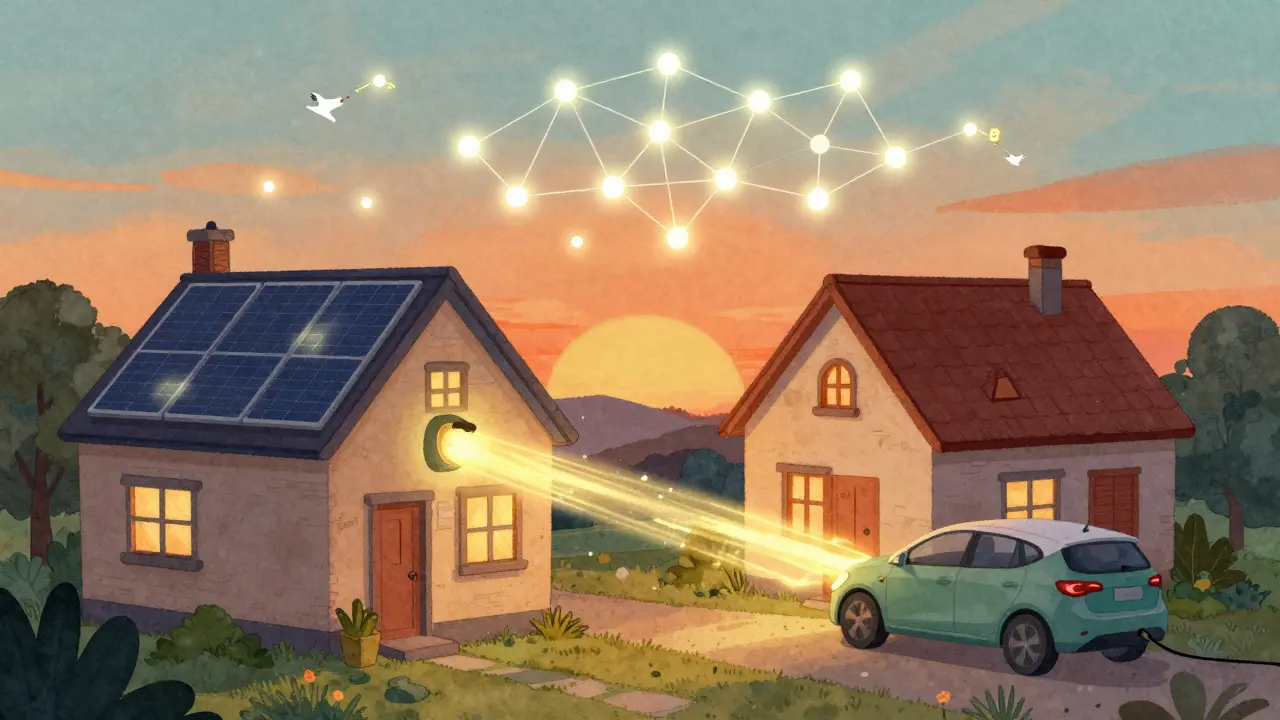
What if your neighbor’s solar panels could power your home - and you paid them directly?
It’s not science fiction. In Fremantle, Australia, homeowners with rooftop solar are selling excess electricity to people next door using blockchain. No utility company. No middleman. Just a digital contract that automatically transfers energy and money when the sun’s shining and the fridge needs power. This is blockchain for peer-to-peer energy trading - and it’s already changing how energy moves across neighborhoods.
Traditional electricity grids are built like highways: power flows one way, from big power plants to homes. But with solar panels on rooftops and batteries in garages, people are now both producers and consumers - or prosumers. The problem? Utilities still control the pricing and take a big cut. Blockchain cuts them out. It lets neighbors trade energy like they trade crypto - securely, instantly, and at fair prices.
How blockchain turns your roof into a power plant
Here’s how it works in practice. Say you’ve got solar panels on your house in Perth. On a sunny afternoon, you’re generating 5 kWh more than you need. Instead of selling it back to the grid for 8 cents per kWh (the typical feed-in tariff), you put that extra power on a local blockchain network. Your smart meter records the output every 15 minutes and uploads it to the system.
Meanwhile, your neighbor, Maria, has an electric car and just got home from work. Her battery is low. Her app shows nearby sellers with surplus power. She picks your offer - 14 cents per kWh, 20% cheaper than the grid. A smart contract kicks in. In under 10 seconds, 2 kWh is transferred to her battery, and $0.28 is sent to your digital wallet. No bills. No delays. No paperwork.
This isn’t theoretical. Power Ledger ran a trial in Fremantle with 100 households. Participants earned between AUD$220 and $350 a month by selling surplus energy. Some cut their electricity bills by over 40%. The blockchain didn’t just record transactions - it made them automatic, tamper-proof, and transparent.
The tech behind the trade: Smart meters, smart contracts, and Ethereum
Three things make this possible:
- Smart meters - These aren’t your old analog dials. They’re digital, internet-connected devices that track energy use and production in real time. Most modern ones follow IEEE 2030.5 or OpenADR 2.0 standards, so they can talk to blockchain platforms.
- Smart contracts - These are self-executing code blocks on a blockchain. You set rules like: “Sell excess solar at $0.12/kWh between 10 AM and 4 PM.” When conditions are met, the contract executes the trade without human input. No calls to customer service. No waiting for a bill.
- Blockchain platforms - Ethereum is the most common. After switching to proof-of-stake in 2022, its energy use dropped by 99.95%. Other systems like Hyperledger Fabric and Corda are used in enterprise trials, especially where privacy matters more than public transparency.
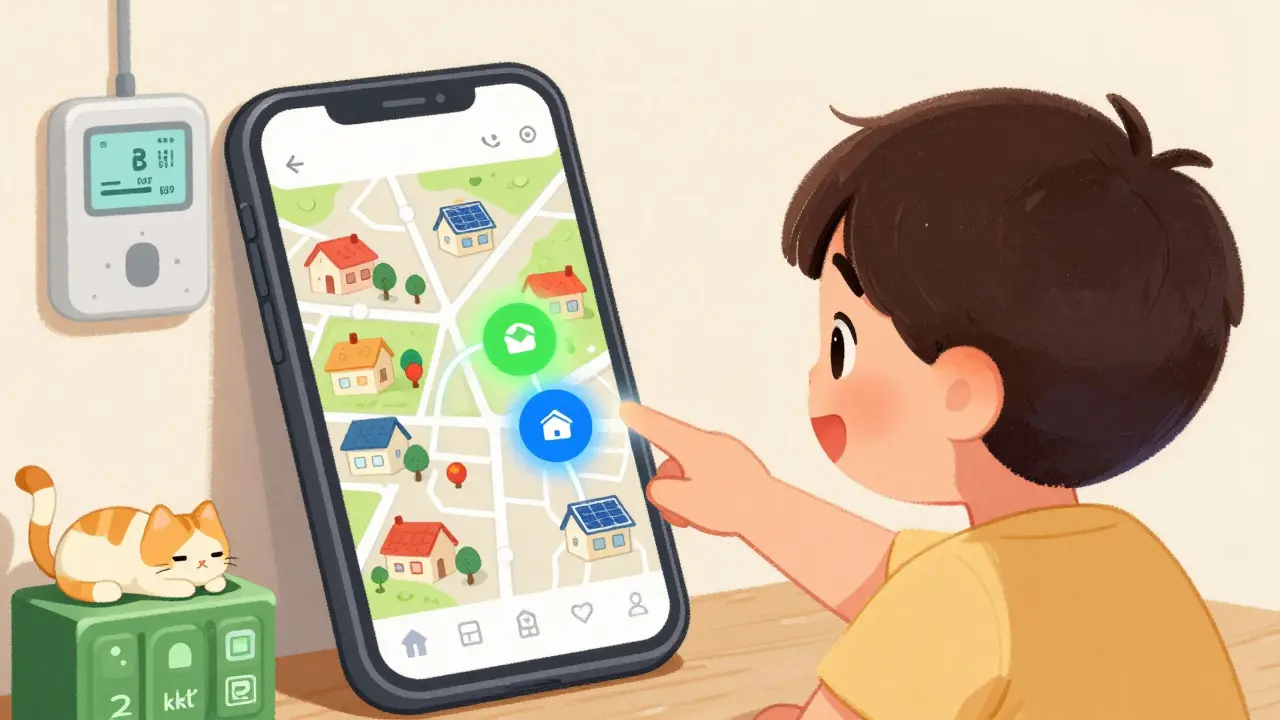
These systems run on apps - web or mobile - that show you how much energy you’ve produced, sold, bought, and saved. You see exactly who you’re trading with, how much it cost, and how much you earned. It’s like Uber for electricity.
Why this beats the old grid
Traditional utilities charge you for power they generate miles away - then add fees for transmission, distribution, and administration. Transmission losses? Around 5-8% of electricity vanishes on the way to your house, according to a 2024 Nature.com study. That’s wasted energy. Wasted money.
P2P trading cuts that out. When you buy energy from someone two houses down, you’re not paying for 10 km of power lines. You’re paying for what’s right outside your window. That cuts losses by about 6.2% on average. It also cuts costs. IRENA found P2P systems reduce transaction fees by 30-45% compared to utility-mediated sales.
And during blackouts? In Brooklyn’s microgrid, when the main grid failed, neighbors kept power flowing to each other. Homes with solar and batteries stayed lit. That’s resilience. That’s local control.
Where it’s working - and where it’s not
Blockchain energy trading isn’t everywhere yet. It thrives where three things exist:
- High solar adoption - At least 15-20% of homes need solar panels for the market to be viable. That’s why Australia, Germany, and California lead.
- Digital infrastructure - You need smart meters, internet, and apps. Rural areas without reliable broadband are left out.
- Supportive rules - In the EU, the Clean Energy Package lets communities trade energy legally. In the US, FERC Order 2222 opened wholesale markets to distributed resources. But in some US states and parts of Asia, laws still say only utilities can sell electricity. Power Ledger’s trial in one US state was shut down in 2022 for breaking those rules.
Success stories? Sonderborg, Denmark, used P2P trading to cut grid dependence by 37% in winter. The Brooklyn Microgrid now connects over 500 households. In Australia, 97% of participants in the Fremantle trial said they’d recommend it.
Failures? WePower in Lithuania stalled for 18 months because regulators didn’t know how to classify peer-to-peer energy sales. They shut it down. The lesson? Tech alone isn’t enough. You need legal clarity.
What’s holding it back?
It’s not perfect. Here’s what still trips people up:
- Complex setup - First-time users report spending 3-5 hours just getting their smart meter linked to the app. Onboarding is clunky.
- Slow transactions - Ethereum handles 15-30 trades per second. Visa does 24,000. During peak solar hours, delays can happen.
- Limited scale - Most systems work in neighborhoods of 50-500 homes. Scaling to a whole city? Still unproven.
- Customer support - Many platforms are run by startups with tiny teams. If your smart contract fails, you might wait days for help.
And yes, there’s still skepticism from grid operators. National Grid warned in 2023 that uncoordinated P2P trading could overload local transformers during heatwaves. That’s why new standards like IEEE 2030.5 Annex D are being rolled out - to make sure P2P systems play nice with the bigger grid.
What’s next? EVs, cross-border trading, and the EU’s blockchain grid
The next big leap? Electric vehicles.
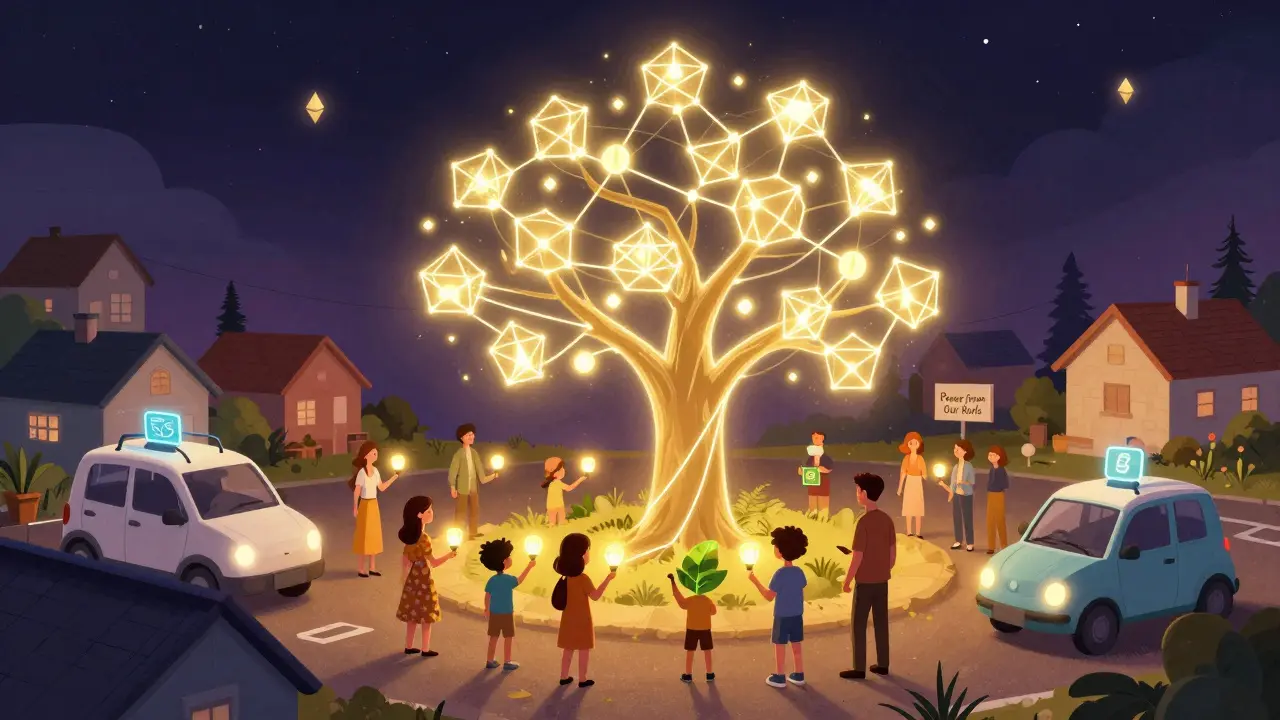
BMW and Siemens launched a trial in Munich in April 2024 connecting 200 EVs to a P2P network. At night, cars charge from solar-powered homes. During the day, they feed power back into the grid when prices spike. That’s vehicle-to-grid (V2G) - and it turns your car into a mobile battery bank.
Meanwhile, the European Blockchain Services Infrastructure (EBSI) launched in January 2024 and now includes energy trading as a certified use case. That means a household in Germany could soon sell power to a school in Portugal - all on one blockchain.
Market forecasts say the global P2P energy market will grow from $1.27 billion in 2023 to $8.43 billion by 2028. Big players are watching: Shell bought sonnen in 2019 and is testing P2P in Germany. Startups like LO3 Energy and Power Ledger have raised over $250 million combined.
Should you join?
If you have solar panels, a smart meter, and live in a place with supportive rules - yes. Start small. Look for local energy cooperatives or trials in your area. In Perth, Power Ledger’s model is being expanded. Ask your energy retailer if they’re planning a P2P pilot.
If you’re renting or don’t have solar? You can still benefit. Join a community solar project. Some are already using blockchain to let renters buy shares in a shared solar farm and trade credits with neighbors.
This isn’t about replacing the grid. It’s about making it smarter, fairer, and more local. The future of energy isn’t just clean - it’s connected.
Frequently Asked Questions
How does blockchain make energy trading more secure than using a utility?
Blockchain creates an immutable, public ledger where every energy transaction is recorded and verified by multiple nodes. Unlike a utility’s private database - which can be hacked or altered - blockchain transactions can’t be changed once confirmed. Smart contracts ensure payments and energy transfers happen only when both parties meet agreed conditions, removing human error or fraud.
Do I need my own solar panels to participate?
No. You can buy energy from neighbors who produce excess power. Some platforms even let you invest in shared solar farms - you get credits for the energy produced, even if your roof doesn’t have panels. Renters and low-income households can still benefit by purchasing cheaper, locally generated power.
Is blockchain energy trading legal in Australia?
Yes. Australia’s energy regulators allow peer-to-peer trading under the National Energy Retail Law. Power Ledger’s Fremantle trial was officially approved, and state-level reforms are expanding access. The key is using licensed platforms that comply with metering and financial regulations.
What happens if the internet goes down?
Smart meters continue recording energy use offline. Transactions are queued and processed once connectivity returns. Critical grid functions - like maintaining voltage and frequency - are still handled by the main utility. P2P trading is an overlay, not a replacement. You won’t lose power if the network drops.
Can I make real money from selling solar energy this way?
Yes. In the Fremantle trial, participants earned AUD$220-$350 per month by selling surplus solar. That’s significantly more than the 8-12 cent/kWh feed-in tariffs offered by utilities. Prices are set by supply and demand - during sunny afternoons, rates can jump to 20-25 cents/kWh. Your earnings depend on your system size, local demand, and how often you produce excess.
How much does it cost to join a P2P energy network?
Most platforms charge a small transaction fee - typically 3-8% per trade - which is still lower than utility fees. Some require a one-time setup fee of $50-$150 for meter integration or app access. Many trials are free for early adopters. Compare platform fees carefully; look for ones that are transparent and don’t lock you into long contracts.

Tiffani Frey
January 7, 2026 AT 03:22Ritu Singh
January 8, 2026 AT 18:04Surendra Chopde
January 10, 2026 AT 16:34Jennah Grant
January 11, 2026 AT 00:00Becky Chenier
January 12, 2026 AT 21:49Veronica Mead
January 14, 2026 AT 15:33Rahul Sharma
January 16, 2026 AT 04:00Paul Johnson
January 16, 2026 AT 20:57Emily Hipps
January 18, 2026 AT 13:38Valencia Adell
January 20, 2026 AT 07:54Sarbjit Nahl
January 20, 2026 AT 23:38Frank Heili
January 22, 2026 AT 14:55Jacob Clark
January 24, 2026 AT 00:48Jon Martín
January 25, 2026 AT 10:18Dennis Mbuthia
January 25, 2026 AT 13:17Tracey Grammer-Porter
January 26, 2026 AT 18:26Don Grissett
January 27, 2026 AT 05:01Katrina Recto
January 28, 2026 AT 03:11Gideon Kavali
January 29, 2026 AT 11:32Allen Dometita
January 29, 2026 AT 11:37