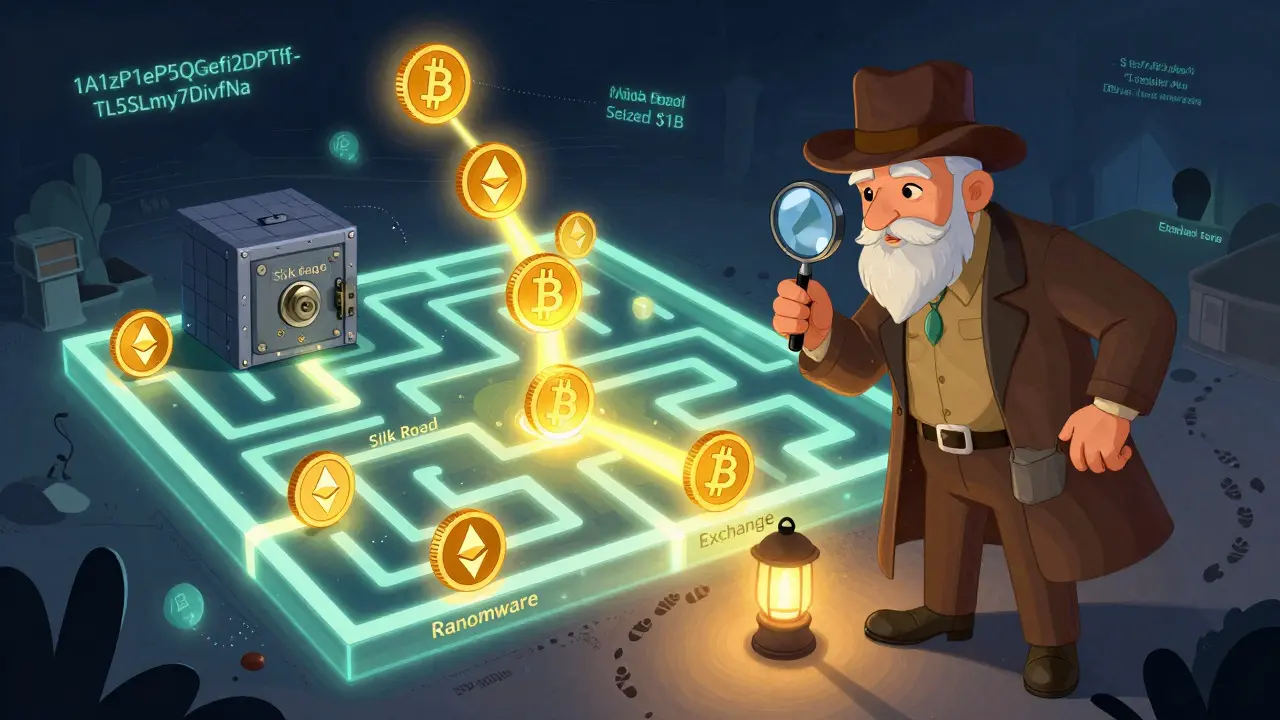
When cryptocurrency transactions go sideways-whether it's a ransomware payout, a darknet market deal, or a stolen wallet-the trail doesn't vanish just because it's digital. That's where blockchain forensics tools like Chainalysis and Elliptic come in. These aren't just software programs. They're the digital equivalent of detectives with access to every transaction ever recorded on a blockchain. And right now, they're the backbone of how law enforcement, banks, and regulators track illegal crypto activity.
How Blockchain Forensics Actually Works
Blockchains are public ledgers. Every Bitcoin, Ethereum, or Litecoin transfer leaves a permanent, traceable record. But that doesn't mean you can easily tell who sent or received it. Wallet addresses look like random strings of letters and numbers: 1A1zP1eP5QGefi2DMPTfTL5SLmv7DivfNa. Without context, they're meaningless.
That’s where Chainalysis and Elliptic step in. They don’t break encryption or hack wallets. Instead, they map connections. By analyzing patterns in transaction flows, linking addresses to known services (like exchanges, mixers, or darknet vendors), and using machine learning to spot anomalies, they turn anonymous addresses into identifiable entities.
Think of it like tracing a money trail through a maze. Most people see dead ends. These tools see the whole map.
Chainalysis: The Investigator’s Toolkit
Chainalysis built its reputation on high-stakes cases. Its most famous win? Tracking down $1 billion in Bitcoin stolen from the Silk Road darknet marketplace. That money was seized. That case went to court. And Chainalysis’s data was the key evidence.
Their main product, Chainalysis Reactor, is designed for investigators. It gives you a visual graph of transaction networks. You click on one address, and it shows you where the funds came from, where they went, and which other wallets are likely controlled by the same person. It clusters addresses based on behavior-like if two wallets constantly send funds to each other, they’re probably linked.
Chainalysis also offers KYT (Know Your Transaction), a real-time monitoring tool used by exchanges and banks. It scans incoming and outgoing transactions and flags anything risky: transfers from known mixers, darknet markets, or ransomware operators. It assigns a risk score from 0 to 100. If a user sends $50,000 from a wallet tied to a past theft, KYT will light up red.
Chainalysis covers 85% of the total cryptocurrency market value. That means it tracks Bitcoin, Ethereum, USDT, and most major coins. It supports over 1,800 services-exchanges, DeFi protocols, wallet providers-and updates constantly as new chains emerge.
Its biggest strength? Real-world proof. Law enforcement agencies from the FBI to Europol rely on it. Courts accept its reports. That credibility makes it the go-to tool when a case needs to hold up in front of a judge.
Elliptic: The Predictive Analyst
If Chainalysis is the detective who solves the crime, Elliptic is the forensics lab that predicts it.
Elliptic monitors over 100 digital assets-more than Chainalysis-and covers 97% of the total crypto market value. That’s not just Bitcoin and Ethereum. It includes privacy coins like Zcash (ZEC) and Horizen (ZEN), which are designed to hide transaction details. Most tools struggle with these. Elliptic doesn’t. It has built-in models to detect when Zcash is being used in a mixer or sent to a known criminal address.
Its standout feature? Predictive risk scoring. While Chainalysis reacts to known bad actors, Elliptic tries to catch threats before they happen. It analyzes how a wallet behaves over time. If a wallet starts receiving small deposits from 10 different sources, then sends a large sum to a privacy mixer, Elliptic flags it as high-risk-even if none of those addresses have been linked to crime yet.
Elliptic’s API lets crypto businesses embed risk checks directly into their systems. A user tries to withdraw $100,000? The system checks the wallet’s history in real time and blocks it if the risk score hits a threshold. No human needs to review it. It’s automated compliance.
They also offer deep training programs. Many firms hire Elliptic not just for software, but for certification courses that teach compliance officers how to interpret blockchain data, configure risk rules, and train their teams. That’s rare. Most vendors sell software. Elliptic sells expertise.

Chainalysis vs. Elliptic: What’s the Real Difference?
It’s not about which is better. It’s about which fits your needs.
Here’s a quick breakdown:
| Feature | Chainalysis | Elliptic |
|---|---|---|
| Market Coverage | 85% of crypto market value | 97% of crypto market value |
| Privacy Coin Support | Basic | Advanced (ZEC, ZEN, Monero) |
| Primary Use Case | Investigations, law enforcement | Real-time compliance, automated monitoring |
| Strength | Visualization, courtroom admissibility | Predictive analytics, customization |
| Training & Support | Standard enterprise support | Comprehensive certification programs |
| Best For | Government agencies, large exchanges | Financial institutions, DeFi platforms |
Chainalysis wins if you need to build a case. Elliptic wins if you need to stop crime before it happens.
Who Actually Uses These Tools?
It’s not just cops.
Major banks like Barclays and MUFG use Chainalysis to monitor crypto deposits. Crypto exchanges like Coinbase and Kraken rely on Elliptic to auto-flag suspicious users before they can withdraw funds. Regulators in the EU and Singapore require firms to use these tools to comply with AML rules.
Even decentralized finance (DeFi) platforms-once seen as lawless-are now integrating Chainalysis and Elliptic. Why? Because without them, they can’t get licensed. Without licensing, they can’t work with traditional banks. It’s a domino effect: no compliance, no access to the real financial system.
And it’s working. Since these tools became widespread, the amount of illicit crypto activity has dropped. In 2021, over $14 billion in crypto was stolen or lost to crime. By 2024, that number fell to under $3 billion. That’s not because criminals got smarter. It’s because they got tracked.

The Hidden Costs
These tools aren’t plug-and-play.
Setting them up takes weeks. Training your team takes months. A compliance officer who’s never seen a blockchain transaction before needs to learn how to read transaction graphs, understand wallet clustering, and interpret risk scores. It’s not easy.
And the cost? Enterprise contracts start at $50,000 a year. For smaller firms, that’s a major investment. But the alternative-getting fined for failing AML checks, or being hacked because you didn’t monitor incoming funds-is far worse.
Both companies offer dedicated support for enterprise clients. But if you’re a small exchange or startup, you’ll be on a slower queue. That’s why many teams hire consultants just to help with implementation.
The Future of Crypto Tracing
Both Chainalysis and Elliptic are racing to keep up with new tech.
Chainalysis is adding cross-chain tracking. That means following Bitcoin that moves to Ethereum, then to Solana, then back. Elliptic is improving its AI models to predict how new privacy protocols will be abused before they even launch.
Regulations are tightening too. The EU’s MiCA law requires all crypto firms to use approved analytics tools. The U.S. Treasury is pushing for mandatory transaction reporting. That means these tools won’t just be useful-they’ll be mandatory.
The next five years won’t be about whether blockchain is anonymous. It’ll be about who controls the tools that unmask it. And right now, Chainalysis and Elliptic are the only two with the scale, data, and credibility to lead that charge.
Can blockchain forensics tools trace Monero?
Most blockchain analytics tools struggle with Monero because it’s designed to hide transaction details. Chainalysis has limited Monero support, but Elliptic is one of the few platforms that can analyze Monero transaction patterns with reasonable accuracy using advanced behavioral modeling. Even so, tracing Monero remains far more difficult than tracing Bitcoin or Ethereum.
Are these tools used by hackers to avoid detection?
Yes, some criminal groups study how Chainalysis and Elliptic work to avoid their detection methods. They use mixers, chain-hopping, and privacy coins to obfuscate trails. But that’s a cat-and-mouse game. As criminals adapt, these tools evolve too. The fact that illicit activity has dropped by 78% since 2021 shows the tools are still effective overall.
Do I need these tools if I’m just buying Bitcoin for personal use?
No. These tools are for businesses, exchanges, banks, and regulators. If you’re an individual buying Bitcoin on Coinbase or Kraken, you don’t need to interact with Chainalysis or Elliptic directly. They’re working behind the scenes to keep the system safe. Your exchange uses them to comply with laws-you just get to use the service.
Can these tools see my wallet balance?
Yes, but only if your wallet is public-which all blockchain wallets are. Anyone can view your transaction history on a blockchain explorer. Chainalysis and Elliptic don’t hack into wallets. They just collect, analyze, and map public data. Your balance isn’t hidden. What’s hidden is who owns the wallet-and that’s what these tools try to uncover.
Is there a free alternative to Chainalysis or Elliptic?
There are free blockchain explorers like Blockchain.com or Etherscan, but they only show raw data. They don’t cluster addresses, assign risk scores, or flag criminal links. Chainalysis and Elliptic combine billions of data points with AI to turn raw numbers into actionable intelligence. There’s no free tool that comes close to their level of analysis.
What Comes Next?
The crypto world won’t survive without these tools. Too much money moves too fast. Too many criminals try to hide in the noise. The only way to keep crypto legitimate is to make sure every transaction can be traced-when it needs to be.
Chainalysis and Elliptic aren’t perfect. They’re expensive. They’re complex. But they’re the only two that have proven they can deliver results at scale. Whether you’re a regulator, a bank, or a crypto exchange, if you’re serious about compliance, you’re already using one-or you’re about to be forced to.





Bonnie Jenkins-Hodges
March 8, 2026 AT 18:04Melissa Ritz
March 10, 2026 AT 02:36Cerissa Kimball
March 11, 2026 AT 14:20Drago Fila
March 12, 2026 AT 23:40Leah Dallaire
March 14, 2026 AT 21:01Issack Vaid
March 15, 2026 AT 05:55Shawn Warren
March 15, 2026 AT 19:41Jackson Dambz
March 16, 2026 AT 20:17Megan Lutz
March 17, 2026 AT 13:28Jesse VanDerPol
March 17, 2026 AT 14:46jonathan swift
March 18, 2026 AT 20:26Datta Yadav
March 20, 2026 AT 10:02Lydia Meier
March 20, 2026 AT 17:03