
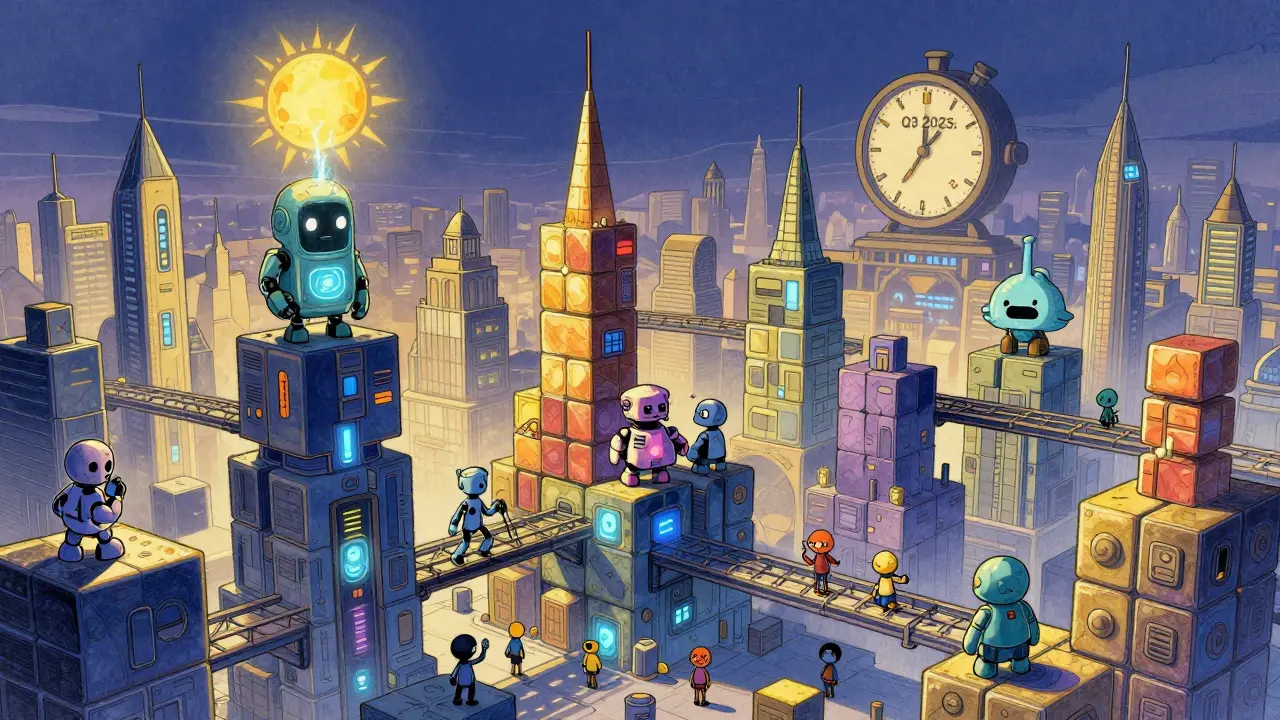
AWE is not just another cryptocurrency-it’s a blockchain project built around something most people haven’t even heard of yet: Autonomous Worlds. These aren’t virtual worlds you explore like in a video game. They’re persistent, living digital environments powered by AI agents that think, act, and evolve on their own. Think of them as digital ecosystems where thousands of AI entities work together, solve problems, and even create their own economies-all verified and recorded on the blockchain.
What Exactly Is AWE Network?
AWE Network started in 2019 as STP Network, a simple decentralized governance platform. But in 2023, the team made a radical shift. They realized the future wasn’t just about voting on proposals or trading tokens-it was about creating self-sustaining digital worlds run by AI. So they rebranded, switched from $STPT to $AWE, and launched a completely new vision: the world’s first scalable platform for Autonomous Worlds.
The $AWE token is the fuel for this entire system. It’s used to pay for agent interactions, vote on protocol upgrades, stake for network security, and earn rewards for contributing to the ecosystem. Unlike Bitcoin or Ethereum, where the main use case is money transfer, AWE is about enabling AI agents to operate in a shared, transparent, and persistent digital space.
How Does AWE Work?
AWE runs on the Base blockchain, which is a Layer 2 solution built on Ethereum. That means transactions are faster and cheaper than on Ethereum’s main network. This is critical because Autonomous Worlds require constant communication between AI agents-sometimes thousands of interactions per second. If every action cost $5 in gas fees, the whole thing would collapse.
The core technology behind AWE is called the Autonomous Worlds Engine. It’s a modular framework that lets developers build persistent environments where AI agents can:
- Collaborate on tasks like simulating climate change or economic markets
- Adapt their behavior based on real-time data and past actions
- Interact with humans and other agents simultaneously
- Have their actions permanently recorded on the blockchain
There’s also World.Fun, a public platform where anyone can explore or create their own Autonomous Worlds. Some worlds are simple simulations. Others are complex economic models used by researchers at Stanford and MIT.
Why Is AWE Different From Other Crypto Projects?
Most blockchain projects fall into two categories: DeFi (finance) or Metaverse (virtual real estate). AWE doesn’t fit neatly into either.
- The Sandbox (SAND) and Decentraland (MANA) let you buy virtual land and build buildings. AWE lets you build AI agents that live, learn, and work on that land.
- Fetch.ai (FET) focuses on individual AI agents doing tasks like booking travel or trading goods. AWE is about teams of agents working together in a shared world over time.
AWE’s biggest edge is its focus on scale and persistence. Other AI-blockchain projects might have one or two agents doing simple jobs. AWE aims for hundreds or thousands of agents operating in the same environment, making decisions, remembering past interactions, and evolving.
Market Data and Token Supply
As of September 2024:
- Total AWE supply: 2,000,000,000 tokens
- Circulating supply: 1,942,419,283 tokens
- Market cap: ~$144 million
- Trading volume (24h): Between $25 million and $185 million, depending on the exchange
- Trading pairs: Available on Binance, Coinbase, MEXC, and other major platforms
With over 97% of tokens already in circulation, there’s very little left to be mined or released. Most of the remaining tokens are reserved for ecosystem development, team incentives, and future grants.

Who Uses AWE?
AWE isn’t for casual crypto traders. It’s for developers, researchers, and AI engineers.
On Reddit, a user named AIBlockchainDev built a multi-agent simulation that ran for 14,000+ blockchain transactions without breaking. That’s impressive-but it took months of work. Meanwhile, a new investor named CryptoNewb99 admitted they couldn’t figure out how to interact with the agents because the documentation assumed you already knew how AI frameworks work.
Trustpilot reviews show a clear split:
- 68% of positive reviews praise the vision and technical depth
- 73% of negative reviews say it’s too complex for non-technical users
Academic institutions are the most active adopters. Stanford researchers are using AWE to model climate change impacts. MIT is testing how AI agents negotiate resource allocation in simulated economies. These aren’t speculative bets-they’re real scientific experiments.
How to Get Started With AWE
If you’re a developer, here’s how to begin:
- Set up a Base-compatible wallet (like MetaMask configured for Base)
- Buy AWE tokens on Binance, Coinbase, or a decentralized exchange on Base
- Visit the official GitHub repository (1,247 commits as of September 2024)
- Study the documentation and join the Discord server (14,328 members)
- Start small: build a single agent that responds to price changes or weather data
Expect a steep learning curve. Developer surveys rate the difficulty at 7.2 out of 10. You need to understand:
- Blockchain development (Solidity or similar)
- AI agent frameworks (like LangChain or AutoGen)
- How decentralized applications (dApps) work
Most experienced developers say it takes 40 to 60 hours just to get comfortable.
What’s Next for AWE?
The roadmap is aggressive and focused on scaling:
- Q4 2024: Cross-chain agent interoperability (agents can move between blockchains)
- Q1 2025: Advanced agent learning protocols (agents improve over time without human input)
- Q3 2025: AWE Mainnet 2.0 upgrade (full decentralization and enhanced security)
They’ve already integrated Chainlink oracles to pull real-world data into AI worlds-like stock prices, weather, or traffic patterns. This turns simulations from theoretical models into live, data-driven experiments.
Is AWE a Good Investment?
Price predictions vary wildly:
- PricePrediction.net forecasts $0.1692 by end of 2025 (217% increase)
- Messari’s base-case estimate: $0.096-$0.122 by 2030
- Standard Chartered: $0.078-$0.105, citing high execution risk
But here’s the catch: AWE isn’t a stock. It’s infrastructure. You’re not buying a product-you’re betting on the future of AI and blockchain convergence.
If autonomous agents become common in research, logistics, or even customer service, AWE could be the backbone. But if the tech proves too complex, too slow, or too niche, it could fade into obscurity.
Analysts at Delphi Digital call it “one of the few projects building foundational infrastructure for AI-blockchain convergence.” That’s high praise. But MIT’s Dr. Alan Chen warns: “Synchronizing hundreds of autonomous agents on a blockchain? We’re still figuring out if that’s even possible at scale.”
The Big Risks
AWE has three major challenges:
- Technical Feasibility: No one has proven you can run thousands of AI agents in sync on a blockchain without lag or failure.
- Adoption Barrier: Most people don’t understand AI agents, let alone want to interact with them.
- Regulation: No government has rules for AI agents that make economic decisions. What if an agent trades tokens and loses money? Who’s liable?
Deloitte’s May 2024 analysis flagged AWE as a potential regulatory gray zone. If an AI agent on AWE generates income, is it a security? A commodity? A new asset class? No one knows yet.
Final Thoughts
AWE isn’t trying to be the next Bitcoin. It’s not aiming for retail investors. It’s a bet on a future where AI agents aren’t just tools-they’re participants in digital economies. Right now, that future is mostly in labs and GitHub repositories. But if it works, AWE could become as foundational as Ethereum was for smart contracts.
If you’re a developer, researcher, or deeply curious about AI, AWE is worth exploring. If you’re looking for a quick crypto flip, walk away. This isn’t a trading pair-it’s a long-term experiment in digital evolution.




Bradley Cassidy
December 17, 2025 AT 06:35who even designs this stuff??
Elvis Lam
December 18, 2025 AT 03:24George Cheetham
December 18, 2025 AT 15:33Donna Goines
December 19, 2025 AT 17:38Dionne Wilkinson
December 20, 2025 AT 20:03Cheyenne Cotter
December 21, 2025 AT 06:42Kelsey Stephens
December 22, 2025 AT 05:17SeTSUnA Kevin
December 23, 2025 AT 09:26Craig Nikonov
December 25, 2025 AT 05:31Heather Turnbow
December 26, 2025 AT 02:44Jonny Cena
December 27, 2025 AT 20:45Shruti Sinha
December 29, 2025 AT 19:06Tom Joyner
December 30, 2025 AT 14:38Emma Sherwood
December 31, 2025 AT 00:43Kayla Murphy
December 31, 2025 AT 21:11Terrance Alan
January 2, 2026 AT 10:21Timothy Slazyk
January 2, 2026 AT 22:39Chevy Guy
January 4, 2026 AT 10:55Samantha West
January 4, 2026 AT 19:25Greg Knapp
January 6, 2026 AT 05:14Rebecca Kotnik
January 7, 2026 AT 19:56Sean Kerr
January 9, 2026 AT 10:06one agent asked if it could pay in hugs
i said no
it cried
now i feel bad 😭
Sally Valdez
January 10, 2026 AT 16:06Sue Bumgarner
January 11, 2026 AT 20:25Jack Daniels
January 12, 2026 AT 19:45