
Imagine waking up to find your digital savings locked behind a government-mandated time window, or worse, seeing your stablecoins frozen because they touched an address flagged by a foreign intelligence agency. For Iranian citizens navigating the cryptocurrency market in 2025 and into 2026, this isn't a hypothetical scenario-it's daily reality. The landscape has shifted dramatically from relative tolerance to strict control, driven by geopolitical tensions, domestic economic pressures, and aggressive international enforcement.
If you are an Iranian trader, investor, or simply someone trying to preserve wealth against inflation, understanding these new rules is critical. You aren't just dealing with market volatility anymore; you're navigating a complex web of regulatory bans, trading hour limits, and sanctions-driven asset freezes. This guide breaks down exactly what has changed, why it happened, and how users are adapting to keep their funds accessible.
The Great Shutdown: When Payment Gateways Closed
The turning point arrived in early January 2025. Without much warning, the Central Bank of Iran (CBI) ordered the closure of rial payment gateways for all domestic cryptocurrency exchanges. This wasn't a minor tweak; it was a hard stop on the primary method Iranians used to move money between bank accounts and crypto wallets. The CBI cited rampant tax evasion and non-transparent financial statements among exchange operators as the primary drivers.
Before this shutdown, exchanges like Nobitex, which served over 11 million users, were operating at billions of dollars in transaction volume. Yet, many operators remained non-compliant with local tax obligations. By cutting off the fiat rails, the government effectively forced a reckoning. While mining remains legal, using digital assets for direct payments is strictly banned. The message from Tehran was clear: if you want to trade, you must do so within a framework that allows the state to see every transaction.
The Nobitex Hack and Trading Hour Bans
If the gateway shutdown was a policy shift, the June 18, 2025 cyberattack on Nobitex was the catalyst for stricter operational controls. This politically motivated hack resulted in losses exceeding $90 million. In response, the regime didn't just tighten security protocols; they imposed unprecedented trading restrictions. Domestic exchanges were prohibited from operating between 8:00 PM and 10:00 AM local time.
This 14-hour trading window (10:00 AM to 8:00 PM) created immediate chaos. Users rushed to execute trades before the cutoff, causing liquidity crunches and price spikes. For instance, Tether (USDT) prices surged to over 12,000 Toman as panic set in. These measures were framed as security protocols, but industry observers saw them as attempts to curb the sector's threat to state authority. The restriction forces users to concentrate their activity into a narrow timeframe, limiting their ability to react to global market movements that happen overnight.
International Enforcement: The USDT Freeze
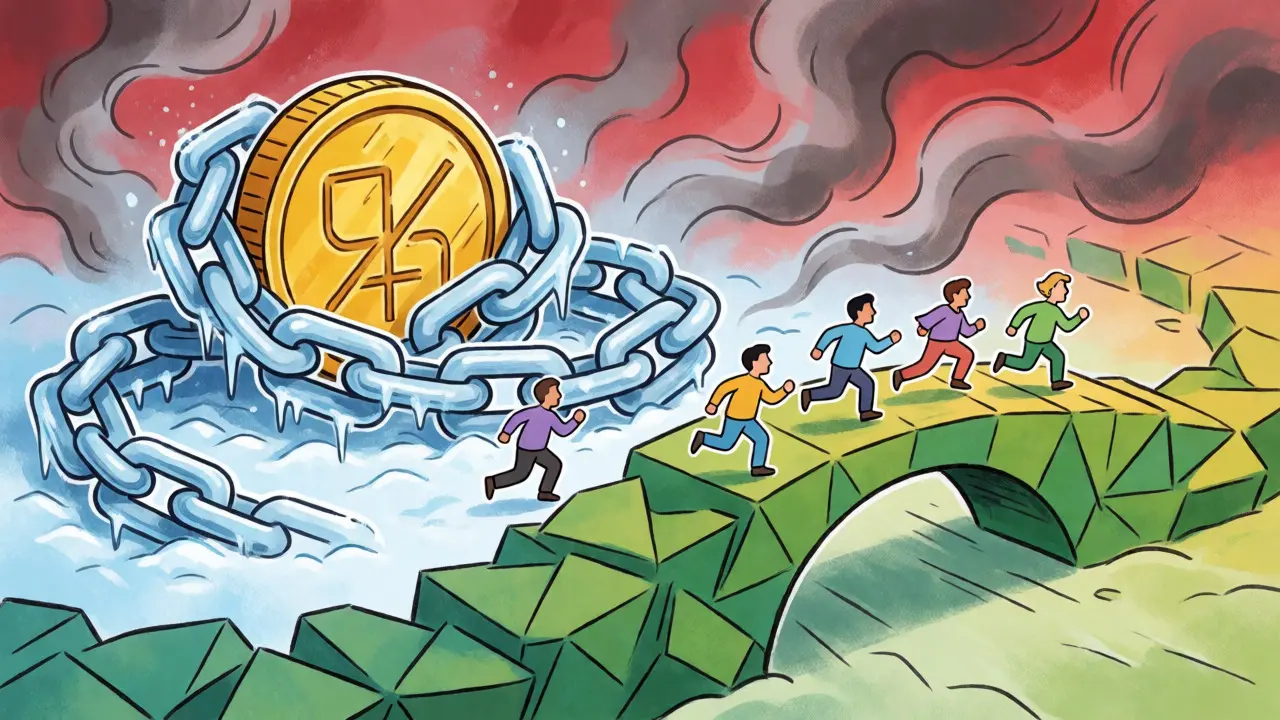
Domestic rules are only half the battle. International enforcement actions have severely complicated access for Iranian users. On July 2, 2025, Tether executed its largest-ever freeze of Iranian-linked funds, targeting 42 cryptocurrency addresses. Many of these wallets had transactional flows linked to Nobitex or addresses previously flagged by the Israeli National Bureau for Counter Terrorist Financing as affiliated with the Islamic Revolutionary Guard Corps (IRGC).
This action disrupted established settlement patterns. Suddenly, holding USDT became risky for anyone with even indirect ties to sanctioned entities. To maintain access to liquid digital assets, many Iranian users began migrating toward alternative stablecoins like DAI via the Polygon network. This shift highlights the agility of retail participants who are constantly seeking ways to bypass both domestic and international chokepoints.
| Method | Risk Level | Accessibility | Key Restriction |
|---|---|---|---|
| Domestic Exchanges (e.g., Nobitex) | High | Limited (10 AM - 8 PM) | No Rial payment gateways; Tax reporting mandatory |
| USDT (Ethereum/Tron) | Very High | Moderate | Address freezes by issuer; Sanctions screening |
| DAI (Polygon Network) | Moderate | High | Lower liquidity than USDT; Requires DeFi knowledge |
| P2P Trading | Medium | Variable | Counterparty risk; Regulatory scrutiny on large volumes |
New Tax Laws and State Control
In August 2025, the Iranian government enacted the Law on Taxation of Speculation and Profiteering. This legislation introduced a capital gains tax on cryptocurrency trading for the first time, positioning digital assets alongside gold, real estate, and foreign exchange. The goal was twofold: to monetize the booming crypto market and to establish mechanisms for enhanced oversight.
The phased implementation suggests the government recognizes the economic significance of crypto while aiming to prevent large-scale tax evasion. However, this also means that every profitable trade now carries a potential tax liability, adding another layer of complexity for individual traders who may lack the accounting resources to track their costs accurately.

Sanctions Evasion Networks Under Fire
It’s important to understand that these restrictions aren't happening in a vacuum. They are part of a broader cat-and-mouse game involving international sanctions. In September 2025, the U.S. Treasury Department’s Office of Foreign Assets Control (OFAC) designated a $600 million Iranian shadow banking network. This network utilized cryptocurrency to launder over $100 million in oil proceeds for Iran's military through international front companies.
Blockchain intelligence firms like Elliptic identified Nobitex not just as an exchange, but as critical infrastructure within Iran's cross-border sanctions evasion apparatus. TRM Labs documented an 11% decline in cryptocurrency inflows to Iran during the first half of 2025, attributing this drop to the combined effects of international enforcement, domestic restrictions, and reduced user confidence. For the average citizen, this means that even personal transactions can get caught in the net if they touch wallets associated with these larger networks.
How Iranian Users Are Adapting
Despite the tightening noose, crypto continues to serve as a practical alternative for Iranians facing high inflation and limited access to global financial systems. The adaptation strategies observed in late 2025 offer a glimpse into the future:
- Diversification of Stablecoins: Moving away from USDT to DAI or other less centralized stablecoins to reduce the risk of issuer-led freezes.
- Network Migration: Shifting activity to lower-cost, faster networks like Polygon to minimize fees and increase speed during the restricted trading hours.
- Peer-to-Peer (P2P) Growth: Increasing reliance on P2P platforms where users can negotiate terms directly, though this comes with higher counterparty risk.
- Self-Custody: A growing trend of moving funds off exchanges entirely to private wallets to avoid exchange-level freezes or hacking risks.
The sophistication of both regulatory measures and user adaptation strategies suggests this dynamic will continue. Authorities are balancing the need to control capital flows and prevent tax evasion with the desire to preserve state-level utility of digital assets for international transactions. For civilians, the tension between regulatory control and economic necessity remains unresolved.
Can Iranian citizens legally own cryptocurrency?
Yes, owning cryptocurrency is generally permitted. However, using it for payments is banned, and trading is subject to strict regulations, including licensing requirements for exchanges and new capital gains taxes.
What are the current trading hours for Iranian exchanges?
Following the 2025 security incidents, domestic exchanges are typically restricted from operating between 8:00 PM and 10:00 AM local time, leaving a 14-hour window for active trading.
Why did Tether freeze Iranian addresses?
Tether froze addresses linked to entities suspected of supporting sanctions evasion, particularly those connected to the Islamic Revolutionary Guard Corps (IRGC) or flagged by international monitoring bodies.
Is mining cryptocurrency legal in Iran?
Yes, mining remains legal in Iran, provided miners obtain the necessary licenses and adhere to energy consumption regulations set by the government.
How has the tax law affected crypto traders?
The Law on Taxation of Speculation and Profiteering introduced capital gains tax on crypto profits, treating digital assets similarly to other speculative investments like gold or real estate.





Kathryn Haber
September 2, 2026 AT 13:15its wild how we think freedom is just a switch you flip but really its more like a cage that gets smaller every time you try to fly out of it they lock the doors at night and call it security while we starve for liquidity during the day its not about money anymore its about who holds the leash
Eugene McGrath
September 4, 2026 AT 02:27Look, I get it. The regime is tightening the screws on the domestic exchanges because they can't handle the volatility or the lack of tax compliance. But blaming Tether freezes for everything is lazy analysis. If your address was linked to IRGC flows via Nobitex, you were asking for trouble. OFAC doesn't play games with sanctions evasion networks. You want to trade? Use DAI on Polygon like everyone else who actually understands on-chain privacy vs issuer risk. Stop crying about USDT when the issuer literally froze your funds due to KYC/AML triggers. It's basic compliance failure.
Abid Bhatti
September 5, 2026 AT 06:54They aren't trying to stop inflation. They are trying to stop you from leaving. The trading hours restriction isn't about security after the hack; it's about surveillance windows. By forcing all trades into a 14-hour block, they create artificial pressure spikes that make it easier to monitor large volume movements. The 'hack' was likely an inside job to justify the lockdown. Now that everyone is panicked, they implement the capital gains tax quietly. It’s a coordinated squeeze between Tehran and Washington to keep the Iranian middle class trapped in a digital goldfish bowl where every splash is recorded.
Paige Ray
September 7, 2026 AT 00:00This sounds incredibly stressful for anyone trying to preserve their savings against such high inflation rates. The uncertainty must be exhausting.
Kathy Siew
September 7, 2026 AT 02:08honestly the shift to dai on polygon is smart but ppl forget gas fees still hit u if ur not careful
also the tax law is gonna be a nightmare to track without proper accounting software which most retail traders dont have so good luck with that mess
Brittany Ross
September 8, 2026 AT 13:42Wow, this is so heavy 😔
The idea that you can lose access to your own money just because of a timestamp feels so unfair 🕒💸
I hope people find safe ways to store their wealth 💎🙌
Maegan Rust
September 9, 2026 AT 01:31It’s fascinating-and heartbreaking-to see how resilient these communities are.
Migrating to decentralized stablecoins like DAI shows such incredible adaptability in the face of centralized chokepoints.
We often take our banking systems for granted, but for them, every transaction is a negotiation with power structures.
Supporting self-custody education is key here because knowledge truly becomes armor in this environment.
Harish Ramaiah
September 11, 2026 AT 09:37Sigh... 😩
Why do governments always ruin everything? 🏛️
First the hacks, then the bans, now taxes?! 📉
It’s never enough for them, is it? 🤷♂️
We just want to save our money! 💰😢
Jennifer Brosnan
September 13, 2026 AT 00:53While the article presents a sympathetic view, let's be real: if you're using crypto to bypass sanctions, you're part of the problem. The USDT freeze wasn't arbitrary; it was precise targeting of illicit flows. Blaming 'geopolitics' ignores the fact that many Iranian users are complicit in laundering schemes. The new tax laws are simply catching up to reality. If you can't navigate complex compliance, maybe stick to gold. Don't expect Western financial infrastructure to tolerate shadow economies indefinitely.
Idowu Emmanuel
September 14, 2026 AT 15:59I appreciate the detailed breakdown. It reminds me of similar challenges we face in Nigeria with FX controls. The move towards P2P and self-custody is definitely the right path forward. Stay strong to all the traders navigating this difficult landscape. We are learning from your resilience!
Finlay Samms
September 14, 2026 AT 22:34Interesting read. 👀
The migration to Polygon makes sense given the fee structure. 📉
Though I wonder if DAI will face similar scrutiny eventually? 🤔
Decentralization is hard when the entry points (on-ramps) are so controlled. 🚧
lea terrade
September 15, 2026 AT 03:17is it really control or is it just incompetence masked as policy? i mean if they wanted total control why allow mining at all? seems contradictory unless the state needs the energy grid load balanced or something deeper is happening behind the scenes regarding oil proceeds routing
Rachel Leet
September 16, 2026 AT 19:48Most people misunderstand the core issue here. It isn't about 'freedom' versus 'control'. It is about liquidity fragmentation.
When you restrict trading hours, you destroy market depth.
Spreads widen.
Slippage kills profits.
Those who survive are those who understand order flow mechanics, not those who cry about 'rights'.
The elite know this; the retail crowd does not.
Adaptation requires technical skill, not emotional reaction.
John Lewis
September 18, 2026 AT 04:11To add some context, the shift to DAI on Polygon is indeed popular, but users should be aware of the bridge risks involved. Moving assets off Ethereum mainnet introduces additional smart contract vulnerabilities. Also, regarding the tax law, the definition of 'profit' can be tricky with volatile assets. Cost basis tracking is essential. I recommend looking into tools specifically designed for multi-chain cost basis reporting, as standard spreadsheets often fail with frequent small transactions typical in P2P markets.
Sophie Fitzgerald
September 19, 2026 AT 06:37The situation is quite challenging. It seems like there are limited options available. Self-custody appears to be the safest route for now.
Ritchie Grogg
September 20, 2026 AT 16:30Man, reading this makes my stomach turn. Imagine waking up and your life savings are frozen because some agency in another country flagged your wallet. That's terrifying. And having to trade only during the day? Like, what if the global market moves while you're asleep? You're just exposed to overnight gaps. It feels like being handcuffed to a desk. Hope everyone stays sane through this chaos.
Alexander James
September 22, 2026 AT 01:06It is morally reprehensible that ordinary citizens are punished for the actions of their government's military-industrial complex!
These families are trying to eat, to live, to breathe!
And yet, they are treated as criminals by both their own state and foreign powers?
Where is the justice? Where is the mercy?
We must demand accountability for this humanitarian crisis disguised as financial regulation!
Mary Burnett
September 22, 2026 AT 11:56Thank you for providing this comprehensive overview. The regulatory environment described is indeed complex and restrictive. It is important to note that legal counsel should be sought regarding the specific implications of the new tax laws, as interpretations may vary based on individual circumstances. The transition to alternative stablecoins represents a pragmatic approach to mitigating counterparty risk.