
Imagine running a cryptocurrency business where the rules are clear, the taxes are low, and the government actually wants you there. For years, this was a fantasy for most digital asset founders. But in 2026, it’s the daily reality for thousands of companies operating out of the United Arab Emirates. If you’re tired of guessing whether your next trade will trigger a regulatory crackdown or if your startup might get banned overnight, the UAE offers something rare: stability.
The country has transformed from a loose playground for speculators into a tightly regulated, globally respected financial center. This shift isn’t just about attracting money; it’s about building infrastructure. With major exchanges like Binance and Bybit setting up shop, and regulators like VARA issuing licenses that mean something on the world stage, the UAE has positioned itself as the go-to hub for serious blockchain players. But how does it work? And more importantly, what does it cost to play here?
Why the UAE Became the Default Choice for Crypto Firms
You might wonder why so many firms chose the desert over Silicon Valley or London. The answer lies in three things: clarity, speed, and geography. In many Western jurisdictions, crypto regulation is still a patchwork of lawsuits and vague guidance. In the UAE, the government decided to write the rulebook first. They didn’t wait for the industry to mature; they built the lanes for the cars to drive in.
This proactive approach means that when you apply for a license, you know exactly what you’re getting. There’s no mystery. The Securities and Commodities Authority (SCA) and the Central Bank of the UAE (CBUAE) oversee federal activities, while specialized bodies handle specific zones. It sounds complex, but for a business owner, it’s actually simpler than navigating inconsistent local laws elsewhere. You pick your lane, you follow the rules, and you operate with legitimacy.
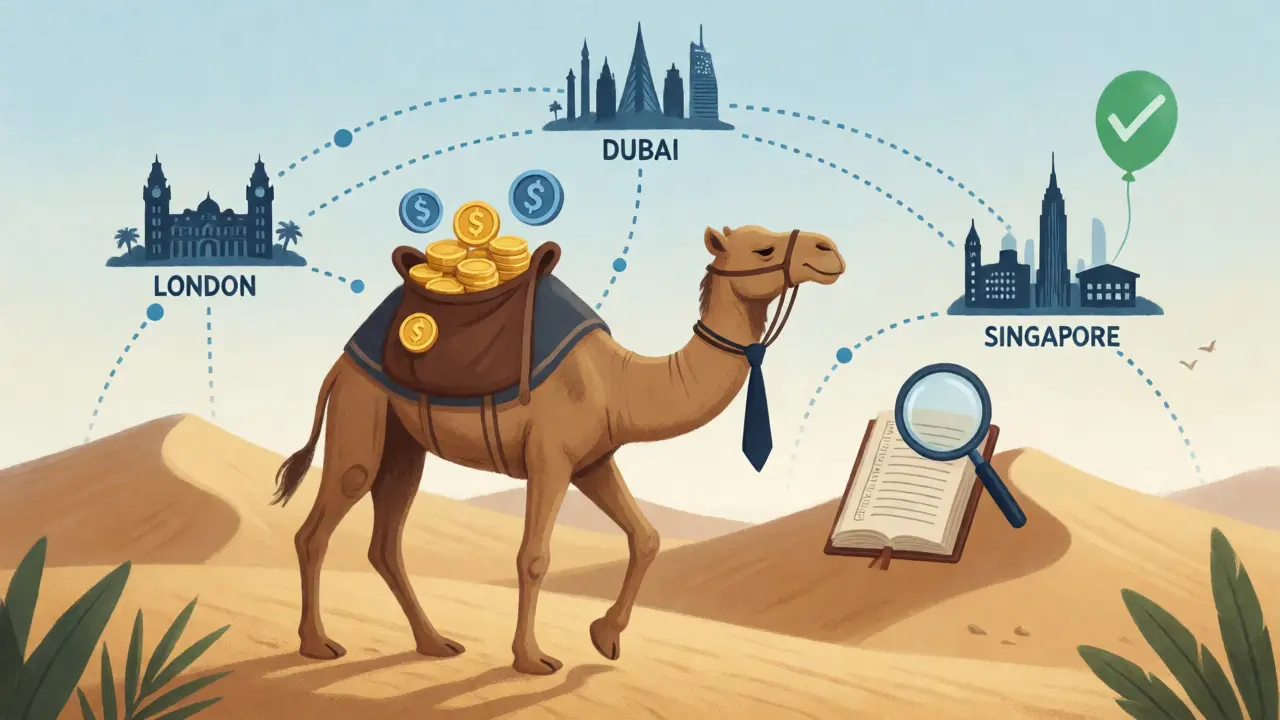
Geography plays a huge role too. Sitting at the crossroads of Asia, Europe, and Africa, the UAE allows firms to serve clients in emerging markets without being hours behind in time zones. When the Asian markets open, your team in Dubai is already awake. When London opens, you’re still within working hours. This operational efficiency reduces friction for trading desks and customer support teams alike.
Navigating the Regulatory Maze: Who Governs What?
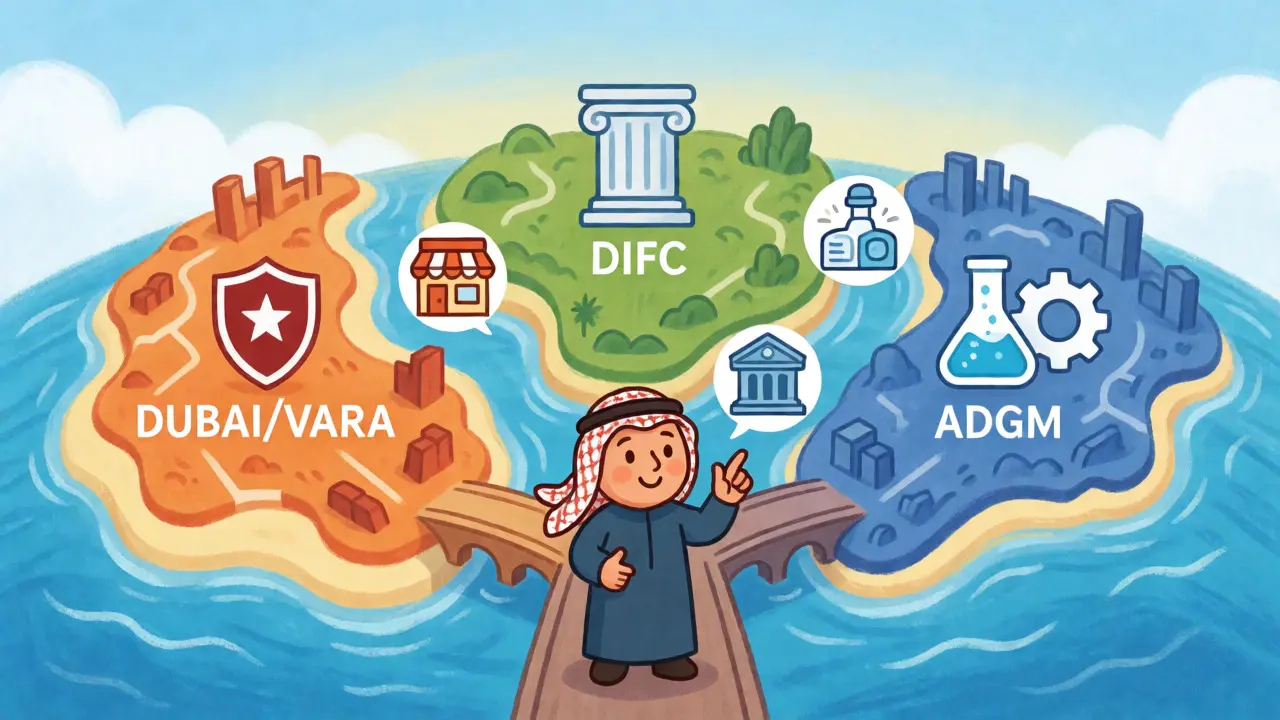
One of the biggest misconceptions about the UAE is that there’s one single crypto regulator. That’s wrong. The system is multi-layered, which can be confusing if you don’t know where to look. Think of it like choosing a neighborhood in a big city. Each area has its own council, but all roads lead to the same highway.
At the federal level, the CBUAE handles payment tokens-think stablecoins used for transactions. The SCA manages investment-grade assets, like security tokens that act like stocks. Then you have the free zones, which is where most international businesses land.
| Jurisdiction | Primary Regulator | Best For | Key Feature |
|---|---|---|---|
| Dubai (Mainland) | VARA | Retail exchanges, wallets, custody | Dedicated virtual asset law |
| DIFC | DFSA | Institutional investors, funds | Common law framework |
| ADGM | FSRA | Fintech startups, token issuance | Flexible sandbox environment |
If you’re running a retail exchange serving everyday users, you’ll likely deal with the Virtual Assets Regulatory Authority (VARA) in Dubai. VARA was established specifically because existing regulators couldn’t keep up with the pace of innovation. They created a bespoke licensing regime that covers everything from broker-dealer services to token issuance. If you’re an institutional player managing billions in assets, the Dubai Financial Services Authority (DFSA) in the DIFC might be a better fit, offering a common-law legal system that appeals to Western investors.
Don’t overlook Abu Dhabi. The Financial Services Regulatory Authority (FSRA) in the Abu Dhabi Global Market (ADGM) has been aggressive in attracting fintech. They offer a regulatory sandbox that lets you test new products before fully launching them. For early-stage Web3 projects, this flexibility is gold.
The Real Cost of Doing Business: Licensing Fees & Capital
Let’s talk money. Getting a license isn’t cheap, but it’s transparent. Unlike some jurisdictions where fees are hidden or arbitrary, the UAE publishes its costs upfront. This predictability helps with cash flow planning.
To get a VARA license, you need paid-up capital ranging from AED 100,000 to over AED 1.5 million ($27,000 to $408,000 USD), depending on your activity. Exchange services sit at the higher end because they hold user funds. Wallet providers might need less. Application fees start around AED 40,000, but annual supervision fees can hit AED 200,000. These numbers aren’t small, but they buy you credibility. When you show a bank account statement with these fees paid, banks take you seriously. You’re not just another fly-by-night crypto shop; you’re a licensed entity.
Beyond fees, you need robust compliance frameworks. Expect to hire compliance officers who understand both traditional finance and blockchain tech. You’ll need technology audits to prove your security standards meet VARA’s stringent requirements. Insurance is mandatory. Record-keeping must be impeccable. These operational costs add up, but they filter out weak competitors. If you can afford the setup, you’re likely serious enough to survive market downturns.
Tax Efficiency: The Hidden Advantage
Here’s the part that gets everyone excited: taxes. For a long time, the UAE had zero income tax and zero corporate tax. Things changed recently, but for crypto, the news is still good.
As of late 2024, most virtual asset transactions are exempt from the standard 5% VAT. This is a massive win. Imagine paying 5% on every swap or transfer. Now imagine not paying it. Your margins improve instantly. While the UAE introduced a 9% corporate tax for large enterprises, many free zone entities can still benefit from exemptions if they meet specific criteria. Always check with a local tax advisor, but generally, the effective tax rate remains significantly lower than in the US or EU.
However, transparency is coming. The Crypto-Asset Reporting Framework (CARF) kicks in fully by 2028. Starting January 1, 2027, exchanges and custodians must report detailed data on trades, balances, and customer identities to tax authorities. This aligns the UAE with global standards set by the OECD. It’s not a tax hike; it’s a reporting requirement. It prevents tax evasion and reassures institutional investors that the ecosystem is clean. If you’re building a long-term brand, this transparency is a feature, not a bug.
Market Trends: From Speculation to Utility
The UAE isn’t just hosting speculative traders anymore. The focus has shifted to real-world utility. Look at the rise of Real-World Asset (RWA) tokenization. Projects are turning property deeds, commodities, and even carbon credits into digital tokens. Why? Because it makes illiquid assets tradable 24/7.
Dubai’s real estate sector is experimenting with tokenized ownership. Instead of buying a whole apartment, you might buy a fraction via a blockchain token. This lowers the barrier to entry for foreign investors. Similarly, the energy sector is using blockchain to track green energy certificates. These use cases attract institutional money, which brings stability to the market.
Major players like BitGo and Laser Digital have set up institutional custody solutions in the region. This signals trust. When big banks feel safe holding Bitcoin in a UAE vault, retail confidence follows. The ecosystem is maturing from a casino to a financial district.
Challenges to Watch Out For
It’s not all sunshine and sand dunes. The multi-jurisdictional approach creates complexity. Choosing between VARA, DFSA, and FSRA requires legal expertise. Pick the wrong one, and you might find yourself restricted from certain activities later. Changing jurisdictions mid-stream is expensive and slow.
Compliance is rigorous. Anti-money laundering (AML) checks are strict. You cannot cut corners on Know Your Customer (KYC) procedures. The SCA conducts enhanced due diligence on all applicants. If your source of funds looks murky, expect delays. Also, while the tax environment is friendly, the CARF implementation will require significant IT upgrades. Your systems need to capture granular transaction data automatically. Manual spreadsheets won’t cut it by 2027.
Finally, competition is heating up. Other hubs like Singapore and Switzerland are fighting back with their own incentives. The UAE’s advantage is speed and government backing, but you need to move fast to secure prime office space and talent. The best engineers and compliance experts are getting snapped up quickly.
Next Steps for Founders
If you’re considering moving operations to the UAE, start with a jurisdiction audit. Map your business model against the capabilities of VARA, DFSA, and FSRA. Don’t guess; consult a specialist lawyer who knows the nuances of each free zone.
- Audit your structure: Determine if you need a mainland license or a free zone entity.
- Budget for compliance: Factor in AED 100k+ for initial setup and ongoing legal fees.
- Prepare for CARF: Upgrade your tech stack now to handle automated reporting by 2027.
- Hire locally: Bring in compliance staff who understand UAE banking norms.
The UAE has built a machine for crypto legitimacy. It’s polished, efficient, and welcoming to those who play by the rules. If you want regulatory certainty and access to global capital, this is the place to be.
Is crypto taxable in the UAE?
Currently, most individual crypto transactions are exempt from VAT and personal income tax. However, corporations may be subject to a 9% corporate tax depending on their structure and location. New reporting rules under CARF will increase transparency starting in 2027, but do not necessarily impose new taxes on individuals.
Which regulator should I choose for my crypto business?
It depends on your target audience and business model. VARA is ideal for retail-focused exchanges and wallets in Dubai. The DFSA in DIFC suits institutional investors and funds. The FSRA in ADGM is great for fintech startups and token issuers looking for flexible testing environments.
How much does it cost to get a VARA license?
Costs vary by activity type. Paid-up capital ranges from AED 100,000 to AED 1.5 million. Application fees are between AED 40,000 and AED 100,000, with annual supervision fees from AED 80,000 to AED 200,000. Additional costs include legal advice, compliance audits, and insurance.
Can foreigners own 100% of a crypto company in the UAE?
Yes, in most free zones and under specific mainland structures, foreign investors can own 100% of their business. This applies to both LLCs and free zone establishments, making it easy for international founders to retain full control.
What is the CARF framework?
The Crypto-Asset Reporting Framework is an OECD-led initiative adopted by the UAE to standardize tax reporting for digital assets. It requires crypto service providers to collect and share transaction data with tax authorities, enhancing transparency and combating tax evasion. Implementation begins in 2027.






Courtney Parker
September 11, 2026 AT 04:23Wait, you're telling me I can just move my whole life to a desert and pay zero taxes? 🤨 That sounds too good to be true. Are they actually checking where the money comes from or is it just vibes and sand? 😂
Maegan Rust
September 11, 2026 AT 17:55I love how this article paints such a vibrant picture of opportunity! It really feels like the UAE is rolling out the red carpet for digital nomads and crypto enthusiasts alike. The clarity mentioned here is so refreshing compared to the murky waters we often see in other jurisdictions. It’s like finding a bright, sunny spot after being stuck in the rain for years. ☀️✨
The emphasis on infrastructure rather than just attracting capital is key. Building lanes for cars before the traffic arrives shows such foresight. For anyone feeling overwhelmed by regulatory chaos, this sense of stability must feel like a warm hug. It’s not just about the money; it’s about the peace of mind that comes with knowing the rules won’t change overnight. This kind of environment allows creativity to flourish without the constant fear of getting shut down. Really inspiring stuff for those looking to build something lasting in the blockchain space.
lea terrade
September 11, 2026 AT 19:10i wonder though if the multi layerd system creates more confusion then clarity for smaller startups. seems like picking the wrong lane could be costly. but hey maybe thats just me overthinking it again lol
Rachel Leet
September 12, 2026 AT 17:47Let's cut through the noise. You don't choose a jurisdiction based on what sounds nice. You choose based on your specific business model and risk tolerance. VARA is for retail. DFSA is for institutional. FSRA is for experimental. If you mix them up, you fail. Period.
Most people read these articles and think 'oh, low tax!' and rush in. They forget that compliance costs are real. AED 200k a year isn't pocket change. If you aren't ready for that level of scrutiny, you shouldn't be there. The UAE isn't a playground anymore. It's a professional arena. Treat it with respect or get out.
John Lewis
September 13, 2026 AT 03:44This is a solid overview. One thing I'd add is the importance of banking relationships. Even with a license, opening a corporate bank account in the UAE can still take time due to internal KYC policies at individual banks. Don't assume the license guarantees instant access to fiat rails. Plan for a 3-6 month buffer for setup.
Sophie Fitzgerald
September 13, 2026 AT 15:03Seems pretty straightforward. Good info.
Ritchie Grogg
September 14, 2026 AT 18:21Dude, I am literally shaking reading this. Can you imagine the freedom? No IRS breathing down your neck every April? I'm already looking at flights. Seriously, my soul needs this escape. The stress of US regulations is killing me slowly. This feels like salvation. 🥺🙏
Alexander James
September 15, 2026 AT 00:48We must remember that financial stability is a moral imperative. When nations create clear frameworks, they protect the vulnerable from predatory practices. The UAE's approach isn't just about profit; it's about ethical stewardship of new technology. We have a duty to support systems that prioritize transparency and integrity over wild speculation. This is progress for humanity, not just for traders. 🌍⚖️
Mary Burnett
September 16, 2026 AT 21:48Thank you for sharing this comprehensive analysis. It provides much-needed clarity for professionals considering relocation. The distinction between the various free zones is particularly helpful for understanding the operational landscape.
Stephen McElreavy
September 18, 2026 AT 15:47From a cultural ambassador perspective, the geographic arbitrage here is fascinating. You're leveraging the GMT+4 timezone to bridge Asian liquidity pools with European market hours. It’s not just about tax havens; it’s about temporal synergy. The integration of VARA into the broader GCC financial ecosystem also signals a shift towards regional harmonization. This reduces cross-border friction significantly for pan-African and South Asian investors. Truly a masterclass in geopolitical positioning. 🌐📈
Indu Nair
September 19, 2026 AT 21:29YES! Finally someone gets it! The UAE is leading the way while others are still playing catch-up. This is exactly the optimism we need in the crypto space. Don't let the naysayers discourage you. The future is bright and it's regulated properly now. Go get those licenses! 🚀💪
Dominic Jones
September 20, 2026 AT 18:40It is worth noting... that the philosophical underpinning of this shift... represents a move from 'code is law' to 'law is code'. The state is no longer an obstacle... but an enabler. However... one must remain cautious... as regulation can sometimes stifle innovation... if applied too rigidly. Balance is key... always.
Sheryl Nelsen Hutton
September 21, 2026 AT 07:16I find myself reflecting deeply on the implications of the Crypto-Asset Reporting Framework (CARF) and its intersection with the existing VAT exemptions, which suggests a nuanced approach to fiscal policy that balances revenue generation with competitive attractiveness in the global fintech marketplace. The transition from a purely speculative environment to one focused on Real-World Asset (RWA) tokenization indicates a maturation of the sector that aligns well with traditional finance principles, potentially reducing volatility and increasing institutional adoption rates over the coming decade. Furthermore, the geographical advantage of serving multiple time zones simultaneously cannot be understated as it reduces operational latency and enhances customer service capabilities for a truly global user base. While the initial capital requirements may seem prohibitive for early-stage ventures, the long-term benefits of operating within a legally certain framework likely outweigh the short-term financial burdens, especially when considering the potential for scaling operations without the threat of sudden regulatory reversals. The emphasis on hiring local compliance talent also highlights the importance of integrating into the local economic fabric rather than simply extracting value, which fosters a more sustainable ecosystem for all stakeholders involved in the blockchain revolution.