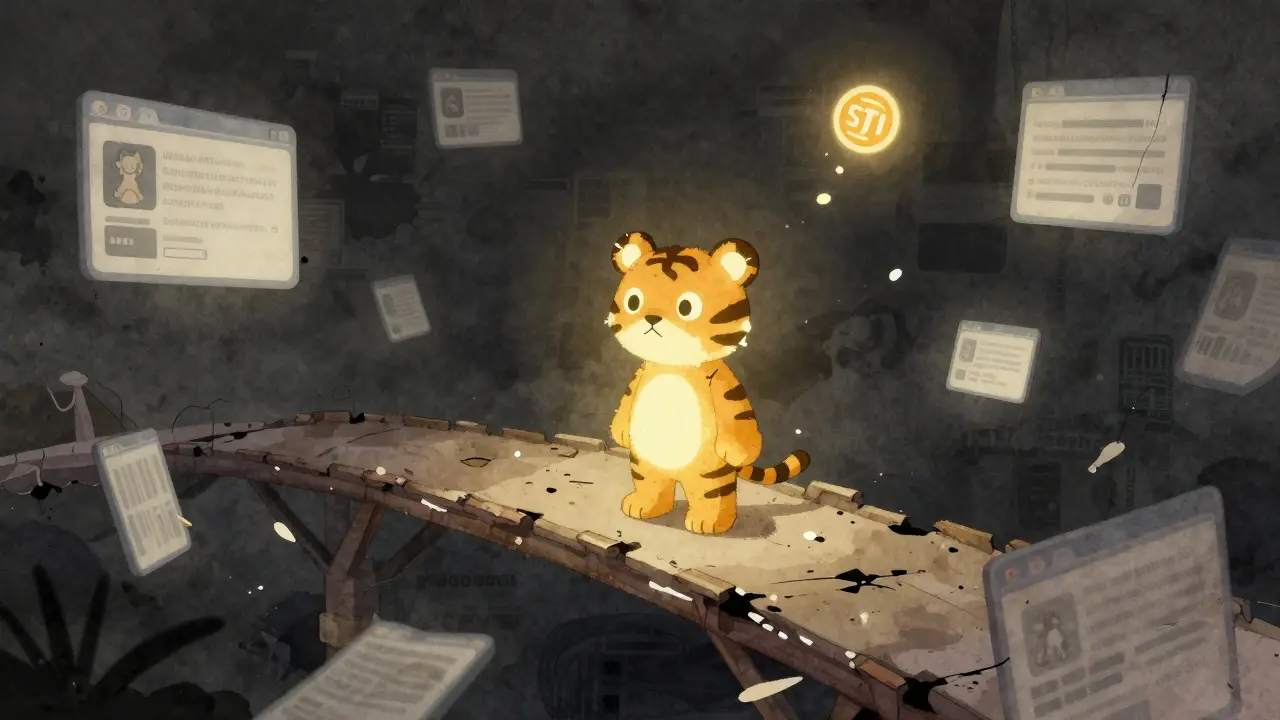
Seek Tiger (STI) was never a success story. It started with big promises - a cross-chain GameFi platform, NFT trading, a metaverse, DAO governance - but ended as a ghost in the crypto graveyard. If you're wondering what STI is today, the answer is simple: it's a token with no ecosystem, no users, and no future.
What Seek Tiger (STI) was supposed to be
Launched in February 2022, Seek Tiger positioned itself as a decentralized platform that would bring together multiple blockchain games under one roof. The idea sounded promising: play games, earn STI tokens, trade NFTs across chains, and vote on project updates through a DAO. It was built on Binance Smart Chain (BSC) as a BEP-20 token, meant to be the fuel for a new kind of gaming economy.
At its peak in April 2022, STI hit $2.52. That’s not a typo. For a few weeks, it looked like another GameFi breakout. But that peak wasn’t a sign of strength - it was a trap. The token’s value collapsed faster than most could sell. By the end of 2022, it had already lost 90% of its value. By 2025, it was trading at around $0.000068 - a 99.997% drop from its all-time high.
How STI died: No game, no users, no updates
Here’s the brutal truth: Seek Tiger never launched its promised platform. No games were built. No metaverse was created. No NFT marketplace went live. The whitepaper links are dead. The official website, seektiger.io, now shows a blank page. The Telegram group went silent in November 2023. The Twitter account hasn’t posted since 2023. GitHub? No repositories. No commits. No updates.
There’s no evidence of development. No team announcements. No roadmap revisions. Just silence. And when a crypto project goes quiet like this, it’s not a pause - it’s a funeral.
Even the trading data tells the story. As of April 2025, STI’s 24-hour trading volume was $1.53. That’s less than what a single user might spend on a coffee. Compare that to Axie Infinity (AXS), which traded over $146 million in the same period. STI isn’t just small - it’s irrelevant. It doesn’t move markets. It doesn’t move wallets. It doesn’t even move prices meaningfully.
Why no one can trade STI without losing money
If you try to buy or sell STI today, you’ll run into a wall. Because liquidity is so low, you need to set slippage tolerance above 45% just to complete a trade on PancakeSwap. That means if you buy $100 worth of STI, you could end up paying $145 in real value just to get it - and that’s before the price drops again.
Why? Because there are barely any buyers. And when there are no buyers, sellers have to slash prices just to find someone to take the tokens off their hands. That’s why the 7-day price range for STI is between $0.00006834 and $0.00006867 - it’s stuck in a death spiral. The token’s volatility is listed at 736% in 2025, but that’s not excitement - it’s chaos. It’s the noise of a dead asset trying to trick people into thinking it’s alive.

Who still holds STI? And why?
As of April 2025, only 1,842 unique wallets hold STI. That’s fewer than the number of people who attended a small crypto meetup in 2021. Most of these are likely people who bought at the peak and never sold - holding on to hope. Or worse, people who bought after the crash, thinking it was a bargain. It’s not. It’s a trap.
Reddit threads about STI are full of users calling it a “rug pull.” One user wrote: “Tried to use STI on PancakeSwap, slippage required over 45% to complete transaction.” Another said: “Worthless token, website dead, no game ecosystem ever launched.” There are no defenders. No believers. Just people who got burned.
Even CoinGecko’s community rating is 1.3 out of 5. The reviews are all one-liners: “Dead.” “Scam.” “Avoid.” No one’s defending it. No one’s buying it. No one’s using it.
Why STI failed when other GameFi projects survived
GameFi had a boom in 2021-2022. Axie Infinity, Splinterlands, Gala Games - they all had real games, real players, real revenue. They didn’t just sell tokens. They sold experiences.
Seek Tiger sold dreams. No gameplay. No mechanics. No community building. Just a token and a website that looked fancy on paper.
It didn’t adapt. When the market turned, other GameFi projects shifted from pure speculation to sustainable play-to-earn models. STI stayed frozen in time - a relic of the bubble. It had no team, no funding, no updates. And in crypto, silence equals death.
What experts say about STI today
Analysts don’t mince words. John Wu of Almost Daily Crypto called STI a “classic zombie token.” CoinDesk labeled it among the “Dying Altcoins.” CryptoSineWave’s TradingView analysis showed a “death cross” - a technical signal that means the trend is permanently down.
LBank predicts STI will drop to $0.000014 by 2026 - another 80% decline. Matthew Hyland from CryptoQuant said tokens like this have “less than 1% probability of meaningful recovery.”
And here’s the kicker: STI isn’t even on Binance. Not listed. Not coming. Not planned. You can’t buy it on any major exchange. You can only trade it on decentralized platforms like PancakeSwap - where liquidity is so thin, you’re basically gambling with your money.
Is there any reason to buy STI now?
No.
Not for trading. Not for investing. Not for gaming. Not for speculation.
There is no utility. No roadmap. No team. No future. The only reason to buy STI is if you want to lose money slowly - and you’re okay with that.
Some people say, “It’s so cheap, why not?” But cheap doesn’t mean valuable. A broken phone is cheap too. So is a dead battery. That doesn’t make them worth owning.
STI is a cautionary tale. It’s what happens when a project raises hype but delivers nothing. When the team disappears. When the website goes dark. When the community vanishes.
What you should do instead
If you’re interested in GameFi, look at projects with real users, real games, and active development. Axie Infinity still has millions of monthly players. Splinterlands runs tournaments with real prizes. Gala Games has partnerships with major studios.
Don’t chase dead coins. Don’t fall for the “it’s so cheap” trap. Don’t confuse low price with opportunity. In crypto, the safest bet is often the one you don’t make.
Final thoughts
Seek Tiger (STI) was a project that promised the future but delivered nothing. It didn’t fail because the market turned - it failed because it was never real to begin with. There’s no comeback story here. No revival. No hidden team working in the shadows.
STI is dead. And the only thing left to do is learn from it.
Dan Dellechiaie
December 27, 2025 AT 02:59STI is the crypto equivalent of a corpse wearing sunglasses and pretending it’s still at the party. 45% slippage? Bro, that’s not trading, that’s donating to the dev’s vacation fund. They didn’t build a game-they built a marketing PowerPoint and vanished. Classic rug pull with extra steps.
And don’t get me started on the ‘it’s so cheap’ crowd. You wouldn’t buy a broken toaster and call it a ‘bargain.’ Why are you doing this with a token?
Someone’s still holding this? Please tell me it’s a bot. Or a very confused grandparent.
Charles Freitas
December 28, 2025 AT 04:53Let’s be real-this isn’t a failure, it’s a public service announcement. STI was never meant to be a project. It was a pump-and-dump designed to fleece retail fools who thought ‘GameFi’ meant ‘get rich quick.’
And now people are still buying it? You’re not investing. You’re funding a graveyard. The only thing STI is good for is teaching people how not to get scammed.
Next time, read the whitepaper. Oh wait-you can’t. It’s gone. That’s the whole point.
roxanne nott
December 29, 2025 AT 12:46STI’s 24hr volume is less than my latte. That’s not a coin. That’s a meme someone forgot to delete.
And the ‘cheap’ argument? Lol. If you think low price = value, congrats-you’re the target demographic. Buy a rock. It’s got better utility.
Also, the website is blank. The team’s ghosted. The community’s dead. This isn’t a dip. It’s a tombstone.
Rachel McDonald
December 29, 2025 AT 18:00I just cried. Not because I lost money-because I used to believe in this stuff. STI had a pretty website, a slick pitch deck, and zero soul.
Now it’s just a ghost in my portfolio. I keep checking the price like it’s gonna wake up. It won’t. It’s been dead for two years.
Why do we keep doing this to ourselves? We’re the ones who keep buying the tickets to the concert after the band’s gone.
💔
Dusty Rogers
December 30, 2025 AT 17:09I’ve seen a lot of dead coins, but STI is one of the cleanest examples of a project that never even started. No code. No updates. No team. No community.
If you’re thinking of buying it, ask yourself: Would you invest in a restaurant that never opened? That’s what this is.
Walk away. Your wallet will thank you.
Kevin Karpiak
January 1, 2026 AT 05:16Why are we even talking about this? This is American crypto trash. We don’t need this junk. Real innovation happens in China and Europe. STI? A joke made by Americans who think ‘blockchain’ is just a buzzword to sell NFTs.
Stop giving this nonsense oxygen. Delete it. Block it. Ignore it.
Amit Kumar
January 1, 2026 AT 13:33Bro, this is why I tell my friends in India: don’t chase hype. STI looked like the next big thing-flashy website, whitepaper full of buzzwords, influencers screaming ‘TO THE MOON!’
But no one checked if the foundation was concrete. Just a thin layer of paint over cardboard.
GameFi isn’t dead. Bad GameFi is. STI was the latter. Learn from it. Build something real. Don’t just sell dreams.
And yes, I lost money on this too. But now I know better.
Helen Pieracacos
January 2, 2026 AT 18:10Wow. So the website is blank. The team vanished. The community is dead. And you’re still holding it?
That’s not ‘hodling.’ That’s Stockholm syndrome.
Just sell. Even for 0.000001. At least you’ll feel something besides regret.
Dustin Bright
January 3, 2026 AT 18:03man i feel you... i bought sti at $0.0002 thinking it was a steal... now i just keep it as a reminder not to chase dead coins
the slippage thing is wild... i tried to sell once and it took 12 mins and i paid 50% more just to get out
it’s like trying to leave a haunted house but the door won’t open unless you scream into the void
rip sti 🕯️
Rebecca F
January 5, 2026 AT 13:11STI is not a token. It is a symptom. A manifestation of the spiritual decay of crypto culture. We worshiped false idols built on vaporware and vanity metrics. We called it innovation. It was vanity.
The death of STI is not tragedy. It is purification.
Those who cling to it are not investors. They are mourners at a funeral they refused to attend.
Ashley Lewis
January 7, 2026 AT 04:01It is evident that Seek Tiger (STI) exhibited all the hallmarks of a non-viable project: absence of verifiable development activity, zero community engagement, and complete lack of utility. The token’s trajectory is a textbook case of speculative malfeasance.
One must conclude that its collapse was not merely market-driven, but structurally inevitable. No rational economic actor would assign value to an asset with no underlying infrastructure.
Further analysis reveals that the liquidity metrics confirm its irrelevance. The 24-hour volume of $1.53 is statistically insignificant.
Zavier McGuire
January 8, 2026 AT 00:09why do people still talk about this
i bought it at $0.0001 and thought i was smart
turns out i was just dumb
now i just stare at it in my wallet like a ghost
no updates no nothing
it’s like keeping a dead phone charger hoping it’ll work someday
Sybille Wernheim
January 8, 2026 AT 00:11hey if you’re still holding STI-you’re not alone. i was there too.
but listen-this isn’t the end of your crypto journey. learn from this. look at projects with real teams, real games, real updates.
you’ve got this. don’t give up on crypto. just stop chasing ghosts.
you deserve better than a dead token. 💪
Sheila Ayu
January 8, 2026 AT 10:28Wait-so you’re telling me the website is blank? The team hasn’t posted in over a year? The GitHub is empty? The Telegram is silent? And you’re STILL considering buying it?
Are you… trying to get scammed on purpose?
Because that’s not investing. That’s self-sabotage with extra steps.
And if you think it’s ‘cheap’-you’re not saving money. You’re just losing it slower.
Janet Combs
January 10, 2026 AT 06:33lol i saw sti on binance scan once and thought ‘hey maybe it’s a hidden gem’
then i clicked the website and it was just a white page
like… did they run out of hosting money or what
it’s sad. like finding a toy in your closet that you loved but now it’s just broken
you don’t fix it. you just… put it away
Radha Reddy
January 11, 2026 AT 12:55STI’s story is not unique. In India, we see many such projects-flashy websites, influencer promotions, then silence. The lesson? Always check for active development. Look for commits. Look for community. Look for real users.
Not hype. Not promises. Not whitepapers written in marketing jargon.
Real work. Real code. Real people.
STI had none. And that’s why it died.
Shubham Singh
January 12, 2026 AT 18:28It is a well-documented fact that STI exhibited zero technical progress post-launch. No code commits, no team disclosures, no community governance. The token’s market cap was entirely speculative, devoid of fundamental anchoring.
Furthermore, the slippage tolerance required for trading exceeds 45%, indicating a non-functional market. This is not a liquidity issue-it is a structural failure.
It is not a ‘dead coin.’ It is a monument to negligence.
Vijay n
January 14, 2026 AT 05:12STI was never real. The team was paid in ETH and disappeared. The whitepaper was written by an AI. The ‘metaverse’ was a figment of a designer’s imagination.
And now the whole thing is a ghost town. But here’s the twist-this was all planned. They knew people would buy at the peak. They knew the hype would last 3 months.
This wasn’t a failure. It was a heist.
And we were the suckers who handed them the keys.
Alison Fenske
January 15, 2026 AT 07:17i used to check sti every day like it was my ex’s instagram
hoping they’d post something
anything
but they never did
and now i just feel… weirdly sad
not because i lost money
but because i believed
and they never even tried
Grace Simmons
January 15, 2026 AT 18:45The United States has long been a breeding ground for speculative crypto ventures with no substance. STI is a perfect example of American financial recklessness. No regulatory oversight. No accountability. Just empty promises wrapped in blockchain branding.
This is not innovation. This is exploitation dressed as entrepreneurship.
Collin Crawford
January 16, 2026 AT 20:46STI’s collapse is not an anomaly. It is the logical conclusion of a market that values presentation over execution. The team did not fail-they never started.
The whitepaper was a brochure. The website was a landing page. The token was a marketing tool.
There was never a project. Only a sales pitch.
And we bought it. Hook, line, and sinker.
Jayakanth Kesan
January 17, 2026 AT 10:31stupid question but… if sti is dead, why does it still show up on pancake swap?
is it just there to trick people?
i feel like it’s like a zombie in a video game-still moves but no one’s home
weird how crypto keeps these ghosts alive just to make more people lose money
Dan Dellechiaie
January 17, 2026 AT 17:40That’s why they keep it listed. To lure in the next batch of fools. It’s not a market-it’s a trapdoor. The devs make money off the liquidity pool fees while everyone else gets drained.
Every trade on STI is a donation to the ghost team.
Don’t be the sucker who feeds the ghost.