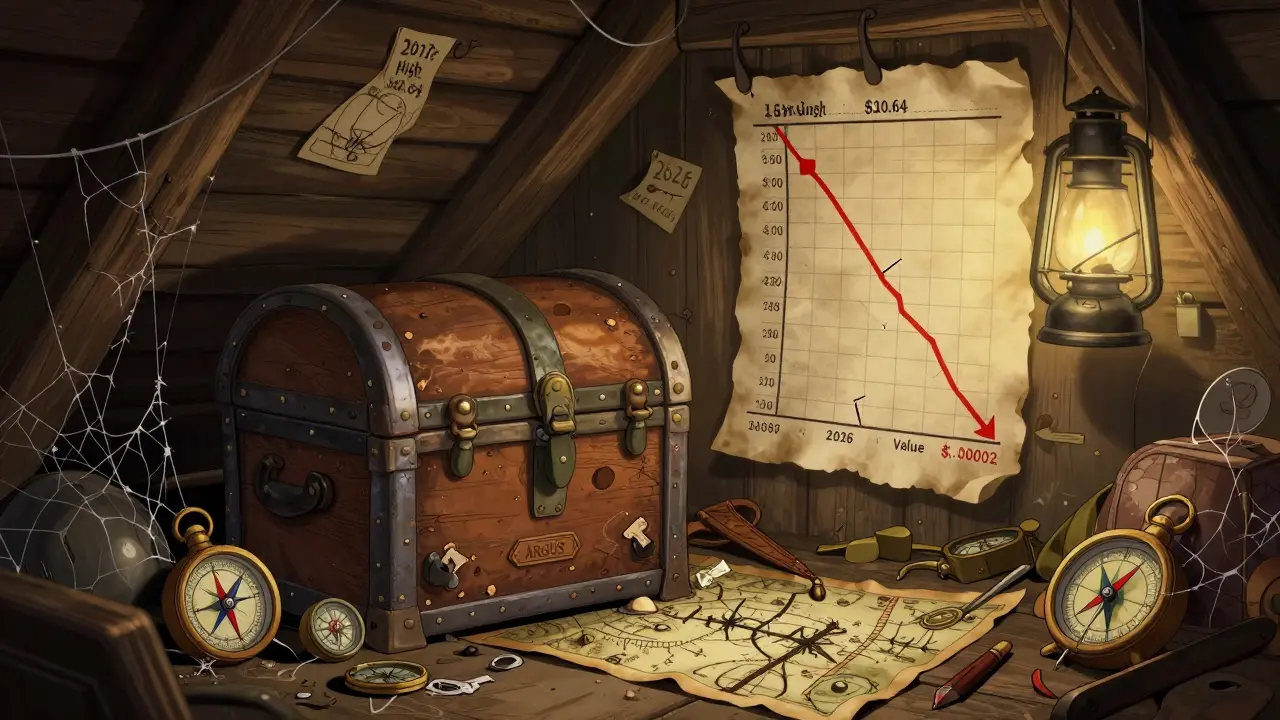
The Argus (ARGUS) cryptocurrency is one of those coins that shows up in search results but barely moves in the real world. If you're wondering whether it's worth your time, here's the straight answer: Argus is a micro-cap token with almost no trading activity, a price that’s crashed over 99.99% from its peak, and supply numbers that don’t match across platforms. This isn’t a hidden gem - it’s a cautionary tale.
What Argus (ARGUS) actually is
Argus is a blockchain-based digital currency that launched with big claims: privacy-focused transactions, instant global payments, and high scalability. It uses a Proof-of-Work mining system to generate new ARGUS tokens, meaning users can mine them using computational power. The network also supports staking, letting holders lock up their coins to help secure the blockchain and earn rewards. On paper, it sounds like it’s trying to compete with privacy coins like Monero or Zcash. But in practice, there’s little evidence anyone is using it.
Price history: From $10.64 to pennies
Argus reached its all-time high of $10.64 on February 28, 2017. That was over eight years ago. Since then, the price has collapsed. As of February 2026, most exchanges list Argus between $0.0002 and $0.001. That’s a drop of more than 99.99%. To put that in perspective: if you bought $1,000 worth of ARGUS at its peak, your investment would now be worth less than $1.
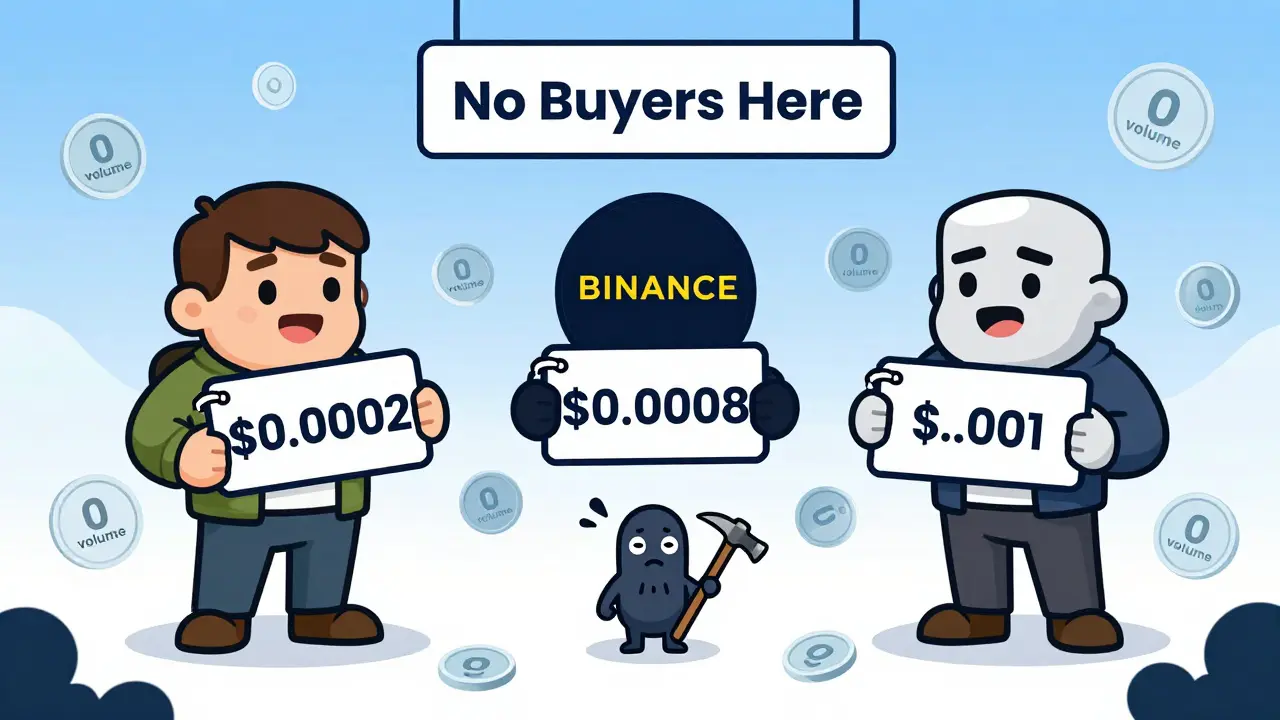
Price data varies wildly between platforms. Binance and Coinbase show it around $0.000983. Investing.com reports a 24-hour range of $0.000240-$0.000250. Bitget says it’s $0.000848. These inconsistencies aren’t just noise - they signal that there’s no real market consensus. There’s no liquidity. No volume. No buyers.
Supply numbers don’t add up
The tokenomics of Argus are confusing - and that’s a red flag.
- Total supply: Around 5,194,373 ARGUS tokens exist.
- Circulating supply: Reports vary wildly. CoinMarketCap says 1,148,324 are in circulation. CoinPaprika says the same. Bitget claims zero circulating supply.
- Maximum supply: Not clearly defined. Some sources say none. Others imply it’s capped at total supply.
- Fully diluted market cap: Around $5,104.64 - meaning if every token were sold at current price, the total value would be just over five thousand dollars.
This kind of mismatch across major platforms doesn’t happen with legitimate, active cryptocurrencies. It suggests either outdated data, poor transparency, or worse - a project that’s no longer being maintained.
Market position: Outside the top 6,500 coins
There are over 20,000 cryptocurrencies tracked by major platforms. Argus sits near the bottom.
- On CoinMarketCap: #6894
- On CoinPaprika: #6786
- On Investing.com: #6589
Compare that to Bitcoin (#1, market cap > $1 trillion) or even small coins like Dogecoin (#18, market cap > $10 billion). Argus isn’t just small - it’s practically invisible. Its market cap hovers between $0 and $1,120 depending on the site. That’s less than the cost of a decent laptop.
There’s also an unrelated token called Argus Scanner (ARGUS) ranked #14,240. This confusion isn’t helpful. It makes it harder for anyone trying to research the real ARGUS to find accurate info.
Trading volume: Almost zero
Here’s the dealbreaker: 24-hour trading volume is near $0 on Binance, CoinMarketCap, and other major exchanges. That means no one is buying or selling. If you bought Argus today, you might not be able to sell it tomorrow - even if you wanted to.
Liquidity is the lifeblood of any asset. Without it, you’re stuck. There are no market makers. No institutional interest. No institutional wallets. Just a few people holding tokens they can’t trade.
Staking and mining: Features without users
Argus offers staking rewards - meaning you can lock your coins to earn more. It also allows mining, so you can generate new tokens by running software on your computer. But without active users, these features are empty promises.
Staking only works if enough people are participating. Mining only makes sense if the network has value. Neither exists here. You could theoretically mine ARGUS, but you’d be spending electricity for a coin that no one wants to buy.
Is Argus still being developed?
The official website - argusnetwork.co - is live. The Twitter/X account (@Argus_coin) has occasional posts. But there are no recent updates on roadmaps, partnerships, or development progress. No GitHub commits. No technical whitepaper revisions. No team announcements.
Projects that are actively building usually share progress. Argus hasn’t since around 2019. That’s not just quiet - it’s dead.
Why this matters: The real risks
If you’re thinking of investing in Argus, here’s what you’re really buying:
- Extreme illiquidity: You won’t be able to sell unless you find a buyer willing to pay your price - and there are almost none.
- Price manipulation risk: With such low volume, a single large trade could crash or spike the price.
- Project abandonment: The team may have vanished. The code may be outdated. The network may be inactive.
- Scam potential: Micro-cap coins with zero volume are often targets for pump-and-dump schemes.
Argus doesn’t have a use case. No businesses accept it. No wallets prioritize it. No DeFi protocols integrate it. It’s a token with no function - just a price chart that’s been erased.
Final verdict: Avoid unless you’re speculating
Argus (ARGUS) is not a viable investment. It’s not a store of value. It’s not a payment tool. It’s not even a speculative play with traction.
There’s no reason to believe it will recover. The market has spoken - and it chose not to.
If you’re looking for crypto opportunities, focus on projects with real trading volume, active development teams, clear use cases, and market caps in the millions or billions - not thousands. Argus belongs in the graveyard of forgotten coins.
Is Argus (ARGUS) still being mined?
Yes, technically Argus still uses a Proof-of-Work mining system, meaning you can run mining software to generate new tokens. But with virtually no trading activity, no exchange listing, and no community demand, mining ARGUS serves no practical purpose. The electricity cost alone likely exceeds any potential return.
Can I buy Argus on Coinbase or Binance?
Yes, Argus is listed on Binance and Coinbase, but only as a very low-volume, illiquid asset. You can place buy orders, but you’ll likely find no sellers. The trading volume is near zero, meaning it’s nearly impossible to execute a meaningful trade without drastically moving the price.
Why do different websites show different prices for Argus?
Because there’s no real market. With almost no trading happening, each platform pulls data from tiny, isolated trades - sometimes from just one or two buyers. This creates wildly inconsistent prices. A $0.0002 price on one site and $0.001 on another isn’t a mistake - it’s a sign that Argus has no active market.
Is Argus a scam?
There’s no proof Argus is a deliberate scam. But it fits the profile of a "dead coin" - a project that launched with hype, faded into obscurity, and now exists only as a ghost. Without updates, team activity, or adoption, it’s effectively worthless. Treat it like an abandoned asset, not an investment.
What’s the difference between Argus and Argus Scanner?
They’re completely different tokens. Argus (ARGUS) is the original coin with the price history described here. Argus Scanner (also ARGUS) is a separate token with its own blockchain, website, and market data. They share a name, but not a project. Confusing them is common - and dangerous if you’re trying to trade the wrong one.
Next steps: What to do instead
If you’re exploring crypto, skip Argus. Instead, look at coins with:
- 24-hour trading volume over $1 million
- Active GitHub repositories with weekly commits
- Clear use cases (payments, DeFi, identity, etc.)
- Market cap above $100 million
- Listing on at least two major exchanges
Argus is a lesson in what not to do. Don’t chase dead coins. Build your portfolio on real activity - not past glory.
Sasha Wynnters
February 18, 2026 AT 15:24JJ White
February 20, 2026 AT 04:32Nikki Howard
February 21, 2026 AT 17:58Nicole Stewart
February 23, 2026 AT 14:59Jennifer Riddalls
February 24, 2026 AT 00:46Charrie VanVleet
February 24, 2026 AT 01:07yogesh negi
February 25, 2026 AT 11:51Nova Meristiana
February 26, 2026 AT 09:19kieron reid
February 27, 2026 AT 23:04Anandaraj Br
March 1, 2026 AT 06:58Tarun Krishnakumar
March 3, 2026 AT 05:57george chehwane
March 4, 2026 AT 19:58Avantika Mann
March 5, 2026 AT 21:55Aileen Rothstein
March 5, 2026 AT 23:36Alan Enfield
March 6, 2026 AT 02:57jennifer jean
March 8, 2026 AT 00:08Kyle Tully
March 9, 2026 AT 12:14Jenn Estes
March 11, 2026 AT 04:20Angela Henderson
March 11, 2026 AT 17:50