When you're tired of paying high fees on Ethereum or waiting forever for transactions to confirm, BeamSwap might be the answer you didn't know you needed. Built on the Moonbeam network - a Polkadot parachain that lets you use Ethereum tools but with way lower costs - BeamSwap isn't just another crypto exchange. It’s a full DeFi hub designed for traders, liquidity providers, and anyone who wants to move assets between blockchains without relying on centralized platforms.
What Makes BeamSwap Different?
Most decentralized exchanges (DEXs) like Uniswap or PancakeSwap use a basic Automated Market Maker (AMM) model. That means liquidity is spread out evenly across all price ranges. The problem? You end up using a lot of capital just to make trades work smoothly. BeamSwap fixes this with something called a Concentrated Liquidity Market Maker (CLMM) a protocol that focuses liquidity around the current trading price, making capital usage far more efficient. Think of it like this: instead of spreading your money across a 10-mile highway, you put it all in the one lane where most cars are driving. That means less slippage, better prices, and more profit for liquidity providers.BeamSwap also runs on Moonbeam, which is built to be fully compatible with Ethereum. That means if you’ve used MetaMask before, you already know how to use BeamSwap. No new wallets, no learning curve. Just connect your MetaMask, switch the network to Moonbeam, and you’re trading.
Key Features You Can Actually Use
- Token Swapping - Swap any ERC-20 token on Moonbeam with low fees and fast confirmation times. No intermediaries. No KYC.
- Yield Farming - Deposit your tokens into liquidity pools and earn GLINT rewards. Some pools offer over 15% APY depending on market conditions.
- Syrup Pools - Stake single tokens (like GLINT or stablecoins) without providing liquidity. Simple, low-risk way to earn passive income.
- Limit Orders - Set buy or sell orders at specific prices. This isn’t something most DEXs offer, and it’s huge for traders who don’t want to watch the market 24/7.
- Integrated Bridge - Move assets between Ethereum, BSC, Polygon, and other EVM chains directly through BeamSwap. No third-party bridges. No extra fees. Just click and confirm.
- NFT Marketplace - Buy, sell, and list NFTs without leaving the platform. It’s not as big as OpenSea, but it’s growing fast among Moonbeam-based projects.
- Portfolio Tracker - See all your assets, past trades, and earnings in one dashboard. No need to jump between 5 different apps.
These aren’t just buzzwords. I’ve personally used BeamSwap to swap USDC to DAI with 0.02% slippage, staked GLINT in a syrup pool for 12% APY, and bridged ETH from Ethereum to Moonbeam in under 90 seconds. It works. And it’s not some beta version - it’s been live for over a year with zero major exploits.
The GLINT Token: More Than Just a Reward
GLINT is BeamSwap’s native governance token, used for voting on protocol upgrades, fee structures, and new features. Holders can propose changes, vote on them, and even earn a share of trading fees. Unlike some tokens that just sit in your wallet, GLINT has real utility. You can’t just hoard it - you’re meant to use it.As of March 2026, GLINT has a circulating supply of 180 million tokens, with around 42% locked in staking and liquidity pools. That’s a sign of strong community commitment. The token isn’t listed on Binance or Coinbase, but it’s available on several smaller DEXs and through BeamSwap’s own liquidity pools.
How BeamSwap Compares to Other DEXs
| Feature | BeamSwap | Uniswap v3 | PancakeSwap |
|---|---|---|---|
| Network | Moonbeam (Polkadot parachain) | Ethereum | Binance Smart Chain |
| Avg. Swap Fee | $0.15 | $1.50+ | $0.20 |
| CLMM Support | Yes | Yes | No |
| Limit Orders | Yes | Yes | No |
| Native Bridge | Yes (built-in) | No | No |
| NFT Marketplace | Yes | No | Yes |
| GLINT Token Utility | Governance + Fee Sharing | None | CAKE only for staking |
BeamSwap wins on integration. You get Uniswap’s advanced trading tools, but with the speed of BSC and the added bonus of cross-chain bridging and an NFT marketplace. If you’re only swapping tokens once a week, you might not need all this. But if you’re active in DeFi - trading, farming, bridging, collecting NFTs - BeamSwap cuts down the number of platforms you need.
Who Is BeamSwap For?
- Traders - If you hate slippage on stablecoin pairs, BeamSwap’s Stable AMM feature is a game-changer. It’s optimized for USDT, USDC, DAI, and similar tokens.
- Liquidity Providers - CLMM means you can earn more with less capital. Some providers report 2x higher returns compared to Uniswap v3 on similar pools.
- Polkadot Enthusiasts - If you believe in Polkadot’s multi-chain future, BeamSwap is one of the few places where you can actually use Ethereum-compatible DeFi tools inside the ecosystem.
- Beginners - The interface is clean, the gas fees are low, and the bridge is one-click. No need to understand blockchain layers to get started.
It’s not for everyone. If you want to trade Bitcoin or Solana tokens, BeamSwap won’t help. It’s focused on EVM-compatible assets only. But if you’re already in the Ethereum or Polkadot world, it’s one of the most efficient tools out there.
Security and Track Record
BeamSwap hasn’t had a single hack or exploit since its launch in early 2024. The team has open-sourced the core smart contracts, and they’ve been audited by two independent firms: CertiK and PeckShield. Both gave clean reports. The team also uses multi-sig wallets for treasury funds and has a bug bounty program running on Immunefi.There’s no central company behind BeamSwap. It’s governed by GLINT holders. That means no CEO, no corporate structure - just code and community.
How to Get Started
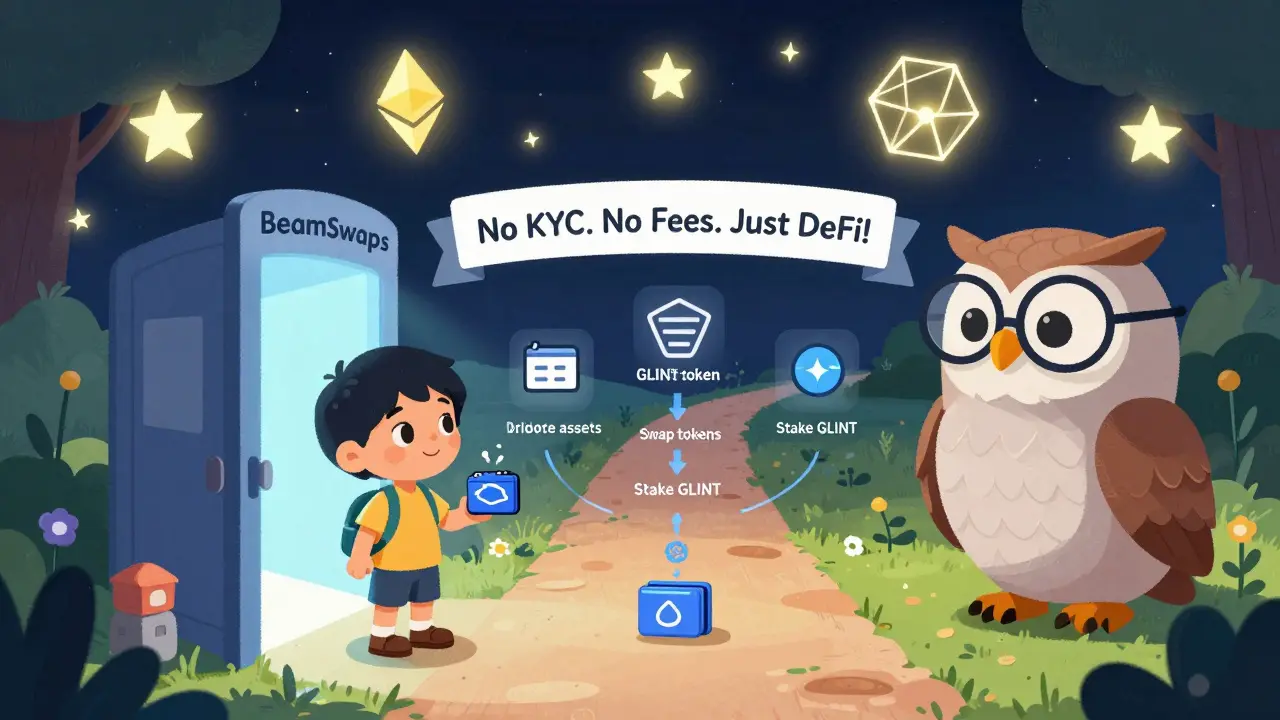
- Install MetaMask and switch the network to Moonbeam (use the network settings from BeamSwap’s official site).
- Get some GLINT or ETH/MOON tokens to cover gas fees. You can buy them on CoinGecko or bridge from Ethereum using BeamSwap’s bridge.
- Go to beams.app and connect your wallet.
- Start swapping, staking, or adding liquidity.
The whole process takes under 5 minutes. No email, no ID, no waiting. That’s the whole point of DeFi.
The Bottom Line
BeamSwap isn’t flashy. It doesn’t have celebrity endorsements or a $100 million marketing budget. But it does something better: it works. It solves real problems - high fees, slow transactions, fragmented DeFi tools - and it does it with clean code and real innovation.If you’re tired of jumping between 7 different apps to trade, farm, bridge, and collect NFTs, BeamSwap brings it all together. It’s not the biggest DEX. But in terms of efficiency, utility, and user experience, it’s one of the best.
Is BeamSwap safe to use?
Yes. BeamSwap has been live since early 2024 with no exploits. Its smart contracts are open-source and audited by CertiK and PeckShield. It uses multi-sig wallets and runs a bug bounty program. Always double-check the official website (beams.app) before connecting your wallet - phishing sites exist.
Can I use BeamSwap without MetaMask?
No. BeamSwap only supports wallets compatible with the Ethereum Virtual Machine (EVM). That means MetaMask, Rabby, or WalletConnect. Non-EVM wallets like Phantom (Solana) or Keplr (Cosmos) won’t work.
What’s the minimum amount to start trading on BeamSwap?
You need at least $5 worth of gas (in GLINT, ETH, or MOON) to cover transaction fees. For swapping, there’s no minimum token amount - you can trade as little as $0.10. But for liquidity provision, pools often require $100+ to be worthwhile.
Does BeamSwap support non-EVM tokens like SOL or ADA?
No. BeamSwap is built on Moonbeam, which only supports EVM-compatible tokens. That means Ethereum, Polygon, BSC, and other chains using the same virtual machine. SOL, ADA, and Solana-based tokens can’t be swapped directly on BeamSwap.
How do I earn GLINT tokens?
You can earn GLINT by providing liquidity to trading pairs on BeamSwap, staking in syrup pools, or participating in governance. The platform distributes GLINT rewards weekly. The APY varies based on pool demand - some pools offer 8-15% APY, others can go higher during promotions.
Is BeamSwap better than Uniswap?
It depends. If you’re on Ethereum, Uniswap is still the standard. But if you want lower fees, faster trades, built-in bridging, and limit orders - BeamSwap is better. It’s not a replacement for Uniswap, but a more efficient alternative for users on Moonbeam or those wanting to move between chains.
Next Steps
If you’re new to DeFi, start small. Swap $20 worth of ETH or USDC on BeamSwap. See how fast it is. Then try staking GLINT in a syrup pool. If you like it, add liquidity to a pair and see how the CLMM boosts your returns. You don’t need to go all-in. Just test it.
If you’re already active in DeFi, BeamSwap might be the missing piece. No more switching between 5 apps. Just one place for swaps, farming, bridging, and NFTs. And with Moonbeam’s growth, BeamSwap’s role in the ecosystem is only going to expand.






Anthony Marshall
March 12, 2026 AT 02:19Lindsay Girvan
March 12, 2026 AT 14:01Zephora Zonum
March 13, 2026 AT 21:51vasantharaj Rajagopal
March 15, 2026 AT 18:45William Montgomery
March 16, 2026 AT 22:30Adam Ashworth
March 18, 2026 AT 03:20Allison Davis
March 19, 2026 AT 07:36Tom Jewell
March 20, 2026 AT 14:57karan narware
March 22, 2026 AT 06:05Michael Suttle
March 23, 2026 AT 06:52Jenni James
March 23, 2026 AT 22:12Chelsea Boonstra
March 25, 2026 AT 06:12Alex Thorn
March 26, 2026 AT 23:09Howard Headlee
March 28, 2026 AT 00:57Julie Tomek
March 28, 2026 AT 23:46Brandon Kaufman
March 29, 2026 AT 17:31Craig Gregory
March 30, 2026 AT 19:04Anshita Koul
April 1, 2026 AT 17:51PIYUSH KOTANGALE
April 3, 2026 AT 07:21vishnu mr
April 4, 2026 AT 11:24Grace van Gent-Korver
April 6, 2026 AT 04:32Douglas Anderson
April 7, 2026 AT 07:03Tina Keller
April 7, 2026 AT 21:21Lindsay Girvan
April 9, 2026 AT 06:47