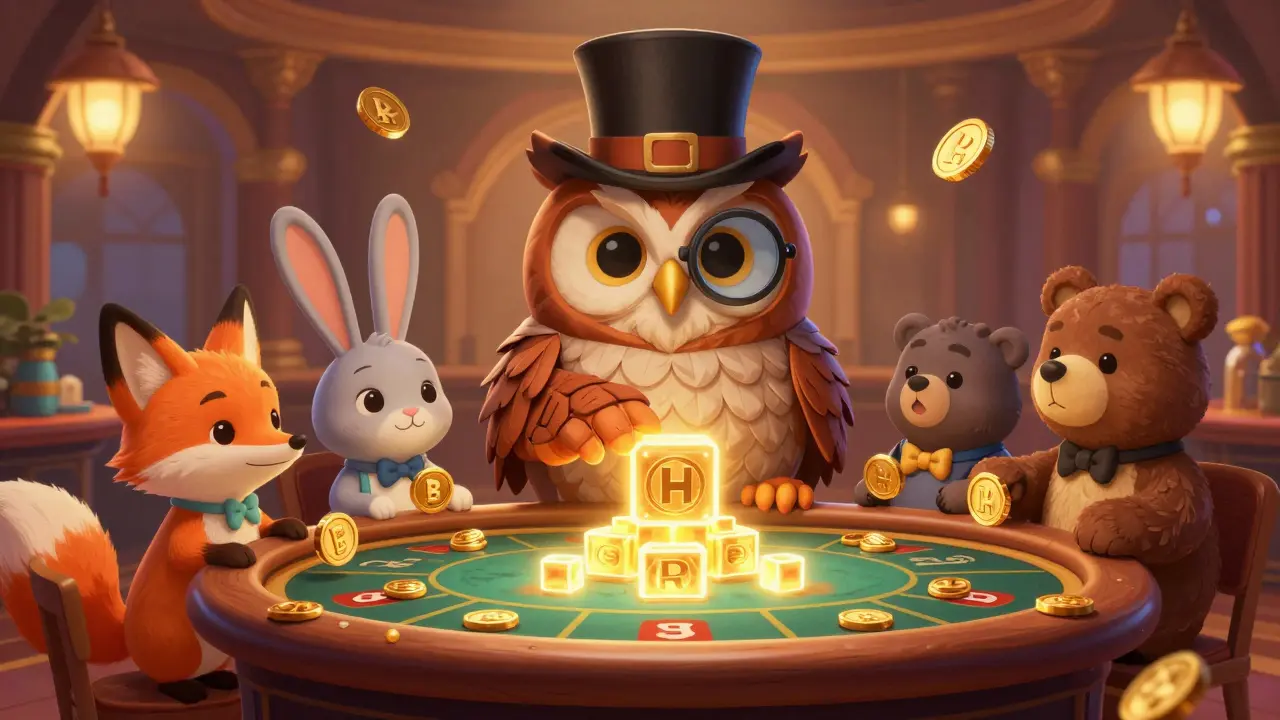
Have you ever wondered where the money goes in a decentralized online casino? In traditional gambling, the house always wins, and the profits stay with the corporation. But what if the "house" was actually a community of token holders? That is the promise behind OwlDAO, a project that blends blockchain gaming with decentralized autonomous organization (DAO) mechanics. At the center of this ecosystem sits the OWL token, the governance and utility asset that allows users to vote on treasury spending and potentially share in the platform's revenue.
If you are looking at OWL, you are likely trying to figure out if it is a legitimate investment opportunity or just another high-risk meme coin disguised as DeFi. The reality is somewhere in between. OwlDAO operates as a white-label casino infrastructure provider, meaning they build the backend for other crypto casinos while running their own platform, Owl.Games. This setup generates real revenue from betting volumes, which is then funneled into the DAO treasury. However, the token itself carries significant risks, including extreme volatility, thin liquidity, and complex tax structures that can eat into your returns.
How OwlDAO Works: The Casino-DAO Hybrid Model
To understand the value of the OWL token, you first need to understand the business model powering it. Most crypto tokens are speculative; they go up because people think they will go up. OwlDAO attempts to ground its value in actual cash flow. The project describes itself as a Web3 casino provider that leverages blockchain technology to offer gaming experiences across multiple networks.
The core engine is Owl.Games, a platform hosting over 3,000 games and sportsbook options. Instead of keeping all the profits, OwlDAO routes a portion of these revenues into a DAO-directed treasury. This is where the OWL token comes in. Holders of OWL don't just hold a receipt of ownership; they hold voting rights. They decide how the treasury spends its money-whether that means funding new game developments, paying for marketing, or buying back tokens to boost scarcity.
This model creates a feedback loop:
- User Activity: Players bet on Owl.Games or partner platforms using the white-label solution.
- Revenue Generation: The platform earns fees from the house edge.
- Treasury Allocation: A percentage of revenue goes to the DAO treasury.
- Token Utility: OWL holders vote on how to use that treasury, often directing funds toward buybacks or staking rewards.
While this sounds robust, it relies heavily on continuous user activity. If players stop betting, the revenue dries up, and the incentive to hold OWL weakens. It is a classic performance-based token model, similar to yield farming protocols but tied to gambling rather than lending.
Tokenomics: Supply, Taxes, and Staking Yields
The economic structure of OWL is aggressive by design. It borrows heavily from the "reflection" or "SafeMoon-style" token models that were popular in earlier bull markets. These tokens typically charge a fee on every transaction to automatically provide liquidity or reward holders. Let’s break down the specific attributes of the OWL token.
| Attribute | Value / Detail |
|---|---|
| Total Supply | 500,000,000 OWL |
| Transfer Tax | 10% per transaction |
| Tax Usage | Auto-liquidity provision, buybacks, and staking pool sponsorship |
| Supported Chains | BNB Chain, Polygon, Fantom |
| Staking APY (Historical) | Up to ~109% for OWL pools; ~77-85% for USDC dividend pools |
The most critical number here is the 10% transfer tax. Every time you buy, sell, or transfer OWL, 10% of that amount is taken. Half usually goes to automatic liquidity provisioning (to keep the trading pool stable), and the rest supports the ecosystem through buybacks and staking rewards. This means if you try to sell $1,000 worth of OWL, you only receive $900 before gas fees even come into play. You must account for this slippage when calculating potential profits.
Despite the tax, the project offers attractive staking yields. Independent reviews have noted staking pools offering around 100-109% APY for standard OWL staking. More interestingly, there are special pools where you stake OWL but receive dividends in USDC, a stablecoin pegged to the US dollar. These pools have historically offered 77-85% APY. For investors tired of volatile crypto swings, earning stablecoins seems like a safer bet. However, these yields are not guaranteed forever. They are funded by the casino’s current revenue. If betting volume drops, those APYs will drop too.

Market Status and Liquidity Risks
Here is where things get tricky. While the tokenomics look structured, the market reality for OWL is fragile. As of mid-2026, data across major tracking platforms is inconsistent and often alarming for a retail investor.
Several aggregators report a circulating supply of zero or near-zero trading volume. Bitget, for instance, has listed OWL with a fully diluted market cap of roughly $1,300 USD based on historical snapshots. To put that in perspective, that is less than the cost of a decent laptop. This suggests that either the token is extremely illiquid, trading only over-the-counter (OTC), or that public liquidity pools have dried up significantly.
LiveCoinWatch records an all-time high price of approximately $0.030051 USD. Recent data points show prices hovering around $0.004 to $0.005, but with frequent gaps in data feeds. Some sources explicitly state that OWL is not currently available on major centralized exchanges (CEX) or active decentralized exchanges (DEX). If you cannot easily buy or sell the token, its utility as an investment is severely limited.
Why does this matter? Because liquidity is oxygen for a crypto token. Without deep liquidity pools on platforms like PancakeSwap (on BNB Chain) or QuickSwap (on Polygon), large transactions will crash the price. If you manage to accumulate a significant amount of OWL, you might find yourself unable to sell it without dropping the price by 50% or more. This is a common trap in micro-cap DeFi projects.
Security, Audits, and Team Anonymity
In the world of crypto gambling, trust is scarce. You are sending money to a smart contract that promises to pay you back later, often with interest. Is OwlDAO safe?
The project claims to have undergone a smart contract audit by CertiK, a well-known blockchain security firm. Reports indicate an audit request in September of the previous year, with revisions completed in January. Having a CertiK audit is a positive signal-it means independent experts looked for obvious vulnerabilities like reentrancy attacks or overflow errors. However, an audit does not guarantee safety against rug pulls, malicious governance votes, or poor economic design.
A bigger red flag is the team’s anonymity. Like many DeFi projects, OwlDAO operates pseudonymously. There are no named founders, no public LinkedIn profiles, and no legal entity clearly disclosed. While this is common in crypto, it removes accountability. If the project fails or the treasury is mismanaged, there is no one to sue. You are relying entirely on the code and the community’s ability to govern.
The project maintains active social channels, including Twitter (@OWLDAOio), Discord, and Telegram groups. Community engagement is high, but remember: hype does not equal fundamentals. Always verify information directly on-chain rather than trusting announcements in chat rooms.
How to Interact with OwlDAO (If You Choose To)
If you decide to take the risk and participate in the OwlDAO ecosystem, here is the practical workflow. Keep in mind that this involves advanced DeFi interactions.
- Set Up a Wallet: You will need a non-custodial wallet like MetaMask or Trust Wallet. Ensure it is configured to support BNB Chain, Polygon, and Fantom, as OWL exists on all three.
- Acquire OWL: Since CEX listings are sparse or inactive, you will likely need to use a DEX. Connect your wallet to PancakeSwap (for BNB Chain) or the relevant DEX on Polygon/Fantom. Search for the official OWL contract address (verify this on CoinCarp or the official website to avoid scams).
- Account for Slippage: When swapping for OWL, set your slippage tolerance to at least 12-15%. Why? Because of the 10% transfer tax. If you set it lower, your transaction will fail.
- Bridge if Necessary: If you bought OWL on BNB Chain but want to stake on Polygon, use the bridge tool integrated into the Owl.Games interface. This allows cross-chain movement of your assets.
- Stake Your Tokens: Navigate to the staking section on the OwlDAO dashboard. Choose between the high-yield OWL pool or the USDC dividend pool. Be aware of withdrawal penalties; short-term unstaking can incur a 2% fee.
- Participate in Governance: Once you hold OWL, you can vote on proposals. Check the governance portal regularly to see how the treasury plans to allocate funds.
Each step carries gas fees. On Ethereum mainnet, these would be prohibitive, which is why OwlDAO focuses on Layer 2s and alternative chains like Polygon and BNB Chain, where transactions cost pennies.
Is OwlDAO Right for You?
OwlDAO is not a passive investment. It is a high-beta, high-risk speculative asset tied to the volatile world of crypto gambling. It appeals to traders who understand DeFi mechanics, are comfortable with anonymous teams, and believe in the long-term growth of Web3 gaming.
However, it is likely not suitable for conservative investors or those unfamiliar with slippage, bridge risks, and smart contract vulnerabilities. The potential for high yields via USDC dividends is enticing, but it is funded by real-world betting revenue that can fluctuate wildly. If the casino stops making money, the token loses its primary value proposition.
Before allocating any capital, ask yourself: Can I afford to lose this entire amount? Are you comfortable holding a token with a 10% tax on exit? Do you trust the community governance model enough to let strangers decide how your money is spent? If the answer to any of these is no, you might want to stick to more established assets.
What is the total supply of OWL tokens?
The total and maximum supply of OwlDAO (OWL) is fixed at 500,000,000 tokens. This capped supply is designed to create scarcity, especially when combined with buyback mechanisms funded by casino revenues.
Does OwlDAO have a 10% tax on transactions?
Yes, OWL features a 10% transfer tax on every buy, sell, or transfer. This fee is automatically split between auto-liquidity provision, token buybacks, and sponsoring staking pools. Users must set higher slippage tolerance on DEXs to accommodate this tax.
Can I earn USDC dividends by staking OWL?
Yes, OwlDAO offers special staking pools where users stake OWL tokens and receive rewards in USDC (a stablecoin). Historical APYs for these pools have ranged between 77% and 85%, though these rates depend on ongoing casino revenue and may change.
Which blockchains support the OWL token?
OWL is a cross-chain token deployed primarily on BNB Chain (BEP-20), Polygon, and Fantom. Users can bridge their tokens between these networks using the Owl.Games interface to access different staking pools or trading venues.
Is OwlDAO audited for security?
Yes, the OwlDAO smart contracts have been audited by CertiK, a leading blockchain security firm. The audit process included initial requests and subsequent revisions to ensure contract integrity. However, audits do not eliminate all risks, such as economic manipulation or governance failures.
Where can I buy OWL tokens?
OWL is primarily traded on decentralized exchanges (DEXs) like PancakeSwap on BNB Chain. It is not widely listed on major centralized exchanges (CEXs). Due to low liquidity, users should exercise caution and verify contract addresses to avoid scams.