
Imagine holding Bitcoin but wanting to use it in the Cardano blockchain ecosystem known for its peer-reviewed development and low fees network. Usually, you’d have to sell your BTC or trust a centralized company to lock it up and give you a fake version. That’s risky. AnetaBTC a decentralized protocol enabling non-custodial wrapping of Bitcoin onto Cardano and Ergo blockchains changes that dynamic. It lets you wrap your actual Bitcoin into a usable asset on Cardano without handing over control to a third party. The native token driving this system on Cardano is cNETA the governance and utility token of the AnetaBTC protocol operating on the Cardano blockchain.
If you are new to cross-chain crypto, this sounds like magic. But it is actually smart contract code. This guide breaks down what AnetaBTC is, how cNETA fits into the picture, and whether it makes sense for your portfolio.
How AnetaBTC Works: The Vault System
The core problem with moving Bitcoin to other chains is trust. Most wrapped Bitcoin solutions, like WBTC on Ethereum, require you to send your coins to a custodian (like BitGo). They hold the real BTC and mint a digital receipt for you. If they get hacked or go bankrupt, your money is gone.
AnetaBTC removes the middleman. Instead of a company, it uses smart contracts. Here is the simple flow:
- Minting: You send your real Bitcoin to a specific address controlled by an AnetaBTC smart contract (a "vault").
- Wrapping: Once the blockchain confirms the deposit, the contract mints an equivalent amount of anetaBTC the wrapped Bitcoin asset created by the AnetaBTC protocol for use on Cardano and Ergo and sends it to your Cardano wallet.
- Usage: You can now use that anetaBTC in Cardano DeFi apps-lending, borrowing, or trading.
- Redeeming: When you are done, you send the anetaBTC back to the contract. The contract burns the tokens and releases your original Bitcoin from the vault back to your Bitcoin wallet.
This process is fully on-chain. No humans approve the transaction. The code does it all. This makes it "non-custodial," meaning you keep sovereignty over your assets as long as the smart contract holds.
cNETA vs. NETA: Understanding the Tokens
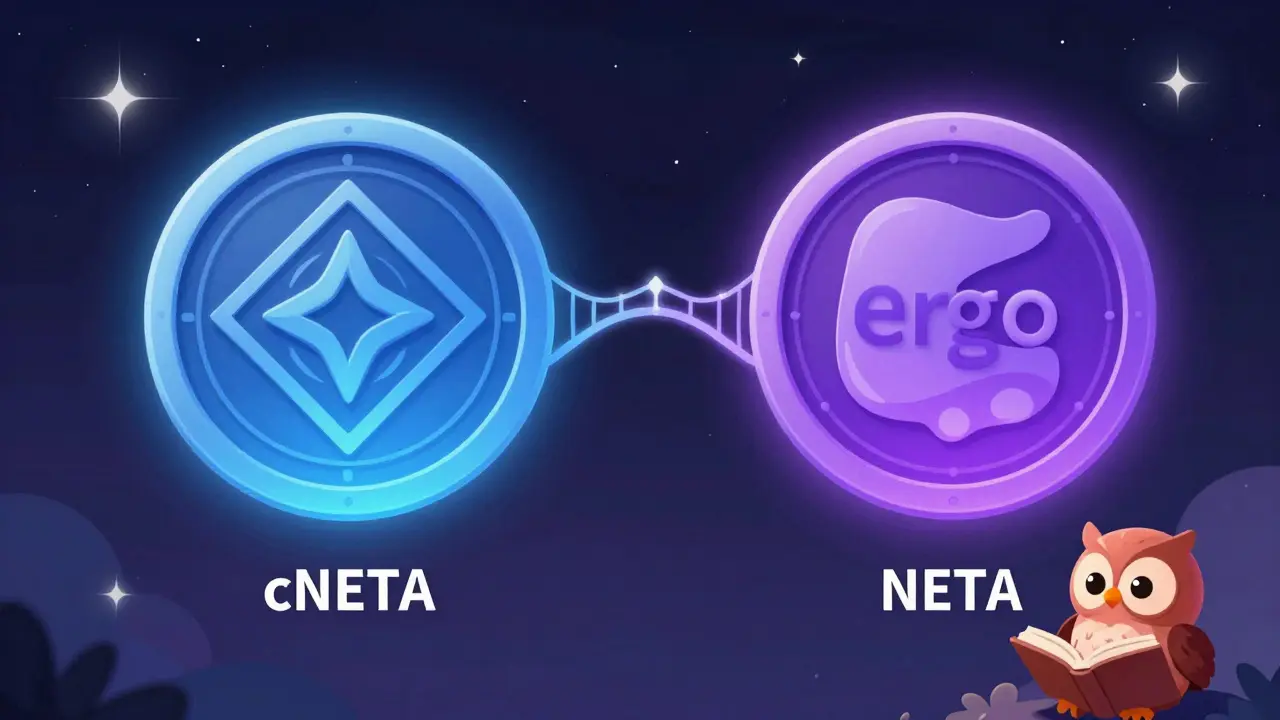
You might see two different ticker symbols associated with this project: cNETA and NETA. They are part of the same ecosystem but live on different blockchains.
| Token | Blockchain | Max Supply | Primary Role |
|---|---|---|---|
| cNETA | Cardano | 1,000,000,000 | Governance, staking rewards, and protocol incentives on Cardano |
| NETA | Ergo | 1,000,000,000 | Governance and incentives within the Ergo ecosystem |
The total supply across both chains is 2 billion tokens. cNETA is the focus for anyone interacting with the protocol via Cardano. It powers the network’s operations and serves as a reward for participants who help secure the system.
Tokenomics and Distribution
Understanding where the tokens come from helps you gauge potential selling pressure. The AnetaBTC team allocated the tokens as follows:
- 70% Public: Aimed at community members and early adopters.
- 25% Team & Investors: Reserved for the developers, advisors, and angel investors.
- 5% Foundation: Held by the NETA Foundation for future initiatives.
A unique feature of cNETA distribution is the Initial Stake Pool Offering (ISPO) a Cardano-specific token distribution method where users delegate ADA to stake pools to earn new tokens instead of ADA rewards. Unlike traditional sales where you buy tokens with cash, ISPOs let you earn them by staking ADA.
In the AnetaBTC ISPO, users delegated their ADA to specific pools named NETA1 and NETA2. For every 1,000 ADA delegated, users received 6 cNETA per epoch (approximately every 5 days). Crucially, delegators gave up their standard ADA staking rewards to receive cNETA. This model filters for serious supporters rather than casual speculators, as you only participate if you believe in the project’s long-term value enough to sacrifice immediate yield.
Market Reality: Liquidity and Price Data
Here is the hard truth about cNETA right now: it is a micro-cap asset with very low liquidity. If you check major data aggregators, you will see conflicting information, which is common for small projects.
CoinMarketCap ranks cNETA around #7,112 by market cap. CoinGecko shows daily trading volumes sometimes as low as $1-$2 USD. This means there aren’t many buyers or sellers active at any given moment. If you try to sell a large amount of cNETA, you could significantly drop the price because there isn’t enough depth in the order book.
Prices also vary wildly between platforms due to thin trading. One aggregator might list it at $0.0038 while another shows $0.00009. Always check multiple sources and understand that slippage (the difference between expected price and executed price) can be high on decentralized exchanges for such low-volume tokens.

Risks You Need to Know
Before putting money into AnetaBTC, consider these specific risks:
- Smart Contract Risk: Since there is no custodian, the security relies entirely on the code. If there is a bug in the vault contract, hackers could drain the locked Bitcoin. Audits help, but they don’t guarantee safety forever.
- Liquidity Risk: As mentioned, low volume makes entering and exiting positions difficult and expensive.
- Regulatory Uncertainty: Cross-chain bridges and wrapped assets are under increasing scrutiny globally. Regulations could impact how these protocols operate in certain jurisdictions.
- Competition: While AnetaBTC offers a non-custodial alternative, established players like WBTC dominate the market. Gaining traction against entrenched incumbents is tough.
Is AnetaBTC Worth Your Attention?
AnetaBTC solves a real problem: bringing Bitcoin liquidity to Cardano and Ergo without trusting a central bank-like entity. Its V2 upgrade, currently on the public testnet, promises more direct and efficient wrapping capabilities. For believers in the Cardano ecosystem who want true decentralization, it is an interesting experiment.
However, it is not for everyone. If you need stable, liquid exposure to Bitcoin, stick to spot BTC or major wrapped versions on high-liquidity chains. cNETA is a speculative play on the success of non-custodial bridging technology. Do your own research, start small, and never invest more than you can afford to lose.
What is the main difference between AnetaBTC and WBTC?
WBTC is custodial, meaning a centralized company (BitGo) holds your Bitcoin and issues the wrapped token. AnetaBTC is non-custodial; it uses smart contracts and on-chain vaults to lock your Bitcoin, removing the need to trust a third-party intermediary.
Can I trade cNETA on Binance or Coinbase?
Currently, cNETA is not listed for direct trading on major centralized exchanges like Binance or Coinbase. It is primarily traded on decentralized exchanges (DEXs) within the Cardano ecosystem, such as SundaeSwap or Minswap, which leads to lower liquidity and higher volatility.
How do I earn cNETA through an ISPO?
You earn cNETA by delegating your ADA to the AnetaBTC stake pools (NETA1 and NETA2). By doing so, you forfeit your standard ADA staking rewards in exchange for receiving cNETA tokens at a fixed rate per epoch. This requires using a Cardano wallet like Daedalus or Yoroi.
Is my Bitcoin safe when using AnetaBTC?
Your Bitcoin is secured by smart contracts rather than a company. This eliminates custodial risk (theft by the operator) but introduces smart contract risk. If the code has vulnerabilities, funds could be compromised. Always verify the latest audit reports before participating.
What happens if I want to get my Bitcoin back?
You initiate a redemption transaction on the AnetaBTC platform. You send your anetaBTC back to the smart contract, which burns the tokens and automatically releases the equivalent amount of real Bitcoin from the vault to your designated Bitcoin wallet address.