Imagine handing a sealed envelope to a stranger on the street. You want to be sure that only the intended recipient can open it, and you want everyone else to know for certain that you are the one who sent it. In the physical world, this requires trusted couriers, notarized seals, and complex legal frameworks. In the crypto world, there is no central authority to verify your identity or guarantee the safety of your assets. Instead, we rely on a mathematical marvel known as public key cryptography, also referred to as asymmetric cryptography. It is the invisible lock and key system that makes Bitcoin, Ethereum, and thousands of other cryptocurrencies possible.
Without this technology, digital money would be just another easily copied file. Public key cryptography provides three non-negotiable pillars for cryptocurrency: authentication (proving who sent the funds), integrity (ensuring the data hasn’t been tampered with), and non-repudiation (preventing the sender from denying they authorized the transaction). This article breaks down how these keys work, why they are secure, and what happens when things go wrong.
The Two Keys That Rule Them All
At its core, public key cryptography relies on a pair of mathematically linked codes: a private key and a public key. Think of the private key as the pin code to your debit card. If anyone gets it, they can drain your account. You must keep it secret at all costs. The public key, on the other hand, is like your bank account number. You can share it freely with anyone who wants to send you money. They need it to locate your wallet, but knowing your account number doesn’t give them access to withdraw funds.
In cryptocurrency, this relationship is one-way. You can derive the public key from the private key using specific mathematical functions, but you cannot reverse the process. Deriving the private key from the public key is computationally infeasible with current technology. For Bitcoin, which uses the secp256k1 elliptic curve, breaking this link would require approximately 2^128 operations. To put that in perspective, even if every computer on Earth worked together, it would take longer than the age of the universe to guess the correct private key by brute force.
This asymmetry is what allows trustless transactions. Two people who have never met, don’t know each other’s identities, and may even dislike each other can exchange value securely because the math guarantees that only the owner of the private key could have signed the transaction.
From Private Key to Wallet Address
You might wonder why we use wallet addresses instead of just sharing public keys directly. The answer lies in privacy and efficiency. A raw public key is a long string of numbers (512 bits). Wallet addresses are shorter, easier to read, and provide an extra layer of obfuscation.
Here is the step-by-step process of how a wallet address is created:
- Generate Private Key: Your wallet software generates a random 256-bit integer. This randomness is critical; if the number isn’t truly random, hackers can predict it.
- Derive Public Key: Using elliptic curve multiplication, the software calculates the corresponding public key.
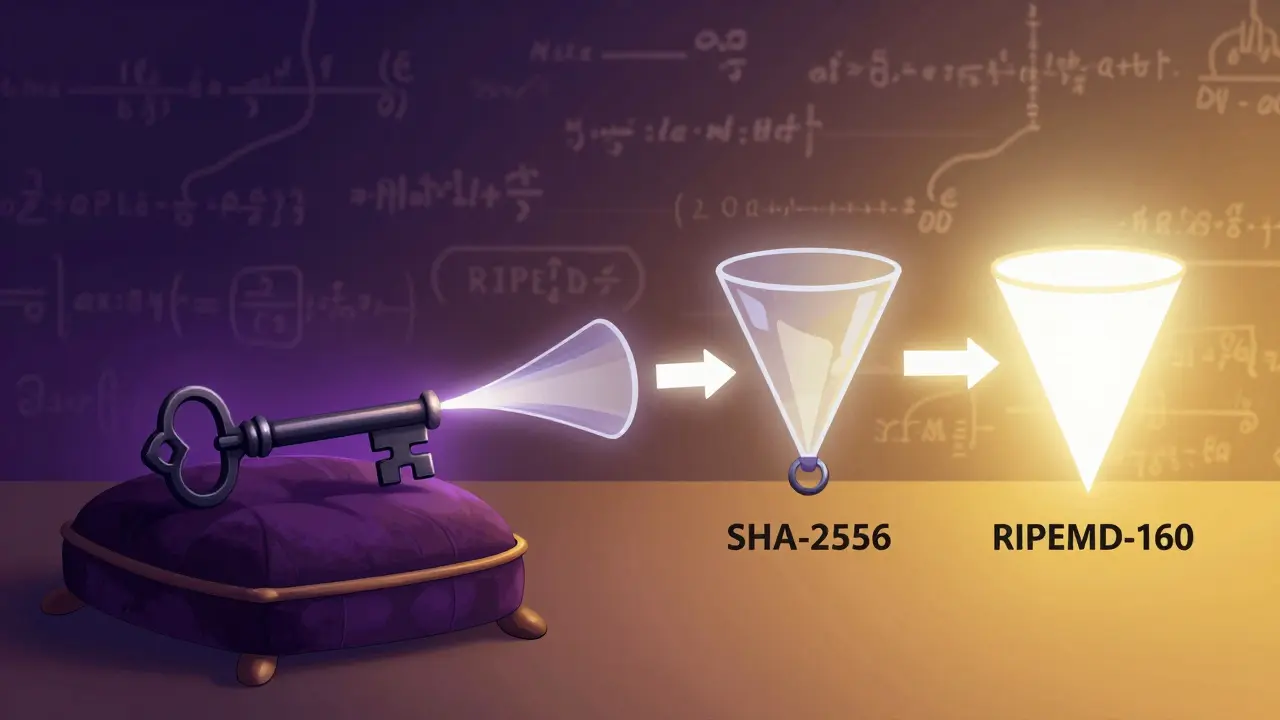
- Hash the Public Key: The public key is run through two hashing algorithms: first SHA-256, then RIPEMD-160. Hashing turns data into a fixed-length string of characters that cannot be reversed.
- Add Checksum: A small piece of data is added to catch typos. If you mistype an address, the network will reject it before any funds are lost.
- Encode: The result is encoded into Base58Check or Bech32 format, creating the familiar string of letters and numbers you see in your wallet app.
This multi-step process ensures that even if someone intercepts your public key during transmission, they still cannot easily trace it back to your private key without solving complex mathematical problems.
Signing Transactions: The Digital Signature
When you send crypto, you aren’t actually moving coins around like physical cash. Instead, you are updating a public ledger (the blockchain) to say that ownership has changed hands. To prove you own the funds, you must sign the transaction with your private key.
This creates a digital signature. Here is how it works behind the scenes:
- The Nonce: Your wallet generates a random number called a nonce. This ensures that every signature is unique, even if you send the same amount to the same person twice.
- The Calculation: The wallet combines the transaction data, the private key, and the nonce using the Elliptic Curve Digital Signature Algorithm (ECDSA).
- The Broadcast: The resulting signature (two numbers, r and s) is broadcast to the network along with the transaction details.
Network nodes then verify the signature using your public key. They check if the math holds up. If the signature matches the public key associated with the input funds, the transaction is valid. Crucially, the private key never leaves your device. It stays offline or within your secure hardware element, while the public verification happens openly on the network.
Why Not Use Symmetric Encryption?
You might ask why cryptocurrencies don’t use symmetric encryption, where the same key locks and unlocks data. Symmetric encryption, like AES-256, is faster and uses smaller keys. However, it fails in decentralized environments because it requires both parties to share a secret key beforehand.
In a traditional banking system, the bank acts as the trusted middleman to manage these secrets. In crypto, there is no middleman. Asymmetric cryptography solves this by allowing anyone to encrypt or verify using the public key, while only the owner can decrypt or sign using the private key. According to analysis by the International Association for Cryptologic Research, asymmetric systems provide 100% non-repudiation capability, whereas symmetric systems offer 0%. This means in crypto, you can mathematically prove who initiated a transfer, which is impossible with shared-secret systems.
| Feature | Asymmetric (Public Key) | Symmetric (e.g., AES) |
|---|---|---|
| Key Distribution | No pre-shared secret needed | Requires secure key exchange |
| Non-Repudiation | Yes (Mathematical proof of origin) | No (Either party could have sent it) |
| Speed | Slower (~0.5ms per signature) | Faster (~0.05ms per operation) |
| Scalability | High (Verifiable by millions of nodes) | Low (Limited to key holders) |
| Primary Use in Crypto | Authentication & Signatures | Data Encryption (Wallet storage) |
The Human Factor: Where Security Fails
The mathematics of public key cryptography are robust. The real vulnerabilities lie in how humans handle keys. In 2025, Chainalysis reported that 92% of cryptocurrency thefts were due to implementation flaws or poor key management, not broken cryptography.
Common mistakes include:
- Phishing: Entering your private key or seed phrase into a fake website.
- Poor Storage: Writing keys on paper that gets lost, or storing them in unencrypted cloud notes.
- Malware: Installing software that steals clipboard contents or screenshots of QR codes.
For example, in November 2025, a developer accidentally committed a private key to a public GitHub repository. Within minutes, bots detected the key and drained 3.2 BTC from the wallet. The cryptography worked perfectly-the thief had the private key-but the user failed to keep it secret. This highlights why hardware wallets, which store private keys in isolated Secure Element chips, are recommended for significant holdings.
Future Threats: Quantum Computing
The biggest theoretical threat to public key cryptography is quantum computing. Current systems rely on the difficulty of factoring large numbers or solving discrete logarithm problems. Shor’s algorithm, running on a sufficiently powerful quantum computer, could solve these problems exponentially faster.
Experts estimate that a quantum computer capable of breaking Bitcoin’s secp256k1 curve would need 1,500 to 2,000 error-corrected qubits. According to IBM’s 2025 roadmap, such machines are at least 15 years away. However, the industry is preparing. The Bitcoin Quantum Resistance Working Group published draft specifications in January 2026 for migrating to lattice-based cryptography, which is believed to be resistant to quantum attacks. Meanwhile, NIST has standardized CRYSTALS-Dilithium as a post-quantum digital signature scheme, signaling a future shift in cryptographic standards.
Best Practices for Securing Your Keys
To ensure your cryptocurrency remains safe, follow these guidelines:
- Use Hardware Wallets: Devices like Ledger or Trezor keep private keys offline, protecting them from online malware.
- Backup Your Seed Phrase: Write down your 12 or 24-word recovery phrase on metal or fireproof paper. Never store it digitally.
- Verify Addresses: Always double-check the last four characters of a recipient’s address before sending.
- Enable Multi-Signature: For high-value accounts, use multi-sig wallets that require multiple private keys to authorize a transaction.
- Keep Software Updated: Ensure your wallet firmware and apps are up to date to patch any known vulnerabilities.
Public key cryptography is the backbone of the digital economy. It transforms abstract mathematics into tangible security, allowing billions of dollars to move across borders without intermediaries. While the tech evolves to meet new threats like quantum computing, the fundamental principle remains unchanged: keep your private key private, and let the math do the rest.
What is the difference between a public key and a wallet address?
A public key is derived directly from your private key using elliptic curve mathematics. A wallet address is a hashed version of that public key. The hash function makes the address shorter and adds a checksum to prevent errors. While the public key can theoretically be traced back to the private key with enough computational power (though currently impossible), the address provides an additional layer of privacy and security by obscuring the public key until a transaction is made.
Can I recover my crypto if I lose my private key?
No. There is no customer support or admin panel in cryptocurrency. If you lose your private key and do not have a backup of your seed phrase (mnemonic phrase), your funds are permanently inaccessible. The decentralized nature of blockchain means no one can reset your password or restore your account. This is why secure backups are critical.
Is public key cryptography vulnerable to quantum computers?
Yes, theoretically. Algorithms like Shor’s algorithm could break elliptic curve cryptography used in Bitcoin and Ethereum. However, current quantum computers are not powerful enough to do this. Experts believe we are at least 10-15 years away from a practical threat. In the meantime, developers are working on post-quantum cryptographic solutions to migrate blockchains to more secure algorithms.
Why do different cryptocurrencies use different curves?
Different curves offer varying balances of speed, security, and compatibility. Bitcoin and Ethereum use secp256k1 because it was well-established and efficient for early implementations. Ripple uses Ed25519, which offers faster signature generation and verification. The choice depends on the specific design goals of the blockchain, such as transaction throughput or energy efficiency.
What is a nonce in cryptocurrency transactions?
A nonce is a random number used once during the signing process. It ensures that each digital signature is unique, even if the transaction details are identical. Reusing a nonce can lead to catastrophic security failures, potentially exposing the private key. Modern wallets generate nonces securely to prevent this risk.