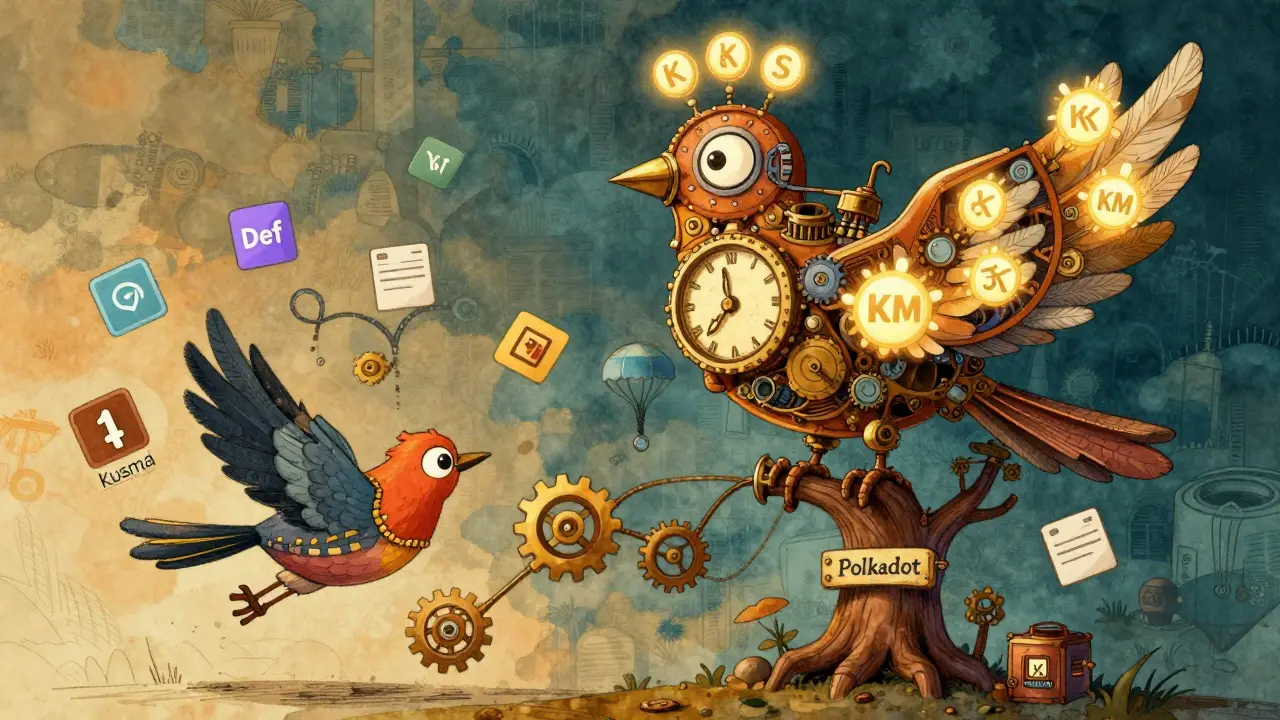
When you hear about Kusama (KSM), don’t think of it as just another cryptocurrency. It’s not designed to be a stable store of value like Bitcoin or a smart contract powerhouse like Ethereum. Kusama is a live experiment - a wild, fast-moving test lab for the future of blockchain technology. Think of it as the adrenaline-fueled cousin of Polkadot, where developers push boundaries, break things, and learn before rolling out changes to the more cautious main network.
What Exactly Is Kusama?
Kusama is a blockchain network launched in August 2020 by the same team behind Polkadot - Web3 Foundation, led by Gavin Wood. Its entire purpose? To be a canary network. In mining, a canary bird was used to detect toxic gases before they harmed workers. Kusama does the same for Polkadot. Any new feature, upgrade, or parachain idea gets tested here first. If it works on Kusama, it might go live on Polkadot. If it crashes? No big deal - the stakes are lower. Unlike fake testnets like Ethereum’s Ropsten, Kusama isn’t built with play money. It runs on real KSM tokens, with real economic value. People trade it. Stake it. Use it to pay fees. And because it’s live, mistakes have consequences - which is exactly the point.How Does Kusama Work?
At its core, Kusama uses a multichain architecture made up of two main parts: the Relay Chain and Parachains. The Relay Chain is the backbone. It handles security, consensus, and communication between all the other chains. Then there are Parachains - independent blockchains that connect to Kusama and share its security. Think of them like apps running on the same operating system. Developers can build their own Parachains for DeFi, NFTs, gaming, or anything else, and they all tap into Kusama’s power without having to build security from scratch. To keep the network running, Kusama uses Nominated Proof of Stake (NPoS). Validators - nodes that secure the network - must lock up KSM tokens as collateral. Regular users can nominate validators by staking their own KSM. In return, they earn rewards. The current annual yield hovers around 13.5%, making staking one of the most popular ways to hold KSM.KSM: The Native Token
KSM is the lifeblood of the network. It’s not just a currency - it’s the tool that powers everything:- Transaction fees: Sending KSM or interacting with a Parachain costs about $0.0005 per transaction - far cheaper than Ethereum.
- Staking rewards: You lock KSM to help secure the network and earn more KSM over time.
- Parachain auctions: To get a Parachain slot, teams must bond (lock up) up to 500,000 KSM for months. This creates real economic pressure - only serious projects can afford it.
- Governance: KSM holders vote on upgrades, treasury spending, and protocol changes. The more KSM you stake and lock, the more voting power you have.
Kusama vs. Polkadot: The Speed vs. Safety Trade-Off
Kusama and Polkadot share the same codebase. But their philosophies are opposite. Polkadot is like a bank: slow, careful, and built for high-value applications. Governance votes take 28 days to pass. Upgrades take weeks to deploy. Security is the top priority. Kusama is like a startup garage: fast, risky, and built for innovation. Voting takes just 8 days. Changes go live in 2 days. That speed means developers can test ideas in real time - not months later. But it also means things can go wrong. In December 2022, a governance proposal accidentally sent 10,000 KSM to a test address. On Polkadot, that would’ve been impossible. On Kusama? It happened - and the community fixed it. Analysts at CoinDesk rate Kusama 4.2/5 for developer experimentation but only 3.1/5 for enterprise use. That’s not a flaw - it’s the design.
Real-World Use Cases
Kusama isn’t just a testing ground. It’s already home to thriving projects:- Karura: A DeFi hub on Kusama offering lending, swaps, and stablecoins. It holds over $1.4 billion in locked value.
- Singular: An NFT marketplace where digital art can own other NFTs - like a character wearing a weapon that’s itself an NFT. This nested NFT system doesn’t exist on Ethereum or Solana.
- StellaSwap and Basilisk: These DeFi protocols are used by companies to test new financial tools before launching on Polkadot.
Why Developers Love It
If you’re a blockchain developer, Kusama is a dream. You can deploy a Parachain in days, not months. The tools are open-source. The community is active. On GitHub, there are over 1,200 Kusama-related repositories with nearly 5,000 contributors. Developers report cutting deployment cycles from weeks to days. One Reddit user said testing a parachain integration went from “a month of waiting” to “a weekend of tweaking.” That speed is priceless. But there’s a catch. You need to know Rust and the Substrate framework. The average learning curve is 8-12 weeks. If you’re new to blockchain dev, it’s not beginner-friendly. But if you’re serious, Kusama is the best place to learn by doing.Volatility and Risk
KSM isn’t for the faint of heart. Its price swings are wild. During market corrections, KSM has dropped as much as 75% - compared to Polkadot’s 65%. One Reddit user described a 40% price drop in just 72 hours after a governance vote they participated in. This isn’t a bug. It’s a feature. The volatility reflects the network’s experimental nature. If you’re holding KSM as an investment, you’re betting on the future of decentralized experimentation. If you’re using it to build, you’re accepting the risk as part of the process.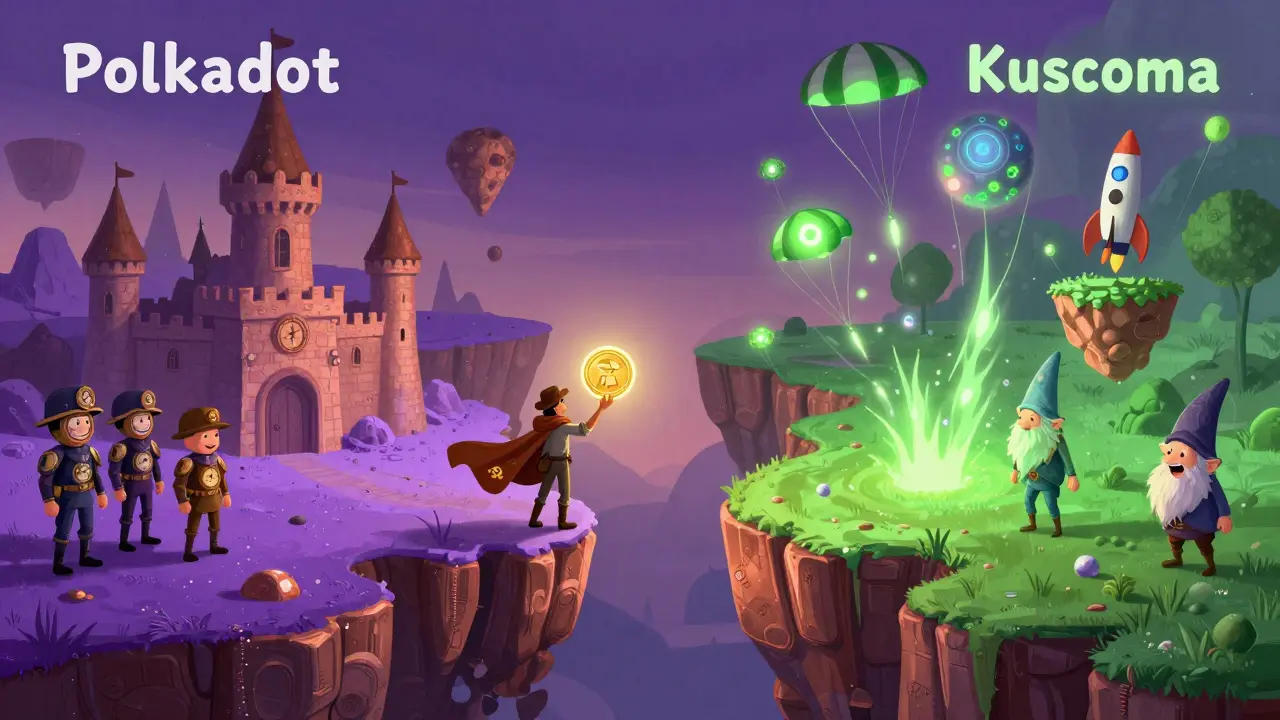
How to Get Started
Want to try Kusama? Here’s how:- Buy KSM on exchanges like Kraken, Binance, or Coinbase.
- Download the Polkadot.js wallet and switch to the Kusama network.
- Transfer a small amount of KSM (at least 0.1 KSM) to pay for transactions.
- Explore staking, governance, or connect to a Parachain like Karura.
What’s Next for Kusama?
Kusama isn’t standing still. In May 2023, it launched Asynchronous Backing, which tripled its parachain block production. In July, OpenGov v2 gave technical experts a special voting role to guide complex upgrades. The roadmap includes Agile Coretime (late 2023), which will let Parachains rent computing power on-demand, and Polkadot 2.0 integration (mid-2024), which will sync Kusama’s upgrades with Polkadot’s next major release. Analysts are split. Messari predicts Kusama’s developer base will grow 15% annually through 2027. Gartner thinks it’ll fade after Polkadot catches up. Citibank says there’s only a 35% chance Kusama becomes more than a testbed by 2030. But here’s the thing: Kusama doesn’t need to be the future. It just needs to help build it.Final Thoughts
Kusama (KSM) isn’t a coin you buy and forget. It’s a tool. A platform. A proving ground. If you’re a developer, it’s your sandbox. If you’re a crypto investor, it’s a high-risk bet on innovation. If you’re just curious, it’s a fascinating glimpse into how blockchain networks evolve - not through theory, but through real-world chaos. It’s not for everyone. But for those who need speed, flexibility, and the chance to shape the next wave of blockchain tech - Kusama is the only place that lets you do it.Is Kusama a good investment?
Kusama (KSM) is not a typical investment. Its value is tied to the success of experimental blockchain projects built on it. If you believe in rapid innovation and decentralized testing, KSM could reward long-term holders. But it’s extremely volatile - price swings of 40-75% in weeks are normal. Only invest what you can afford to lose. Staking KSM for rewards is less risky than trying to time the market.
How is Kusama different from a testnet like Ethereum’s Rinkeby?
Ethereum testnets use fake tokens with no real value. You can get them for free. Kusama uses real KSM tokens that trade on exchanges. Developers risk real money to launch projects. Governance decisions affect real wealth. This creates real incentives and consequences - making Kusama a true economic system, not just a playground.
Can I stake KSM on exchanges?
Yes. Exchanges like Kraken and Binance offer staking services for KSM. But you give up control of your tokens. For full control and higher rewards, use the Polkadot.js wallet and stake directly on the network. You’ll need to lock your KSM for at least 28 days to vote in governance, but staking rewards are paid out weekly regardless.
Why does Kusama have no supply cap?
Kusama’s inflation model is intentional. New KSM tokens are created to reward validators and nominators who help secure the network. This keeps participation high and ensures the network stays decentralized. A fixed supply would make staking less attractive over time. Inflation is kept low - around 5-10% annually - so it doesn’t dilute value too quickly.
Is Kusama regulated?
Yes. The European Securities and Markets Authority (ESMA) classifies KSM as a utility token with potential security characteristics under MiCA regulations. Exchanges must follow strict KYC rules when trading KSM. In the U.S., regulators haven’t made a clear ruling, but KSM is generally treated as a cryptocurrency subject to general crypto tax and reporting rules.
What happens if a Parachain fails on Kusama?
If a Parachain stops working or gets compromised, its bonded KSM is slashed - meaning the project loses its collateral. The Parachain is removed from the network, and users can withdraw their assets. This economic penalty ensures only serious projects compete for slots. Failures are common and expected - that’s why Kusama exists.
Can I build my own blockchain on Kusama?
Yes. Kusama is built for developers. Using the Substrate framework and Rust, you can create your own Parachain that connects to the Kusama Relay Chain. You’ll need to win a parachain slot through an auction by bonding KSM. The process is complex, but documentation is strong, and the community offers workshops and guides. Many successful projects started here before moving to Polkadot.
How does Kusama’s governance work?
Kusama uses OpenGov - a real-time on-chain voting system. KSM holders propose changes, debate them, and vote. Voting power is proportional to the amount of KSM you lock up. You must lock tokens for at least 28 days to vote. Proposals pass in just 8 days, compared to Polkadot’s 28. This speed allows fast innovation but also increases risk - bad proposals can pass quickly. That’s why experts and developers have a special role (Fellowship) to review critical changes.
Gavin Francis
January 28, 2026 AT 22:49Brandon Vaidyanathan
January 29, 2026 AT 13:28Dahlia Nurcahya
January 30, 2026 AT 22:29Gary Gately
January 31, 2026 AT 19:28Meenal Sharma
February 1, 2026 AT 16:34Dylan Morrison
February 2, 2026 AT 00:48Brianne Hurley
February 3, 2026 AT 09:35mary irons
February 4, 2026 AT 05:06christal Rodriguez
February 5, 2026 AT 18:33Rob Duber
February 7, 2026 AT 07:30Freddy Wiryadi
February 8, 2026 AT 11:45Gareth Fitzjohn
February 8, 2026 AT 13:12Tressie Trezza
February 9, 2026 AT 10:30Calvin Tucker
February 9, 2026 AT 15:51William Hanson
February 10, 2026 AT 21:35Wayne mutunga
February 11, 2026 AT 04:58Gustavo Gonzalez
February 12, 2026 AT 18:43Moray Wallace
February 14, 2026 AT 06:53Gurpreet Singh
February 15, 2026 AT 02:28Mark Ganim
February 16, 2026 AT 02:20Christopher Michael
February 16, 2026 AT 11:15Crystal Underwood
February 17, 2026 AT 09:22