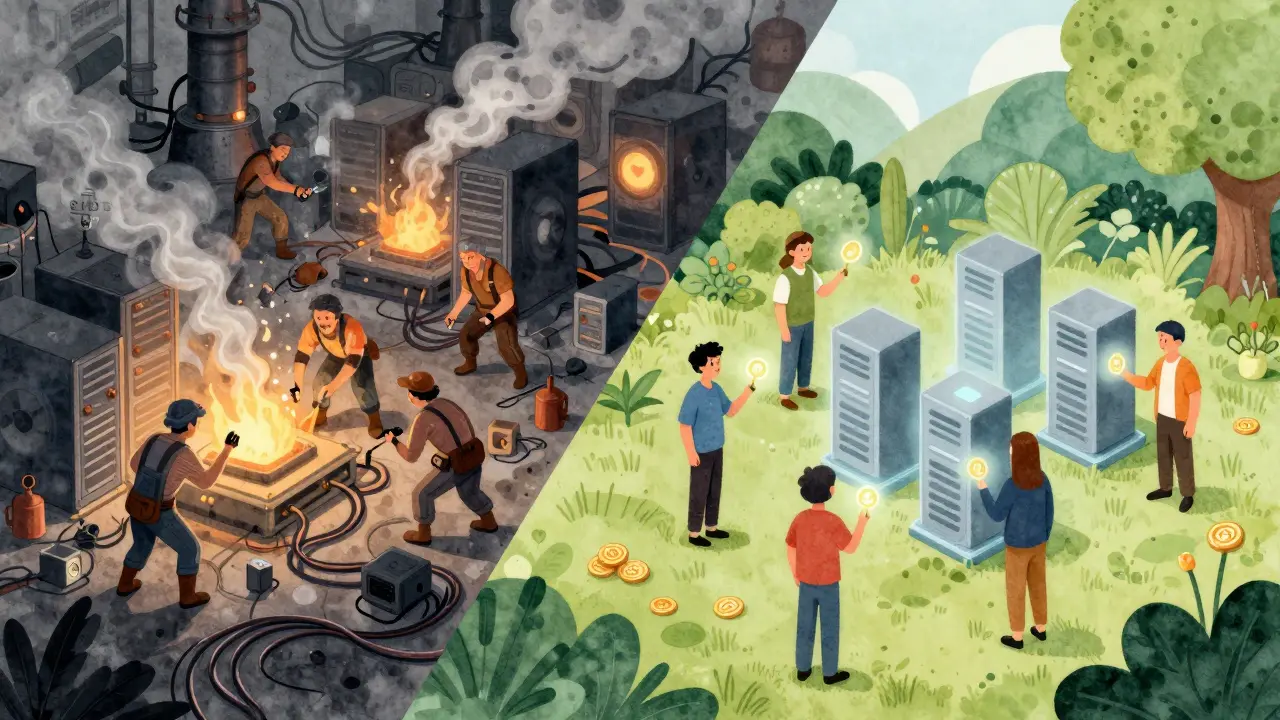
Remember when running a Bitcoin node meant buying expensive mining rigs and paying through the nose for electricity? That era is fading fast. Today, the backbone of blockchain security isn’t brute force computation-it’s Validator Networks, which are decentralized systems where participants lock up cryptocurrency to secure the network and validate transactions. As we move deeper into 2026, these networks are evolving from simple staking pools into sophisticated, high-performance infrastructure that powers everything from DeFi to enterprise supply chains.
If you’re trying to understand where blockchain technology is heading, you need to look at validators. They are no longer just passive holders of tokens; they are active gatekeepers of digital truth. But what does the future hold for them? Are we moving toward greater decentralization, or will a few large players dominate? Let’s break down the current landscape and where it’s going.
From Miners to Validators: The Great Shift
To understand the future, we have to acknowledge the past. For years, Proof-of-Work (PoW) was a consensus mechanism where miners compete to solve complex mathematical puzzles to add blocks to the blockchain. It worked, but it was inefficient. Bitcoin alone consumes as much energy as some medium-sized countries. This model created a barrier to entry so high that only industrial-scale operations could compete effectively.
The pivot to Proof-of-Stake (PoS) changed the game entirely. Instead of burning energy to prove work, validators put their own skin in the game-literally. By locking up assets as stake, they gain the right to propose and validate blocks. If they act honestly, they earn rewards. If they cheat or go offline, they face slashing penalties, losing part of their stake. This economic incentive aligns security with financial responsibility rather than computational power.
This shift wasn’t just about saving electricity. It democratized participation. While early PoS systems still required significant capital, the barrier was no longer hardware-heavy data centers. This opened the door for a new type of participant: the individual validator. However, this transition also introduced new complexities around centralization risks and technical requirements that the industry is still grappling with today.
How Modern Validator Networks Actually Work
You might think validation is just saying "yes" to a transaction. It’s much more nuanced. In modern networks like Ethereum or Cosmos, validators perform several critical functions simultaneously. First, they attest to the validity of blocks proposed by other nodes. Think of this as a signed vote confirming that the state of the ledger is correct. Second, they propose new blocks themselves, ordering transactions and ensuring they follow protocol rules.
The magic happens in the consensus layer. Most major networks now use variations of Byzantine Fault Tolerant (BFT) consensus. This means the network can continue to operate safely even if up to one-third of the validators are faulty or malicious. Ethereum’s Casper FFG is a hybrid consensus mechanism that combines Proof-of-Stake with finality gadgets to ensure irreversible block confirmation. Similarly, Cosmos’s Tendermint uses a BFT consensus algorithm designed for high throughput and instant finality in interconnected blockchain ecosystems.
But here’s the catch: being a validator is not a set-it-and-forget-it job. You need reliable infrastructure. High uptime is non-negotiable. If your node goes down, you miss attestation opportunities and lose rewards. Worse, repeated failures can trigger slashing conditions. This technical demand has given rise to a professional class of validator operators who treat node management as a serious business operation.

The Centralization Dilemma: Who Really Controls the Network?
Here’s the uncomfortable truth about many current validator networks: they are becoming centralized. On Ethereum, while there are hundreds of thousands of validators, a small percentage of them control a massive portion of the total stake. Why? Because running a validator requires expertise, capital, and risk tolerance that most individuals don’t have.
Large institutions and specialized staking-as-a-service providers have flooded the market. They offer lower fees, better infrastructure, and insurance against slashing. For the average user, delegating to these giants feels safer than running a solo node. But this creates a dangerous concentration of power. If a few large validators collude or fail simultaneously, the entire network’s security could be compromised.
Liquid Staking Derivatives (LSDs) are tokenized representations of staked assets that allow users to earn staking rewards while maintaining liquidity. Protocols like Lido have made it easy for anyone to participate in staking without meeting minimum thresholds. While this boosts overall participation, it inadvertently funnels more stake to large operators. The industry is now racing to find solutions that encourage distribution without sacrificing efficiency.
Emerging Trends Shaping the Next Decade
So, what’s next? Several key trends are reshaping validator networks in 2026 and beyond.
- Sovereign Validation: More projects are encouraging independent, community-run validators over corporate entities. Initiatives like EigenLayer on Ethereum are exploring restaking, where validators can secure multiple protocols simultaneously, increasing capital efficiency but also introducing new correlation risks.
- Hardware Optimization: As networks scale, the hardware requirements for validators are changing. We’re seeing a move away from generic servers toward specialized, energy-efficient nodes designed specifically for consensus workloads. This reduces costs and lowers the barrier to entry for smaller operators.
- Cross-Chain Validation: With the rise of interoperability standards like IBC (Inter-Blockchain Communication), validators are increasingly expected to secure multiple chains. A single validator set might soon be responsible for maintaining consistency across an entire ecosystem of connected blockchains.
- AI-Driven Node Management: Artificial intelligence is beginning to play a role in optimizing validator performance. AI tools can predict network congestion, adjust gas strategies, and detect potential anomalies before they lead to slashing events. This doesn’t replace human oversight but enhances operational resilience.

Risks and Challenges Ahead
It’s not all smooth sailing. Validator networks face significant hurdles. Slashing remains a real threat. Even honest mistakes-like misconfiguring software or experiencing unexpected downtime-can result in financial loss. As networks become more complex, the attack surface grows. Quantum computing threats, though still distant, loom over cryptographic foundations that validators rely on.
Regulatory uncertainty also hangs over the sector. Governments worldwide are scrutinizing staking activities. Are validators providing a financial service? Do they need licenses? Clarity on these issues will determine how institutional capital flows into validator networks. Without clear frameworks, many large players may hesitate to commit long-term resources.
Furthermore, the environmental narrative continues to evolve. While PoS is vastly greener than PoW, the sheer number of nodes required for decentralization still has a carbon footprint. Sustainable energy sourcing for validator infrastructure is becoming a competitive differentiator, especially in regions with strict ESG regulations.
| Feature | Ethereum (PoS) | Cosmos (Tendermint) | Solana (PoS + Tower BFT) |
|---|---|---|---|
| Minimum Stake | 32 ETH | Variable (ATOM) | No minimum (but high infra cost) |
| Consensus Finality | ~12 minutes | Instant | ~400ms |
| Slashing Risk | High (for equivocation/downtime) | Moderate | Low (no direct slashing, but delisting) |
| Decentralization Level | Medium-High | Medium | Low-Medium |
| Primary Use Case | Smart Contracts, DeFi | Interoperability, Custom Chains | High-Throughput Applications |
Practical Steps for Engaging with Validator Networks
If you’re looking to get involved, whether as a staker or aspiring validator, start small. Don’t rush to run a full node unless you have the technical skills and budget. Consider delegating to a reputable, decentralized validator first. Look for those with transparent operations, good uptime records, and reasonable commission rates.
For those interested in running their own node, education is key. Join communities, read documentation, and test in staging environments. Tools like Docker and Kubernetes can simplify deployment, but understanding the underlying consensus logic is crucial. Remember, your stake is at risk. Treat it with the seriousness of managing a bank account.
Also, keep an eye on emerging standards. Restaking and modular blockchain architectures are changing the value proposition of validation. Being adaptable and staying informed will give you an edge in this rapidly evolving space.
What is the main difference between a miner and a validator?
Miners use computational power to solve puzzles in Proof-of-Work systems, consuming vast amounts of energy. Validators, in contrast, lock up cryptocurrency as stake in Proof-of-Stake systems to secure the network. Validators are selected based on their stake and reputation, not their hardware speed, making the process far more energy-efficient.
Can I lose my money if I become a validator?
Yes. If you act maliciously or fail to maintain proper uptime, you can face "slashing," where a portion of your staked assets is permanently confiscated. Additionally, if the network experiences severe issues or the token value drops, your investment can decrease significantly. Always assess technical risks before committing funds.
Why are validator networks important for blockchain security?
Validators ensure that every transaction recorded on the blockchain is valid and agreed upon by the network. By requiring economic collateral, they create a strong disincentive for fraud. A diverse and distributed validator network makes it extremely difficult for any single entity to manipulate the ledger, preserving trustlessness and decentralization.
What is liquid staking and how does it affect validators?
Liquid staking allows users to stake their tokens and receive a derivative token in return, which can be traded or used in DeFi. This increases liquidity but often concentrates stake among large professional validators who manage the pool. While it boosts participation, it can reduce decentralization if too much stake flows to a few large operators.
Will validator networks remain decentralized in the future?
This is a major concern. Currently, trends show increasing centralization due to economies of scale and institutional adoption. However, new technologies like restaking, improved tooling for solo validators, and regulatory pressures may help redistribute power. The outcome depends on how well the community balances efficiency with true decentralization goals.