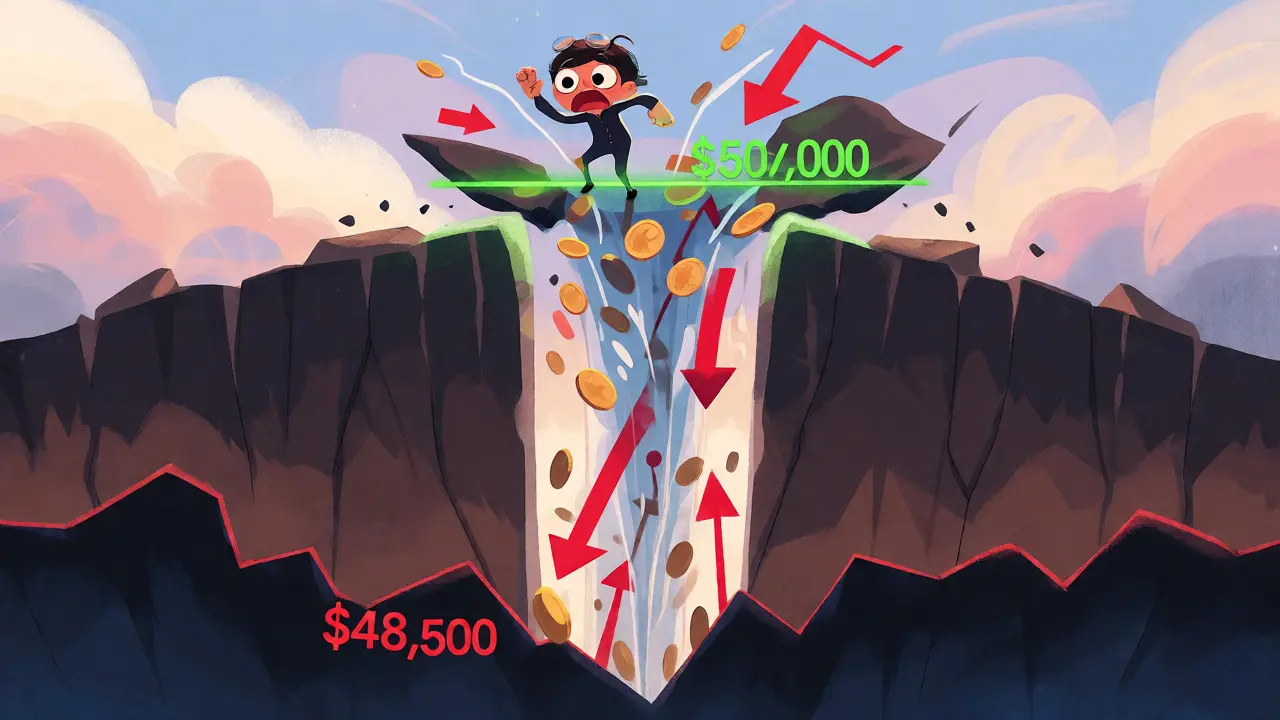
You set a stop-loss at $50,000 for your Bitcoin position. The price hits $50,000, and you expect to exit cleanly with a small loss. Instead, the market crashes through that level in seconds, and your order fills at $48,500. You just took a 3% hit instead of the planned 1%. This isn't a glitch; it's stop-loss order execution risk, the inherent possibility that the actual fill price of a triggered stop order will differ significantly from the specified trigger price due to market mechanics like slippage, gaps, and liquidity constraints. Many traders treat stop-losses as insurance policies with fixed payouts, but they are more like fire alarms that trigger a chaotic evacuation where you might end up further away from safety than expected.
The Core Mechanism: Trigger vs. Execution
To understand why things go wrong, you need to grasp what actually happens when your stop price is touched. A standard stop-market order is not a limit on how much you lose; it is simply an instruction to sell once the price reaches a certain point. According to FINRA Rule 5350, once the transaction price hits or passes your stop price, the order instantly converts into a market order. A market order demands immediate execution at whatever price is currently available in the order book. It prioritizes speed over price certainty. This distinction is critical because it means the "stop" is merely a trigger mechanism, not a guaranteed exit price. Regulatory bodies like the SEC and brokerages consistently warn that the stop price is only a condition for activation, not a promise of performance.
Slippage: The Silent Killer in Fast Markets
Slippage occurs when there is no counterparty willing to buy at your exact stop price, forcing the system to move down the order book to find a buyer. In highly liquid markets like major forex pairs, this difference might be negligible-perhaps a few pips. But in cryptocurrency markets, which often feature fragmented liquidity across multiple exchanges, slippage can be brutal. Imagine a sudden news event causes a cascade of sell orders. If the best bid is at $50,000 and the next bid is at $49,800, your market order will skip the empty space between them and execute at $49,800. If the drop continues rapidly, it might execute even lower. Questrade and other educational resources define this as the difference between the intended stop price and the actual execution price. During high-volatility events, such as economic data releases or unexpected regulatory announcements, this gap can widen dramatically, turning a manageable loss into a significant drawdown.
Gap Risk: When the Market Jumps Over Your Stop
While slippage happens within continuous trading sessions, gap risk occurs when the price jumps from one level to another without trading at intermediate prices. This is common in equities during overnight breaks or in crypto during weekends when traditional markets are closed but digital assets keep trading. If you hold a stock that closes at $100 and negative earnings news hits after hours, causing the pre-market price to open at $90, your stop-loss set at $95 will not trigger at $95. Since the price never traded at $95, the first available transaction might be at $90 or lower. Your stop order activates immediately upon the opening bell (or whenever trading resumes) and executes at the prevailing market price, which could be far below your trigger level. Investopedia highlights that this can lock in losses much larger than anticipated, especially if the asset opens significantly lower than the previous close.

Liquidity Constraints and Order Book Depth
In thin markets, the problem isn't just speed; it's volume. Liquidity depth refers to the amount of buy or sell orders waiting at various price levels. In a deep order book, thousands of shares or coins might be available at each cent increment. In a shallow crypto order book, particularly for altcoins, there might be very little interest at any given price. When a large stop-loss order triggers, it can consume all available bids at the current price and then eat through subsequent levels. This creates a chain reaction known as a liquidity vacuum. CryptoState notes that in these scenarios, a single large stop-loss can push the price down several percentage points as it searches for enough buyers to fill the entire order size. This is particularly dangerous for leveraged positions, where a slight deviation in exit price can trigger liquidations, exacerbating the downward pressure.
| Order Type | Mechanism Upon Trigger | Primary Benefit | Primary Risk |
|---|---|---|---|
| Stop-Market | Converts to Market Order | Guarantees execution (if market is open) | Unlimited slippage/gap risk |
| Stop-Limit | Converts to Limit Order | Controls maximum loss price | Risk of non-execution (order stays open) |
| Trailing Stop | Adjusts dynamically, then acts as Stop-Market | Locks in profits automatically | Vulnerable to same slippage/gap risks as Stop-Market |
The Stop-Limit Trade-Off: Certainty vs. Control
Many traders attempt to mitigate execution risk by using stop-limit orders. These combine a stop price (trigger) with a limit price (maximum acceptable execution price). For example, you might set a stop at $50,000 and a limit at $49,900. Once the price hits $50,000, the system places a limit order to sell at $49,900 or better. This seems like a perfect solution until you realize the downside: if the price crashes straight through $49,900 without pausing, your limit order may never get filled. You remain exposed to the falling market, potentially watching your asset drop to $45,000 while your sell order sits unfilled above the current price. FINRA’s Regulatory Notice 16-19 emphasizes that while stop-market orders prioritize execution certainty, stop-limit orders prioritize price control, but neither eliminates risk entirely. Choosing between them requires assessing whether you fear missing the exit more than you fear taking a larger loss.

Cascading Effects and Market Microstructure
Execution risk isn't just about individual orders; it's about collective behavior. When many traders place stop-losses at similar technical levels (like round numbers or recent support zones), a phenomenon called a stop hunt or liquidity cascade can occur. As the price approaches these clusters, market makers and algorithms may push the price slightly lower to trigger these stops. Once triggered, these orders become market orders, adding significant selling pressure. This surge of sell orders consumes remaining liquidity, pushing the price even lower, which triggers the next cluster of stops. This feedback loop can cause prices to overshoot their fundamental value temporarily. AMF’s ombudsman has noted that investors often misunderstand this dynamic, believing their stop protects them from volatility, when in reality, their stop contributes to the volatility that worsens their own exit price.
Practical Mitigation Strategies
So, how do you handle these risks? First, avoid placing stops exactly at obvious psychological levels. If everyone sees support at $50,000, put your stop at $49,850 or use a wider buffer based on the asset's Average True Range (ATR). Second, consider position sizing. If you know slippage could cost you an extra 2%, ensure your position size is small enough that even a worst-case scenario doesn't breach your total portfolio risk tolerance. Third, for highly illiquid assets, consider using alerts instead of automatic stops. This allows you to manually assess the market conditions before exiting, avoiding panic sells during temporary spikes. Finally, in crypto markets, be aware of exchange-specific liquidity. Moving funds to deeper exchanges or using decentralized aggregators can sometimes provide better execution quality than relying on a single venue's order book.
Does a stop-loss guarantee I won't lose more than my planned amount?
No. A stop-loss guarantees that an order will be sent to the market once the trigger price is reached, but it does not guarantee the execution price. Due to slippage and gaps, you can lose significantly more than the distance between your entry and stop price, especially in volatile or illiquid markets.
What is the main difference between a stop-market and a stop-limit order?
A stop-market order converts to a market order upon triggering, ensuring execution but accepting any price. A stop-limit order converts to a limit order, ensuring a specific price range but risking that the order may not be filled if the market moves too quickly past the limit price.
Why do stop-losses fail during crypto flash crashes?
Crypto markets often have thinner liquidity compared to traditional equities. During a flash crash, buy orders disappear rapidly. Stop-market orders trigger simultaneously, creating a massive sell imbalance that exhausts available bids, causing the execution price to plummet far below the trigger level due to lack of counterparties.
Can circuit breakers help with stop-loss execution risk?
Circuit breakers pause trading during extreme moves, which can prevent some cascading effects. However, they do not retroactively improve execution prices for orders already triggered. When trading resumes, there may still be a significant gap between the last trade and the new opening price, leaving stop-loss holders exposed to gap risk.
Is it better to use tighter or wider stop-losses to reduce execution risk?
Wider stops generally reduce the likelihood of being stopped out by normal market noise, but they increase the potential monetary loss per trade. Tighter stops risk frequent triggering due to volatility spikes (slippage). The optimal width depends on the asset's volatility profile, typically measured by indicators like Average True Range (ATR).