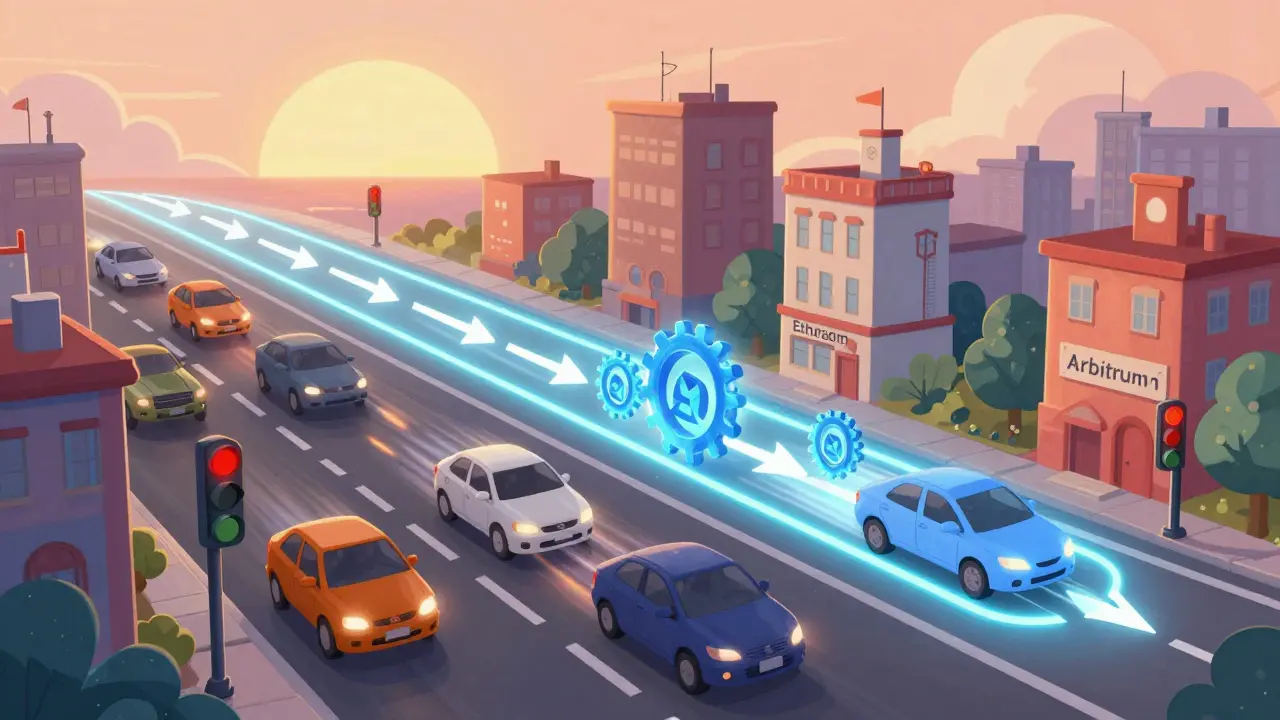
Blockchain networks like Ethereum used to feel like a single-lane highway during rush hour. Every transaction had to wait its turn, fees spiked, and confirmations took minutes. That’s why scaling became the biggest challenge in crypto. Two main ideas emerged to fix this: sharding and Layer 2 solutions. They sound similar, but they’re built on completely different principles. One changes the road itself. The other builds new roads on top. Let’s break down what each one does, how they work, and when one makes more sense than the other.
What Layer 2 Solutions Actually Do
Layer 2 solutions don’t touch the main blockchain. Instead, they create a separate layer where transactions happen off-chain, then bundle them up and settle back on the main chain. Think of it like taking a bunch of errands in one car trip instead of driving separately each time. You save fuel, time, and reduce traffic.The two big types are optimistic rollups and ZK rollups. Optimistic rollups assume transactions are valid unless someone proves otherwise using fraud proofs. ZK rollups use math-heavy zero-knowledge proofs to prove validity without revealing the data. Both cut costs dramatically. Ethereum Layer 2s like Arbitrum, Optimism, and ZkSync now handle over 80% of all Ethereum transactions.
Why does this matter? Because users get faster trades, cheaper fees, and smoother DeFi experiences. A simple swap on Ethereum mainnet might cost $5 and take 15 seconds. On a Layer 2, it’s often under $0.10 and finishes in under a second. That’s why DeFi apps, NFT marketplaces, and gaming platforms rushed to adopt them.
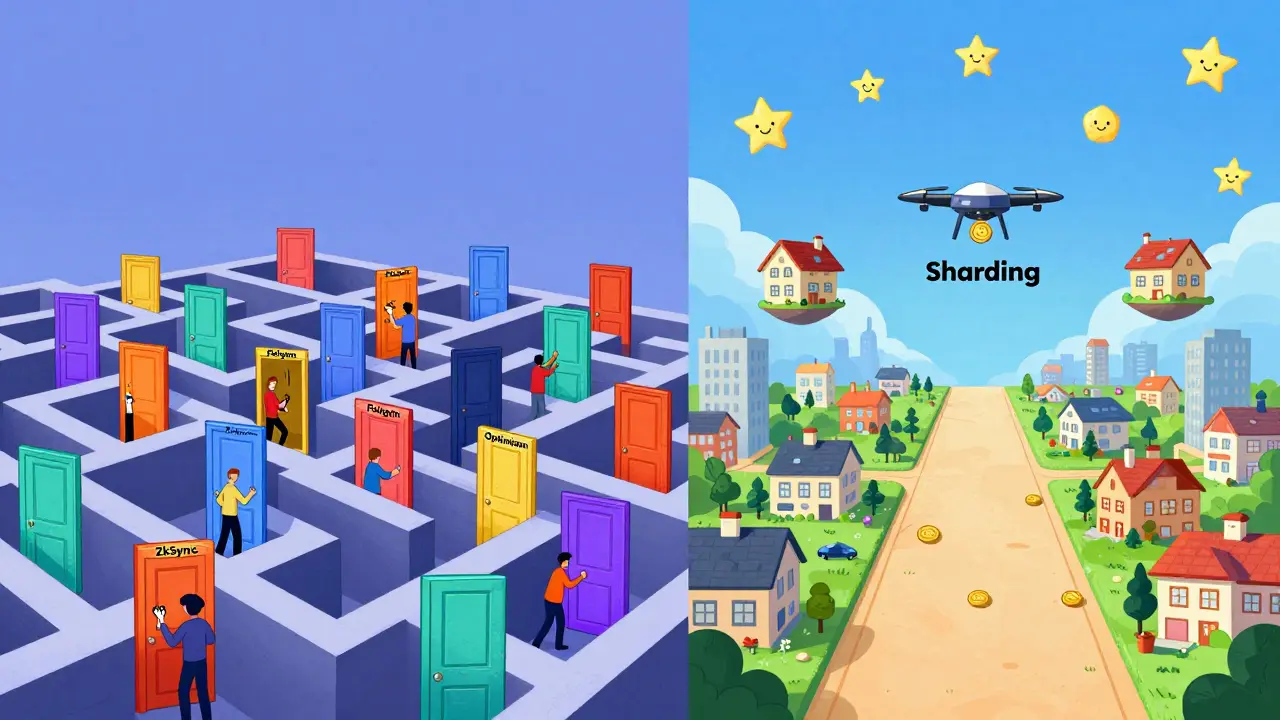
But there’s a catch. Layer 2s still depend on Ethereum (or whatever the base chain is) for security. If the main chain goes down, so do the Layer 2s. Also, moving money between Layer 1 and Layer 2 takes time and gas fees. And if you’re using multiple Layer 2s, bridging between them can be messy-like needing different keys for different doors.
How Sharding Splits the Blockchain
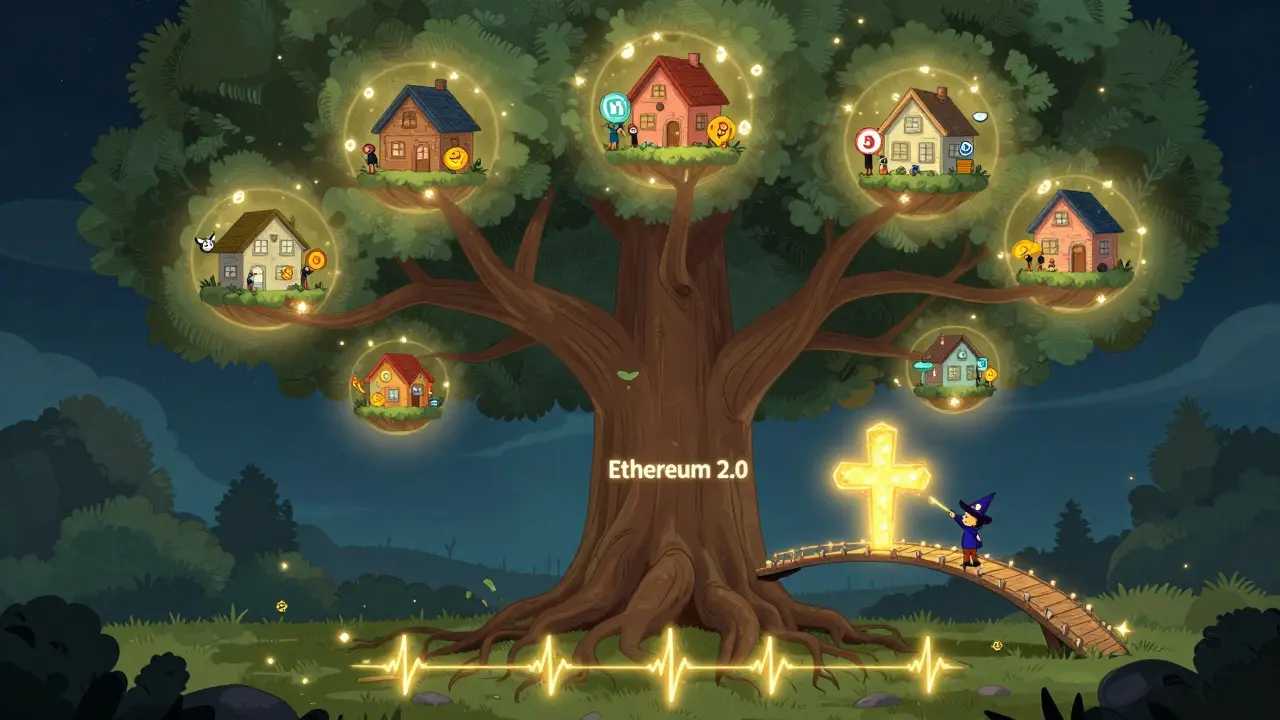
Sharding doesn’t build on top. It splits the blockchain itself into smaller pieces called shards. Each shard handles its own transactions and data. Instead of every node in the network storing every piece of information, each node only keeps the data from one shard. That cuts storage, speeds up processing, and lets the whole network handle more at once.Ethereum 2.0 plans to launch 64 shards. Right now, Ethereum processes about 30 transactions per second. With sharding, it could hit 100,000+. That’s not a small upgrade-it’s a complete overhaul.
NEAR Protocol already uses sharding. It breaks its chain into dynamic shards that adjust based on demand. If one shard gets flooded with NFT minting, it can split further. If another is quiet, it can merge. This flexibility lets the network scale naturally without needing to build new chains.
The biggest win? Native cross-shard communication. If you’re trading an NFT on Shard A and sending tokens from Shard B, it happens automatically. No bridges. No extra steps. No risk of a bridge being hacked. It’s like living in one city where all neighborhoods connect seamlessly.
Security: Who’s Really in Charge?
Layer 2s rely on the main chain for security. That’s good because Ethereum is battle-tested. But it also means Layer 2s inherit Ethereum’s limitations. If Ethereum’s consensus slows down, so do the Layer 2s. Fraud proofs and ZK proofs help, but they’re not foolproof. A clever exploit in a rollup’s code could still drain funds-though the main chain can reverse it.Sharding is different. Security is baked into the protocol. Each shard is validated by the same proof-of-stake mechanism as the main chain. Cross-shard communication is handled by the core network, not by external contracts. That makes it harder to hack. But it also makes sharding harder to build. One mistake in shard coordination can crash the whole network. That’s why only a few chains have done it successfully.
Cost, Speed, and Real-World Use Cases
Layer 2s are the quick fix. They’re already here. They work. You can use them today. If you’re running a DeFi app and need low fees right now, Layer 2s are your best bet. They’re perfect for high-frequency use cases: trading, staking, lending, and microtransactions.Sharding is the long game. It’s not as mature. But if you’re building a metaverse, a gaming platform with thousands of players trading items every second, or a global payment network, sharding gives you true parallel processing. Solana uses a similar approach (though not called sharding), and its speed comes from splitting work across validators.
Cost-wise, Layer 2s reduce fees but still charge for moving assets between layers. Sharding reduces fees at the root level. Nodes don’t need expensive hardware because they’re only handling a fraction of the data. NEAR claims state sharding cuts storage costs by nearly 40%. That means more people can run nodes, which boosts decentralization.
Why Ethereum Chose Layer 2s-and NEAR Chose Sharding
Ethereum’s team, led by Vitalik Buterin, made a strategic call: keep the base layer simple. Instead of building complex sharding logic into Ethereum’s core, they let developers build Layer 2s outside. This gave the ecosystem room to experiment. Rollups evolved fast. ZK-SNARKs got better. New protocols popped up. It was innovation without risking the main chain.NEAR took the opposite path. They believed true scalability needed to be native. If users have to bridge between Layer 2s, the experience breaks. If apps can’t talk to each other seamlessly, the ecosystem stays fragmented. NEAR’s sharding lets apps on different shards interact like they’re on the same chain. No bridges. No extra steps. Just one network.
That’s why NEAR’s ecosystem feels more unified. Games, DeFi, and social apps all live on the same network. Ethereum’s ecosystem is powerful-but it’s split across dozens of Layer 2s, each with its own token, its own wallet, its own rules.
Which One Should You Bet On?
If you’re a user: Layer 2s win. They’re faster, cheaper, and already working. Use Arbitrum for trading, ZkSync for payments, Polygon for NFTs. You don’t need to understand sharding to benefit from Layer 2s.If you’re a developer building a long-term project: Sharding might be better. If your app needs to interact with dozens of other apps, handle thousands of users at once, or scale without adding complexity, sharding gives you a cleaner foundation. It’s harder to build on, but it’s more future-proof.
If you’re a blockchain builder: Layer 2s are easier to launch. Sharding takes years of research and testing. But sharding gives you true scalability. Layer 2s are like adding more lanes to a highway. Sharding is building a whole new highway system with smart traffic control.
The truth? You don’t have to choose. Ethereum uses Layer 2s today, but plans to add sharding later. NEAR uses sharding now, but is exploring Layer 2s for niche use cases. The future isn’t one or the other. It’s both.
What’s Next?
Layer 2s will keep improving. ZK proofs will get faster. Cross-L2 interoperability will get smoother. But they’ll always be limited by the base chain’s capacity.Sharding is still in its early days. Ethereum’s full sharding rollout is years away. But when it lands, it could change everything. Suddenly, blockchain won’t just be for trading and staking. It’ll be for social networks, virtual worlds, and real-time payments at scale.
For now, Layer 2s are the answer to today’s problems. Sharding is the answer to tomorrow’s.

Richard Cooper
March 1, 2026 AT 01:12Tanvi Atal
March 3, 2026 AT 01:00Brian Lemke
March 4, 2026 AT 03:17Mae Young
March 5, 2026 AT 08:27Trenton White
March 6, 2026 AT 23:01Michael Teague
March 8, 2026 AT 01:02kati simpson
March 10, 2026 AT 01:01Cory Derby
March 11, 2026 AT 03:58Colin Lethem
March 12, 2026 AT 22:56Jeremy buttoncollector
March 13, 2026 AT 23:11Sriharsha Majety
March 15, 2026 AT 16:57Tabitha Davis
March 16, 2026 AT 17:58Vishakha Singh
March 17, 2026 AT 17:26Don B.
March 18, 2026 AT 11:02Arya Dev
March 20, 2026 AT 09:43Leslie Cox
March 21, 2026 AT 09:09Andrew Hadder
March 21, 2026 AT 22:48Derek Sasser
March 22, 2026 AT 12:36Shannon Black
March 22, 2026 AT 18:55Dee Resin
March 24, 2026 AT 04:27