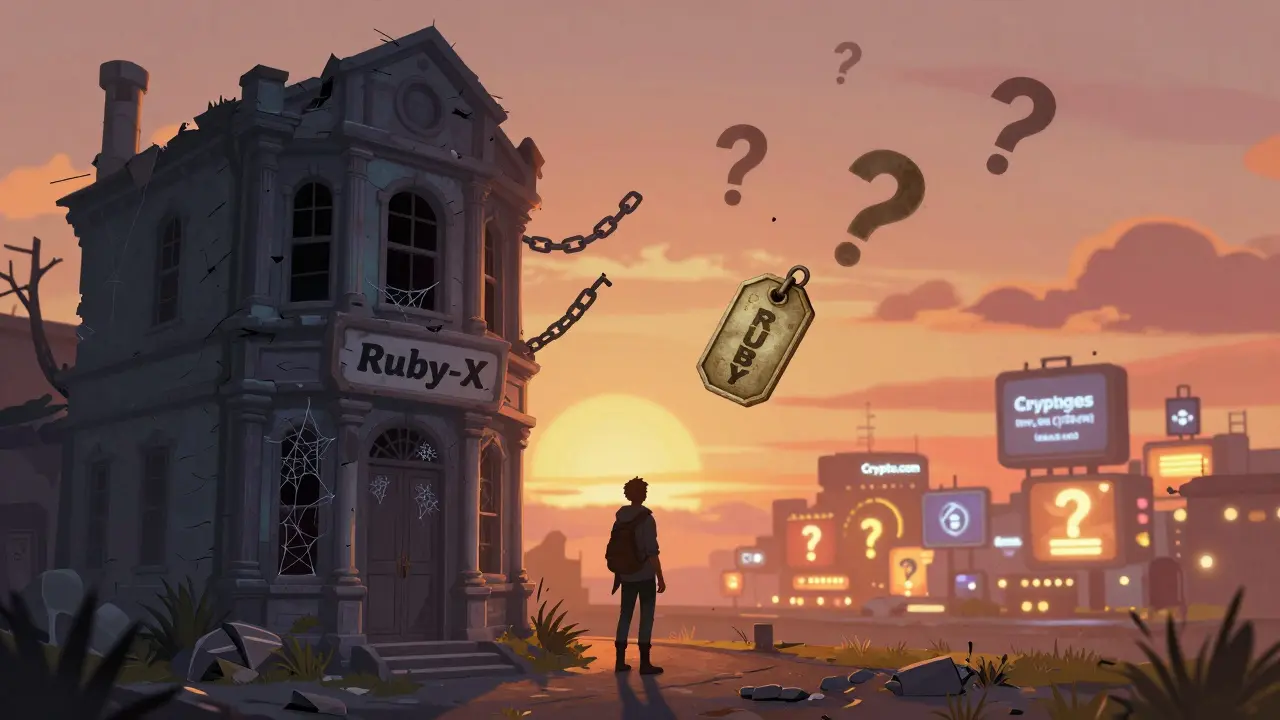
If you're looking at Ruby.Exchange - also called Ruby-X - as a place to trade crypto, you're not alone. But here’s the hard truth: Ruby.Exchange is a mystery. There’s no clear answer on whether it’s a legitimate platform, a startup still in testing, or something that’s already gone quiet. After digging through every public source, forum, and review site in early 2026, the facts are thin. No user reviews. No security audits. No fee schedules. No official blog updates since late 2024. That’s not just unusual - it’s a red flag in a space where transparency is the only thing keeping users safe.
What Is Ruby.Exchange Supposed to Be?
Ruby.Exchange claims to be a full-service crypto exchange where you can buy, sell, and trade digital assets. Their marketing talks about "straightforward, extensible, and unbreakable" systems. Sounds great, right? But those are buzzwords, not features. There’s no breakdown of how the platform works. No mention of whether it uses hot or cold wallets, what encryption it employs, or how it handles withdrawals. Even their own website doesn’t list supported coins, trading pairs, or deposit methods. You can’t even find a clear link to a mobile app or web interface without clicking through multiple unclear redirects.They mention "RUBY trading" as if it’s a major asset, but there’s no public record of RUBY being listed on any major exchange or tracked by CoinMarketCap or CoinGecko. That’s not normal. If a platform is built around trading a specific token, that token should have a public chain, a whitepaper, and at least some trading volume. None of that exists for RUBY. It’s possible it’s an internal token with no real market - which makes the whole exchange feel like a closed loop with no outside value.
How Does It Compare to Real Exchanges?
Let’s put Ruby.Exchange next to platforms people actually use. Kraken supports 466 cryptocurrencies, with maker fees as low as 0.00% and taker fees under 0.40%. Crypto.com offers cashback rewards, crypto debit cards, and staking options with clear terms. Even smaller exchanges like Bitget or KuCoin publish detailed fee tables, security reports, and customer support hours.Ruby.Exchange doesn’t do any of that. No fee structure. No liquidity data. No API documentation. No mobile app on Google Play or Apple App Store. No Twitter account with more than 200 followers. No Reddit community. No YouTube tutorials. No third-party audits from firms like CertiK or Hacken. In 2026, if a crypto exchange doesn’t have at least one of these, it’s not operating like a serious business - it’s operating like a demo site or a honeypot.
Security: No Evidence, No Trust
Security isn’t optional in crypto. It’s the foundation. You don’t just need a password. You need two-factor authentication, cold storage for 95%+ of funds, regular penetration testing, and public proof of reserves. Ruby.Exchange doesn’t publish any of this. No incident reports. No bug bounty program. No insurance fund. No mention of multisig wallets or cold wallet addresses you can verify on-chain.They claim "portable cold wallet functionality," but that’s not a feature - it’s a vague phrase. Cold wallets are physical devices like Ledger or Trezor. You can’t "port" them like a cloud service. If they mean they integrate with hardware wallets, they should say so. If they mean they store your funds in offline vaults, they should show proof. They don’t. That’s not mysterious - it’s negligent.

Who Is Using It? (Spoiler: No One)
Here’s the quietest part of this whole story: nobody is talking about Ruby.Exchange. Not on Reddit. Not on Twitter. Not on Telegram. Not on Trustpilot. Not even on obscure crypto forums in Eastern Europe or Southeast Asia. If 10,000 people were trading on it, someone would’ve posted about a withdrawal delay, a bug, or a profit. But there’s nothing. Zero. Not even a single complaint.That doesn’t mean it’s perfect. It means it’s dead - or never alive. In crypto, silence is the loudest warning sign. Real platforms have chatter. Real users have stories. Real exchanges have memes, TikTok videos, and YouTube unboxings. Ruby.Exchange has nothing. Not even a ghost.
Can You Even Get Started?
Try to sign up. Try to find a "Get Started" button. Try to read their FAQ. Try to find a support email. You can’t. Their website looks like a placeholder. No onboarding flow. No KYC process. No deposit instructions. No withdrawal limits. No help center. No live chat. No ticket system. You’d think a platform that calls itself "comprehensive" would at least have a simple guide: "How to deposit Bitcoin," or "How to trade RUBY." But there’s nothing. Not even a PDF.Without any of this, you’re not just navigating an app - you’re navigating a black box. You’d be depositing money into a system you can’t test, can’t verify, and can’t escape from if something goes wrong. That’s not trading. That’s gambling.
Why This Matters in 2026
The crypto exchange market in 2026 is crowded, competitive, and regulated. Even small players like Bybit and MEXC publish monthly reports on their reserves and security updates. Regulators in the EU, US, and Australia are cracking down on unlicensed platforms. If Ruby.Exchange is operating legally, where’s their license? If they’re not, why are they still online?There’s a chance this is a scam site built to harvest private keys or steal deposits. There’s also a chance it’s a failed project abandoned by its devs. Either way, it’s not a place you should put money. There’s no evidence it works. No proof it’s secure. No community to back it up. And in crypto, if you can’t prove it, you can’t trust it.
What Should You Do Instead?
If you want to trade crypto safely in 2026, stick with platforms that have a track record:- Kraken: Best for advanced traders, deep liquidity, and transparent fee structure.
- Crypto.com: Best for rewards, debit cards, and beginner-friendly features.
- Bitget: Best for copy trading and low fees on altcoins.
- Binance: Best for volume, variety, and global support (if available in your region).
All of them have public audits, user reviews, mobile apps, and customer service. They don’t hide behind buzzwords. They show you the numbers. Ruby.Exchange doesn’t even try.
Final Verdict
Ruby.Exchange isn’t a crypto exchange you can use. It’s a ghost. A placeholder. A risk with no reward. There’s no data, no users, no security, no support, and no future. If you’re looking for a place to trade, walk away. Don’t waste time. Don’t deposit a single dollar. There are dozens of legitimate, transparent, and thriving exchanges waiting for you - none of them require you to guess what’s going on behind the curtain.Is Ruby.Exchange a scam?
There’s no direct proof Ruby.Exchange is a scam, but it shows every red flag of one. No user reviews, no security details, no fee structure, no verified team, and no public presence. In crypto, if a platform hides its basics, it’s usually hiding something dangerous. Treat it as high-risk until proven otherwise - and there’s no evidence it’s proven at all.
Can I withdraw my funds from Ruby.Exchange?
There’s no verified way to deposit or withdraw from Ruby.Exchange. No official withdrawal instructions exist. No user has publicly confirmed a successful withdrawal. If you’ve already deposited funds, assume they’re stuck. Do not send more money. Contacting support is unlikely to help - there’s no public contact method.
Is RUBY a real cryptocurrency?
No. RUBY is not listed on any major crypto tracking site like CoinMarketCap or CoinGecko. There’s no blockchain explorer for it, no wallet support, and no trading volume. It appears to be an internal token with no real market value - likely created to make Ruby.Exchange sound more legitimate than it is.
Why haven’t I heard of Ruby.Exchange before?
Because it doesn’t have a real presence. Major crypto media outlets like CoinDesk, The Block, and Cointelegraph have never covered it. No analysts have mentioned it. No YouTube reviewers have tested it. No Reddit threads discuss it. If it were a real, active exchange, it would be impossible to miss. Its silence speaks louder than any marketing claim.
Should I use Ruby.Exchange if I’m new to crypto?
Absolutely not. New users are the most vulnerable to fake platforms. Stick with well-known exchanges that have been around for years, have clear terms, and offer customer support. Platforms like Kraken, Crypto.com, or Bitget have beginner guides, tutorials, and help centers. Ruby.Exchange has none of that - and that’s not a feature. It’s a danger.






Amanda Markwick
February 25, 2026 AT 06:28It’s wild how many platforms just vanish into thin air these days. I’ve seen this pattern before - the buzzwords, the lack of transparency, the silence. It’s not just Ruby.Exchange; it’s the whole vibe of crypto now. Too many people chasing the next big thing without asking who’s actually building it. I’ve walked away from more than a few ‘promising’ projects because they refused to show their work. This isn’t skepticism - it’s basic hygiene. If you can’t explain how your platform works in plain terms, you’re not ready for real users.
Sriharsha Majety
February 25, 2026 AT 18:24bro i tried signing up like 3 times and it just froze on the captcha page lmao i think its just a dummy site
Tabitha Davis
February 26, 2026 AT 16:48OMG I LOVE THIS POST. I KNEW IT. I TOLD MY FRIENDS THIS WAS A SCAM. I EVEN WENT TO A CRYPTO MEETUP LAST WEEK AND ASKED IF ANYONE USED RUBY.EXCHANGE. NO ONE EVEN KNEW WHAT I WAS TALKING ABOUT. I’M SURE IT’S A FRONT FOR SOME THERAPY BOT THAT STEALS YOUR KEYS AND THEN SAYS ‘I’M SORRY YOU FEEL THAT WAY’ IN A SMOOTH VOICE. THIS IS THE FUTURE. WE’RE ALL JUST PUPPETS.
Arya Dev
February 28, 2026 AT 12:49...and yet... people still send money to these places... why?... because they think... it’s gonna be the next binance... but it’s not... it’s just a... placeholder... for... a... dream... that... died... in... 2023...
Leslie Cox
March 1, 2026 AT 08:41Let’s be honest - if a platform doesn’t have a Twitter account with more than 10K followers, a YouTube channel with 50K subs, and a Discord server with 5000 active members, it doesn’t exist. Ruby.Exchange is a digital ghost story. And yet, somehow, people still fall for this. I’ve seen it: someone’s cousin’s friend’s dog walker invested $5000 because the site had a nice color scheme. That’s not investing. That’s performance art.
Paul Reinhart
March 3, 2026 AT 00:25I’ve been in crypto since 2017, and I’ve watched dozens of platforms rise and fall. What’s striking about Ruby.Exchange isn’t just that it’s silent - it’s that it’s silent in a world that’s never quiet. Even the worst exchanges have at least one angry Reddit thread. One person who lost money. One guy who says, ‘I deposited, then the site went down.’ That’s the bare minimum of legitimacy. Ruby.Exchange doesn’t even have that. It’s not a scam - it’s an absence. And in crypto, absence is the most dangerous thing. It means no one’s even angry enough to warn you. It means you’re being ignored by the entire ecosystem.
Robert Conmy
March 4, 2026 AT 18:07You people are too soft. This isn’t a ‘red flag’ - it’s a neon sign flashing ‘RUN’. No audits? No team? No mobile app? You’re not ‘researching’ - you’re giving your private keys to a black hole and hoping for a miracle. I’ve seen this movie before. The first 100 people get to withdraw $20. Then the site goes dark. Then the devs post a ‘temporary maintenance’ tweet and vanish. Don’t be one of the 101st. Delete the tab. Close your eyes. Walk away. Now.
Lilly Markou
March 5, 2026 AT 11:03While I appreciate the thoroughness of this analysis, I must respectfully submit that the absence of empirical evidence does not necessarily equate to malefic intent. One must consider the possibility that Ruby.Exchange is a private, permissioned network operating under non-disclosure agreements, or perhaps a research initiative funded by a consortium of academic institutions seeking to explore decentralized infrastructure under constrained regulatory environments. To label it a ‘scam’ without verified forensic data is, frankly, premature.
McKenna Becker
March 7, 2026 AT 03:57Zero reviews. Zero transparency. Zero future. Walk away.
precious Ncube
March 8, 2026 AT 06:38If you’re even considering depositing into Ruby.Exchange, you’re already one step away from financial ruin. This isn’t about risk - it’s about basic competence. If you can’t tell the difference between a real exchange and a PowerPoint deck, you shouldn’t be near crypto. Period.
Amita Pandey
March 8, 2026 AT 21:58The philosophical underpinnings of this critique are profoundly aligned with the epistemological framework of trust in decentralized systems. A platform that refuses to disclose its operational mechanics violates the fundamental axiom of cryptographic transparency. The absence of verifiable data is not merely an omission - it is an ontological negation of the very concept of trustworthiness. One cannot engage with an entity that refuses to be known. Ruby.Exchange is not a platform; it is a negation.
Jan Czuchaj
March 10, 2026 AT 02:31I’ve been helping beginners navigate crypto for years. And honestly? The hardest part isn’t learning how to trade. It’s learning how to say ‘no’ to shiny things. Ruby.Exchange is the ultimate test of discipline. It looks like a real exchange. It has the right buzzwords. It even has a name that sounds like a luxury brand. But if you have to guess how to deposit, how to withdraw, or whether your funds are even stored somewhere - then you’re not trading. You’re gambling. And if you’re gambling, you’re not ready. Take a breath. Go to Kraken. Learn the basics. Build your confidence. Then come back. This isn’t about FOMO. It’s about staying alive.
Tracy Peterson
March 10, 2026 AT 04:30I don’t care how ‘mysterious’ it sounds - if you can’t find a single person who’s used it successfully, it’s dead. I’ve been in crypto since 2015. I’ve seen dozens of ghost platforms. This one? It’s not even a ghost. It’s a tombstone with no name on it.
Dianna Bethea
March 10, 2026 AT 14:12Just wanted to add - if you’re new and saw this post, please don’t panic. Just remember: real exchanges don’t make you guess. They show you. They guide you. They answer your questions. If you can’t find a ‘how to deposit’ page, that’s not a bug - it’s a feature of the scam. Stick to the big names. Use their apps. Watch their YouTube tutorials. You don’t need to chase the next big thing. You just need to not lose your money.
KingDesigners &Co
March 11, 2026 AT 15:41LOL. this is why crypto is a joke. people spend hours writing essays about a site that doesn’t even have a working button. i tried to sign up and got a 404. i laughed so hard i spilled my coffee. if you’re still reading this, you’re already lost. go buy bitcoin on coinbase and stop wasting your life.
Felicia Eriksson
March 13, 2026 AT 08:29quietly deleting my draft of a deposit request
aaron marp
March 13, 2026 AT 21:35I’ve been thinking about this for days. The real tragedy isn’t that Ruby.Exchange is fake - it’s that so many people want it to be real. We’re so desperate for something new, something revolutionary, that we ignore the red flags because they feel like boring old rules. But crypto isn’t about innovation - not really. It’s about trust. And trust is built on transparency, not buzzwords. If you can’t explain your wallet system in 30 seconds, you don’t deserve to be in this space. I’m not mad. I’m just sad for the people who still believe.
Patrick Streeb
March 14, 2026 AT 08:53While the analysis presented is comprehensive and logically sound, one might consider the possibility that Ruby.Exchange operates under a regulatory framework not yet recognized by Western jurisdictions - for instance, a jurisdictional sandbox under the auspices of a sovereign digital asset zone. The absence of public documentation may reflect intentional opacity, not malice. Further investigation into jurisdictional licensing regimes beyond the Anglosphere may yield alternative interpretations.
Tracy Whetsel
March 14, 2026 AT 23:23My best friend lost $8k on something like this in 2022. She thought the ‘RUBY’ token was going to be the next Solana. She cried for weeks. I didn’t say ‘I told you so.’ I just sat with her. Now? We both only use Coinbase and Kraken. No drama. No guessing. Just clear fees, real support, and actual withdrawals. You don’t need to be a genius to trade crypto. You just need to be smart enough to walk away from the glitter.
Amanda Markwick
March 15, 2026 AT 18:18That last comment about your friend... that hit me. That’s the real story behind all these posts. Not the tech. Not the fees. Not the tokens. It’s the people who lost their savings because they trusted a website that looked too pretty to be fake. We talk about scams like they’re abstract. But they’re not. They’re real. They’re your sister. Your cousin. Your coworker. We need to stop treating crypto like a game and start treating it like a responsibility. Ruby.Exchange isn’t just a ghost - it’s a warning.