You log into your trading app, ready to buy Bitcoin, only to see a cold, hard message: "Service Unavailable in Your Region." It’s frustrating. You might be wondering if you’re doing something wrong or if the platform is just broken. Usually, it’s neither. You’ve hit a regulatory wall.
OKX is a leading global cryptocurrency exchange that serves millions of users but restricts access based on strict national laws and international sanctions. Founded in 2017 as OKEx, it has grown into one of the largest platforms by volume, processing over $13 billion daily. But size doesn’t mean universal access. In fact, where you can trade depends entirely on where you live.
As of August 2026, the landscape for crypto exchanges is tighter than ever. Governments are cracking down, and exchanges like OKX are playing defense. This guide breaks down exactly which countries are blocked, which have limited features, and what this means for your ability to trade.
The Three Tiers of Restriction
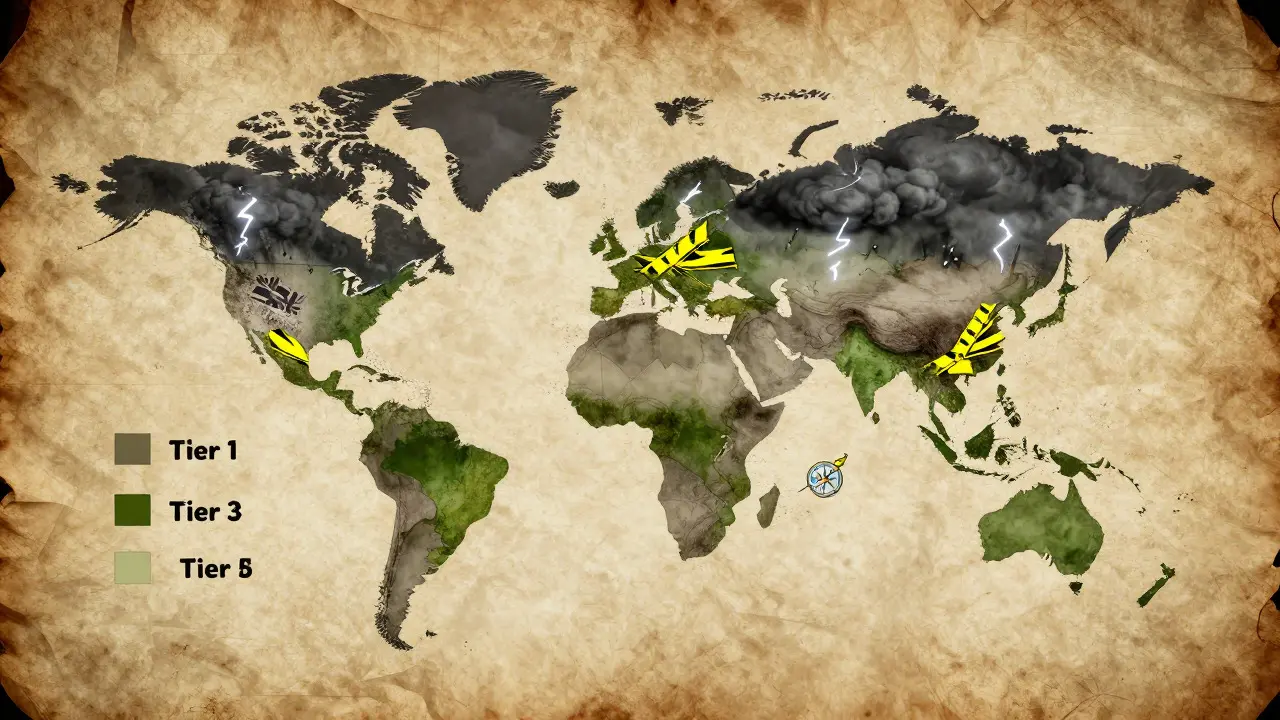
Not all bans are created equal. OKX categorizes its restrictions into three distinct tiers. Understanding which tier applies to your location is the first step in figuring out your options.
Tier 1: Complete Service Bans
In these jurisdictions, OKX blocks access entirely. You cannot create an account, deposit funds, or trade. This list includes major economies and sanctioned regions:
- United States (including residents)
- Canada
- United Kingdom
- Singapore (for the global entity)
- Malaysia
- Bahamas
- Cuba, Iran, North Korea, Syria
- Crimea, Donetsk, and Luhansk regions
If you live here, you are effectively locked out of the main OKX platform. The reason? Compliance with U.S. sanctions (via OFAC) and local financial regulations that either ban crypto or require specific licenses OKX does not hold globally.
Tier 2: Territorial and Specific Country Blocks
This group includes U.S. territories and other nations with specific regulatory hurdles:
- Puerto Rico
- Guam
- Northern Mariana Islands
- U.S. Virgin Islands
- Bangladesh
- Bolivia
- Malta
Users in these areas face similar total bans, often due to alignment with U.S. federal banking rules or local government directives.
Tier 3: Feature-Limited Access
This is the most confusing category. You can use OKX, but not everything works. Countries like Australia, Brazil, and South Korea fall here. You can trade spot markets (buying and holding coins), but derivatives like futures and perpetual contracts are prohibited. Why? Because regulators in these countries view leveraged trading as too risky for retail investors without stricter oversight.
The Singapore Paradox: A Case Study in Confusion
If you’re in Singapore, you might be scratching your head. Singapore is on the Tier 1 ban list for the global OKX platform. So why do some people there still trade?
It comes down to corporate structure. OKX operates a separate entity called OKX Singapore, which is regulated by the Monetary Authority of Singapore (MAS). This entity serves only Singaporean residents who meet specific criteria. However, if you try to sign up for the global OKX app using a Singapore IP address, you will likely be rejected. The key is knowing which portal you are accessing. This split-entity approach is common among large exchanges trying to navigate complex local laws, but it creates a fragmented user experience.
How OKX Enforces These Rules
You might think you can bypass these restrictions using a Virtual Private Network (VPN). Before you try, know this: OKX uses sophisticated detection methods.
| Method | Accuracy/Impact | Risk to User |
|---|---|---|
| IP Geolocation | 99.2% accuracy | Immediate login block |
| Device Fingerprinting | Detects hardware ID changes | Account flagging for review |
| KYC Document Verification | Checks address against banned lists | Permanent account termination |
In September 2025 alone, OKX closed over 14,000 accounts for "geolocation fraud." If you use a VPN to trick the system, you risk losing your funds. The platform’s terms explicitly prohibit this, and enforcement is strict. When you submit your Know Your Customer (KYC) documents, the address on your ID is cross-referenced with their banned list. If you’re from Texas but claim to live in Germany, the mismatch will trigger a manual review-and likely a ban.
Why Does This Matter? Comparing Exchanges
Is OKX stricter than its competitors? Let’s look at the data. As of late 2025, Binance restricts access in 49 countries, while Coinbase operates primarily in the U.S. and 41 other compliant jurisdictions. Kraken bans 47 countries but keeps limited operations in Canada.
OKX ranks fourth in regulatory comprehensiveness among top exchanges. Its advantage is liquidity; by serving 160 countries, it offers deep order books even in smaller markets. The downside? Fragmentation. A CoinTelegraph study found that 63% of users in partially restricted countries felt confused about which features were available to them. If clarity is your priority, Coinbase or Kraken might offer simpler, albeit more limited, experiences. If you need advanced trading tools and live in a permitted region, OKX remains a top choice.
What’s Changing in 2026?
The regulatory environment is shifting fast. Here’s what you need to watch for:
- U.S. Expansion Plans: OKX has announced discussions with U.S. regulators to launch a compliant entity. While no timeline is set, this could open doors for American traders in the future.
- EU MiCA Regulations: With the Markets in Crypto-Assets (MiCA) regulation fully effective since December 2024, OKX has adjusted services across Europe. Derivatives are now restricted for many EU residents, aligning with stricter consumer protection rules.
- New Market Entries: In late 2025, OKX expanded derivatives access to Thailand and Vietnam, showing a proactive approach to emerging markets.
- Increased Scrutiny: Japan’s Financial Services Agency issued warnings in August 2025, and France’s AMF added OKX to its restricted list in September. Expect more such actions as governments tighten controls.
Analysts predict that by mid-2026, OKX will establish compliant operations in 35 previously restricted countries through local partnerships. However, the U.S. market remains a significant hurdle due to ongoing legal battles involving other exchanges like Binance.
Practical Steps for Traders
If you’re unsure about your status, follow these steps:
- Check the Official List: Visit OKX’s Risk & Compliance Disclosure page. It’s updated regularly and lists all restricted jurisdictions.
- Verify Your Identity Early: Mandatory KYC is required for all core features. Level 1 verification allows $10,000 daily transactions; Level 3 goes up to $1 million. Start this process before you deposit large sums.
- Monitor Local Laws: Just because OKX allows you to trade doesn’t mean your country does. Tax obligations and legal protections vary wildly. In Australia, for example, you can trade spot crypto, but you must report gains to the ATO.
- Avoid Workarounds: Don’t use friends’ IDs or fake addresses. The risk of permanent fund loss outweighs the convenience.
Can I use OKX in the United States?
Currently, no. The United States is on OKX's Tier 1 restriction list. Residents are blocked from creating accounts or trading. While OKX has discussed launching a U.S.-compliant entity, there is no active service for U.S. citizens as of August 2026.
Why is Singapore both banned and allowed?
The global OKX platform restricts Singaporean IPs to comply with international standards. However, a separate entity, OKX Singapore, is regulated by the Monetary Authority of Singapore (MAS) and serves local residents who qualify under specific criteria. Ensure you are signing up for the correct regional version.
What happens if I use a VPN to bypass restrictions?
You risk permanent account termination. OKX uses IP geolocation, device fingerprinting, and KYC document verification to detect fraud. In 2025, over 14,000 accounts were closed for geolocation fraud. Funds may be frozen during investigation.
Which countries have limited features instead of full bans?
Countries like Australia, Brazil, South Korea, and the UK allow spot trading but restrict derivatives (futures and perpetual contracts). This is due to local regulations that limit leveraged trading for retail investors.
Is OKX safe to use in permitted countries?
Yes, for users in permitted regions. OKX maintains a robust compliance framework, including Proof of Reserves audits and multi-entity regulatory structures. It ranks highly in security and liquidity, though users should always verify local tax laws and regulatory status.
Will OKX expand to the U.S. soon?
OKX has announced plans to explore a U.S.-compliant entity following discussions with regulators. However, no specific launch date has been confirmed. The U.S. regulatory environment remains complex, with ongoing lawsuits affecting other major exchanges.
How does OKX compare to Binance in terms of restrictions?
Binance restricts access in 49 countries, while OKX serves approximately 160 countries with varying levels of restriction. OKX’s approach involves separate regulated entities for different regions, offering more nuanced access but potentially causing confusion. Binance has faced larger fines for regulatory non-compliance.

Candice Cornett
August 10, 2026 AT 12:42typical corporate cowardice. they hide behind 'compliance' while their executives fly private jets to tax havens. if they really cared about freedom they would just let us trade like adults instead of treating us like children who need babysitting by the SEC and MAS
Lance Jantz
August 10, 2026 AT 19:48Oh, Candice, you always see the grand conspiracy in every terms-of-service agreement, don't you? It is quite the dramatic flair you bring to the mundane reality of financial regulation. But tell me, does your outrage actually help you navigate the labyrinthine corridors of global finance, or does it merely serve as a theatrical backdrop for your own intellectual superiority? I find that true enlightenment comes not from screaming at the clouds but from understanding the intricate dance between state power and digital currency. The ban is not a conspiracy; it is a bureaucratic necessity born of fear, yes, but also of order. And we must respect the order, even if it stifles our wild spirits.
Kat Bennett
August 12, 2026 AT 12:49I have been trying to figure this out for weeks because I honestly thought there was some kind of loophole I was missing, especially since my cousin in Canada seems to be struggling with similar issues on other platforms, and it is so frustrating when you feel like you are being left out of the conversation entirely, but reading this makes me realize that maybe the system is just designed to keep things simple for the majority even if it feels exclusionary to those of us who are eager to participate in the crypto revolution, and I guess we just have to wait and see if the US expansion plans actually come to fruition because hope is a powerful thing and I truly believe that eventually technology will overcome these artificial barriers that governments try to impose on us
Don Fizy
August 14, 2026 AT 04:50Hey folks! :) Just wanted to chime in and say that checking your local laws is super important before you dive in. Don't want anyone getting burned! If you are in a restricted area, look into Kraken or Coinbase depending on where you live. Stay safe out there! :)
Ed Mitchell
August 15, 2026 AT 06:35The entire concept of 'compliance' is a facade designed to track your every move. They claim it is for your protection, but in reality, it is about control. The 14,000 accounts closed for 'geolocation fraud' are not victims; they are martyrs in the war against privacy. OKX is working hand-in-hand with the deep state to ensure that no one can escape the surveillance net. Trust nothing. Verify everything. The government wants you poor and tracked.
Ken G
August 17, 2026 AT 01:00ed mitchell is right. the whole thing is rigged. why do you think they banned the us? because they know we are too smart to fall for their fiat scam. okx is just another pawn in the chess game of the elite. keep your cash off grid if you can. trust no one
Emma Smith
August 17, 2026 AT 17:13the ontological status of a blockchain transaction is irrelevant if the legal framework surrounding it is unstable. we are essentially playing a game of jenga with our financial security while the regulators pull blocks from the bottom. it is a precarious existence isn't it. i find myself wondering if the KYC process is less about security and more about creating a database of dissenters. very interesting dynamic
Billy Cunningham
August 17, 2026 AT 22:26😐
Ed Wallace
August 18, 2026 AT 15:48Billy, silence is golden, but sometimes words illuminate the darkness. This article touches upon a profound philosophical dilemma: the tension between individual liberty and collective order. When OKX restricts access, are they protecting the user from risk, or are they enforcing a hegemonic narrative of financial safety? It reminds me of Plato's cave, where the shadows on the wall are mistaken for reality. Here, the 'Service Unavailable' message is the shadow, hiding the complex machinery of geopolitical maneuvering behind it. We must ask ourselves: what is the nature of value in a world where access is gated by geography?
Joshua Hofford
August 20, 2026 AT 13:12I think it is pretty cool how different countries handle this. In Thailand, they are opening up derivatives, which shows that progress is possible. It gives me hope that maybe one day the US will follow suit. We should celebrate these small victories because they pave the way for a more inclusive future. Let's stay positive and keep learning about the market!
Marcia Albert
August 21, 2026 AT 21:19it is like watching a slow-motion car crash. you know the regulations are coming, you can smell the bureaucracy in the air, but you still sit there hoping against hope that maybe, just maybe, the rules won't apply to you. then bam. tier 1 ban. cold hard reality check. singapore is such a weird edge case though. half in, half out. it is like living in a liminal space where the walls are made of red tape and the floor is lava
Erica Johnson
August 22, 2026 AT 21:58you guys are overthinking this. just use a vpn if you have to. wait no the article says they catch you. okay fine. but seriously, if you are in the US you are screwed anyway. might as well use coinbase and pay higher fees. it is what it is. :)
Lorraine Surringer
August 24, 2026 AT 09:34honestly i think people are just lazy. if you want to trade crypto you should do your homework. dont blame okx for following the law. its not their fault the government is scared of decentralized money. stop whining and start researching. its basic personal responsibility. ugh
Alex Di Mango
August 25, 2026 AT 13:42Let's all try to understand each other here. Some people are genuinely confused, and others are frustrated. There is room for both perspectives. I appreciate the detailed breakdown in the post. It helps clarify things for many of us. Let's keep the discussion respectful and informative.
Amor Jordan
August 26, 2026 AT 08:27I hear you, Alex. It is easy to get heated when your financial freedom feels threatened. But let's remember that everyone has their own journey. For those in Tier 1 countries, it is indeed a heavy burden. For those in Tier 3, it is a confusing maze. We should support each other in navigating these challenges rather than judging those who struggle. Empathy goes a long way.
Nick Darring
August 27, 2026 AT 04:30You know what I think? I think the whole idea of 'restricted features' is a joke. Why should Australians get spot trading but no futures? It is arbitrary nonsense designed to appease regulators without actually solving anything. And don't get me started on the Singapore paradox. It is a mess. A complete and utter mess. But hey, at least we have something to complain about, right? Because complaining is free, unlike trading on OKX if you live in the wrong zip code. It is absurd, really. The fragmentation of the market is going to kill liquidity in the long run, but sure, let's pretend it is all fine and dandy.
Eden Tadesse
August 28, 2026 AT 07:27i agree with nick. it is so confusing. why cant they just make one rule for everyone? it would be so much easier. but i guess thats life now. gotta read the fine print every time u log in. typos in my head today sorry
Michael Mostyn
August 29, 2026 AT 11:25The data presented regarding the enforcement methods is particularly illuminating. Device fingerprinting represents a significant leap in surveillance capability compared to mere IP geolocation. One must consider the implications for privacy advocates. If hardware IDs are being tracked, the notion of anonymity in cryptocurrency is further eroded. This suggests a future where pseudonymity is effectively dead, replaced by a fully identified digital identity tied to physical location. A sobering prospect indeed.
Phil Babb
August 30, 2026 AT 00:21LISTEN UP!!! IF YOU ARE IN THE EU WATCH OUT FOR MiCA!!! IT CHANGES EVERYTHING!!! DERIVATIVES ARE GONE FOR MANY OF YOU!!! DO NOT GET CAUGHT OUT!!! CHECK YOUR LOCAL LAWS NOW!!! STOP BEING LAZY AND READ THE REGULATIONS!!! THIS IS YOUR WARNING!!!