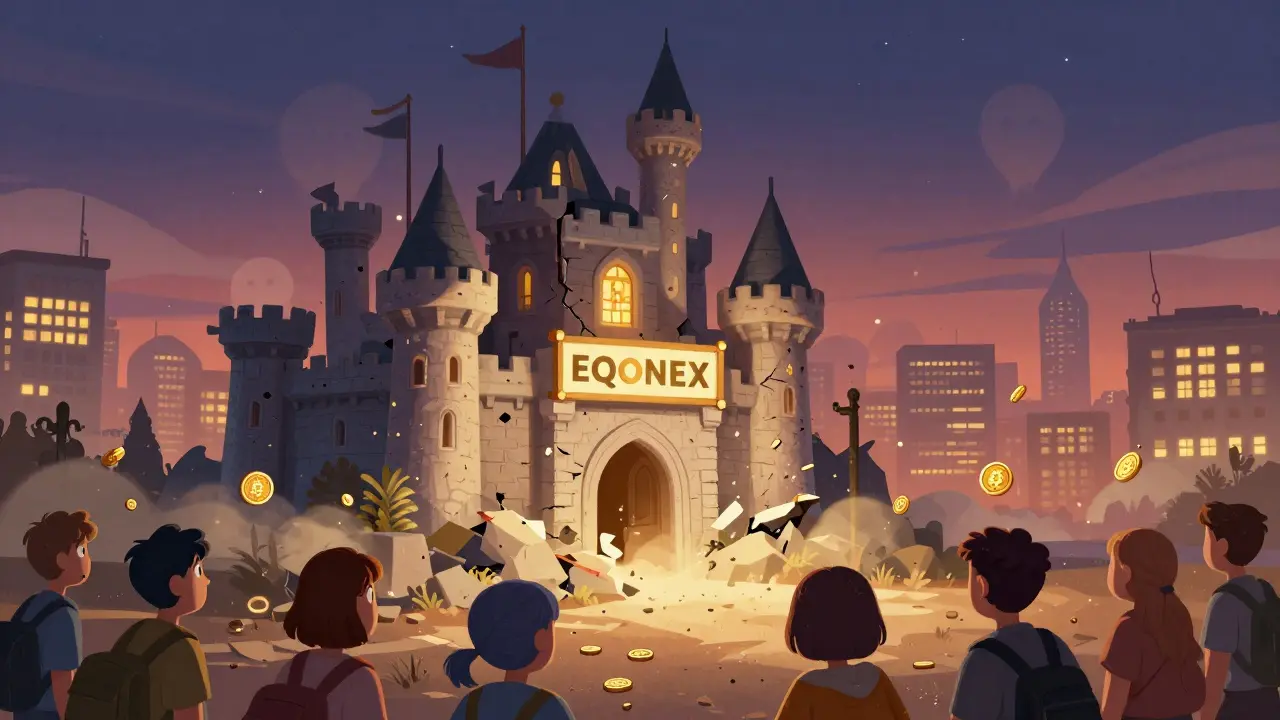
EQONEX was once promoted as a serious player in the crypto exchange space - low fees, a native token, and a Singapore base made it look legit. But today, it's gone. Completely. No website. No trading. No customer support. Just silence. If you're looking for a crypto exchange to use in 2026, EQONEX isn't an option. It hasn't been for over three years. This isn't a review of a working platform. It's a postmortem of what went wrong - and what you should learn from it.
What EQONEX Actually Was
EQONEX started as EQUOS Exchange in May 2020, owned by Diginex, a company that made headlines by becoming the first crypto exchange to list on Nasdaq under the ticker EQOS. At launch, it promised a clean, simple interface with no minimum deposits and low trading fees. It supported spot trading, futures with leverage, and introduced its own token, EQO, in April 2021. Holding EQO gave users reduced fees, staking rewards, and even free withdrawals if you had over 500 EQO in your wallet. Daily airdrops of EQO were also offered, which sounded like a nice perk.
The platform had a basic but functional trading view. Charts showed candlesticks, moving averages, RSI - the usual tools. Order books were clear. Support was reportedly fast, with some users saying replies came in under three minutes. But even then, red flags were there. The number of supported cryptocurrencies stayed small - never hitting 100, while competitors like Kraken offered 400+. And while most exchanges let you trade spot with leverage, EQONEX only allowed it on futures. That meant if you wanted to go long on Bitcoin with 5x leverage, you couldn’t do it on the spot market. You had to jump into riskier perpetual contracts.
The Slow Death of Trading Volume
EQONEX never gained real momentum. In June 2021, its 24-hour trading volume hit $180 million. A year later, in December 2021, it had dropped to $85 million. That’s not just a decline - that’s a collapse. In crypto, volume is oxygen. No volume means no liquidity. No liquidity means traders leave. And once traders leave, the exchange becomes a ghost town.
Compare that to Kraken, which consistently handled over $2 billion daily in 2021. Or Coinbase, which had millions of active users. EQONEX didn’t have a unique product. It didn’t have institutional backing. It didn’t have regulatory clarity. It was operating under a temporary exemption from Singapore’s Monetary Authority, not a full license. That’s like running a bank without a permit. No serious investor or fund would touch it.
Why It Closed - And What Really Happened
In November 2022, EQONEX announced it was shutting down. The official reason? "Streamlining operations" and focusing on asset management and custody services. CEO Jonathan Farnell said they were leaving the "crowded crypto exchange space" to chase more profitable areas. That sounds reasonable - until you dig deeper.
Traders Union, a watchdog group, labeled EQONEX as "fraudulent" in its 2025 review. They pointed to declining volume, lack of transparency, and the sudden bankruptcy as signs of deeper issues. No official audit was released. No plan for user fund recovery was made public. And now, in 2026, there’s no trace of any compensation for users who had Bitcoin, Ethereum, or EQO tokens on the platform.
Meanwhile, Diginex quietly shifted gears. It hired ex-Jefferies sales executives to build a new business offering structured crypto products to institutions - think leveraged ETFs and synthetic exposure. No retail traders. No public exchange. Just private deals for wealthy clients. That’s not a pivot - it’s an exit.
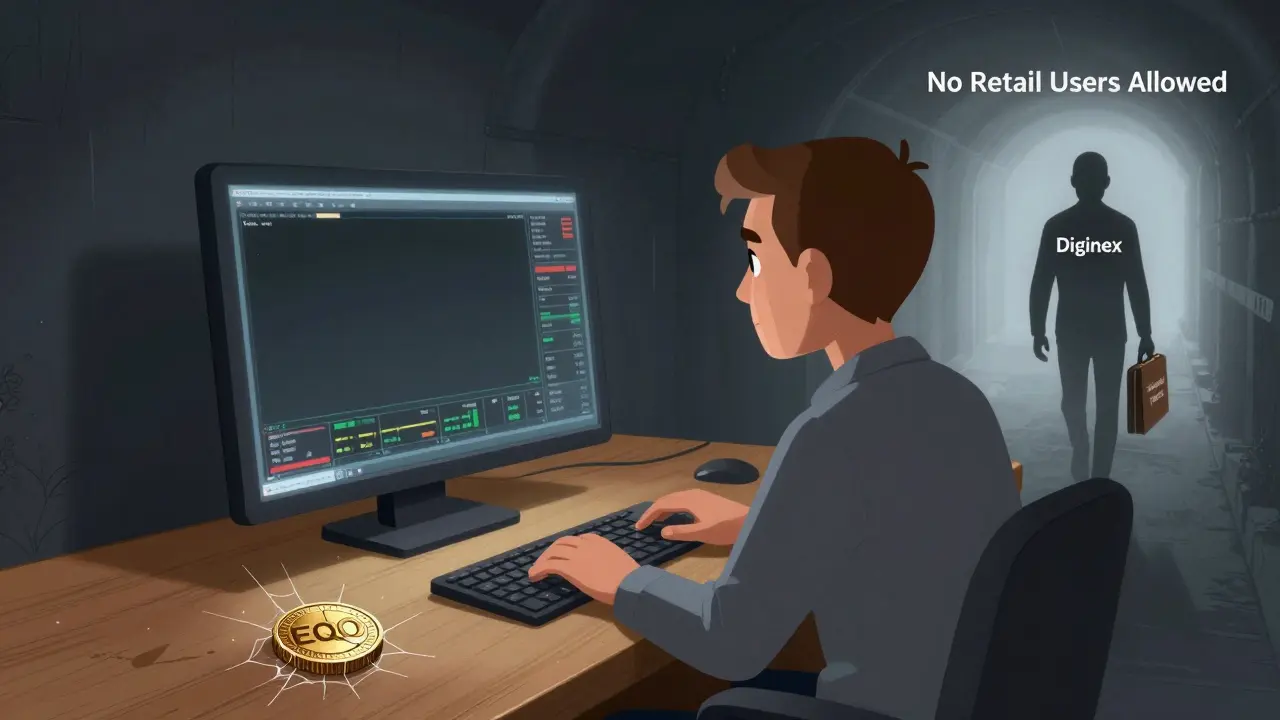
What You Lost When EQONEX Died
If you held assets on EQONEX when it shut down, you were out of luck. Centralized exchanges like this one hold your keys. That means they control your funds. When they go bankrupt, your crypto becomes part of their debt. Creditors get paid first. Users? Often last. And in EQONEX’s case, there’s no public record of anyone getting anything back.
The EQO token? Worthless now. The airdrops? Gone. The staking rewards? Frozen. The platform’s website? Redirects to Diginex’s corporate page. No trading interface. No login. No hope.
How EQONEX Compares to Today’s Top Exchanges
Today’s reliable exchanges don’t just have more coins - they have trust. Kraken has been operating since 2011 and has never been hacked. It’s licensed in multiple jurisdictions, offers insurance on deposits, and has a 10/10 Trust Score on CoinGecko. Coinbase is regulated in the U.S., has over 100 million users, and supports direct bank deposits. Crypto.com offers cashback, debit cards, and staking with clear terms.
EQONEX had none of that. No insurance. No clear license. No long-term track record. Just a flashy token and a promise of low fees. When the market turned in 2022 - with FTX collapsing, Celsius freezing withdrawals, and TerraUSD crashing - EQONEX didn’t survive the storm. It wasn’t a victim of bad luck. It was a victim of poor planning, weak regulation, and lack of real demand.
What You Should Do Instead
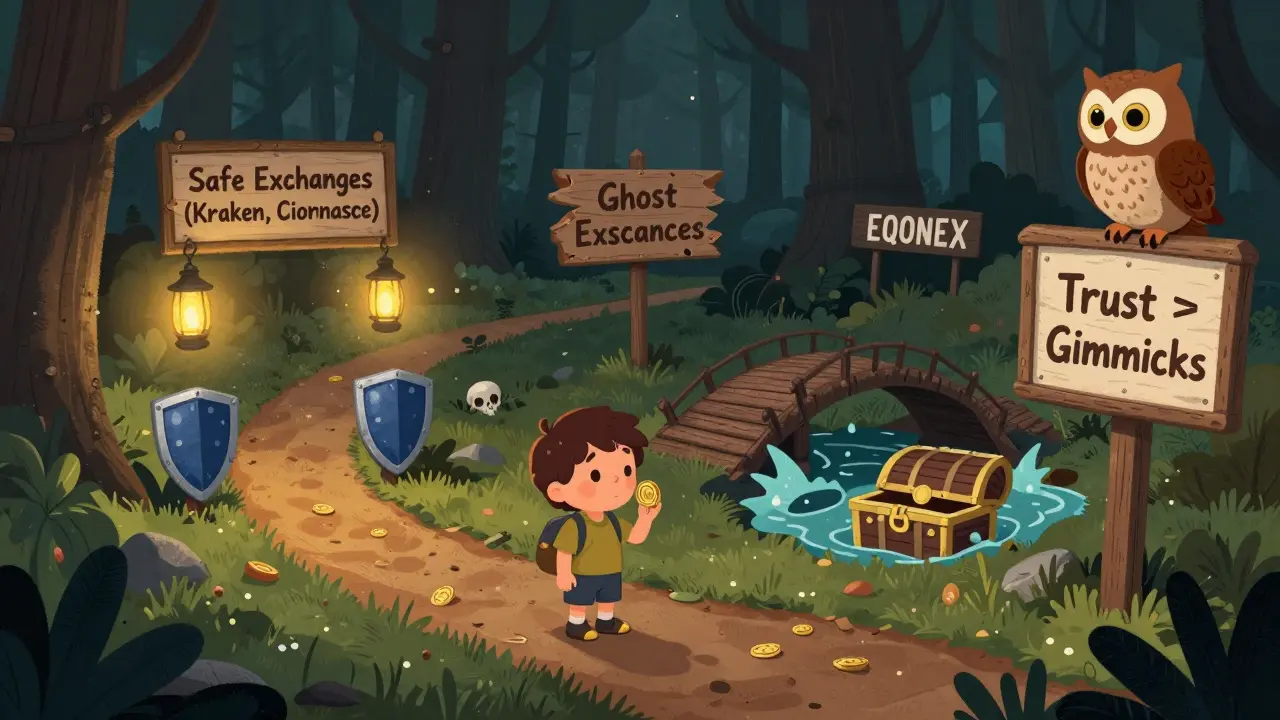
If you’re looking to trade crypto in 2026, skip the ghost platforms. Stick with exchanges that:
- Have been around for five+ years
- Are licensed in at least one major jurisdiction (U.S., EU, UK, Singapore, Japan)
- Offer insurance or cold storage guarantees
- Have real, verifiable trading volume (not inflated by fake bots)
- Don’t rely on a single token to make their platform work
Platforms like Kraken, Coinbase, and Uphold meet all these criteria. They’ve survived bear markets, regulatory crackdowns, and crypto winters. EQONEX didn’t. And that’s the biggest lesson here: crypto exchanges are not all created equal. Some are built to last. Others are built to vanish.
Final Thoughts
EQONEX was never going to win. It entered a market dominated by giants with deeper pockets, stronger regulation, and loyal users. It offered nothing new. It failed to build trust. And when the crunch came, it didn’t have the resources to survive. Now, it’s a footnote - a warning sign for anyone thinking they can start a crypto exchange with a nice UI and a token airdrop.
Don’t look for EQONEX. Don’t search for it. Don’t even remember its name. Just remember this: if an exchange shuts down without warning, and leaves you with no way to recover your funds - it was never safe to begin with.
Is EQONEX still operating in 2026?
No, EQONEX ceased operations in November 2022 after filing for bankruptcy. Its website and trading platform are completely offline. There is no way to access accounts, withdraw funds, or trade on the platform. Any site claiming to be EQONEX is a scam.
Can I get my money back from EQONEX?
There is no public record of users recovering funds after EQONEX’s bankruptcy. As a centralized exchange, it held custody of user assets. When it collapsed, those assets became part of its bankruptcy estate. Creditors were prioritized. Retail users were not. Without an official liquidation plan or court-ordered payout, recovery is highly unlikely.
Was EQONEX regulated?
EQONEX operated under a temporary exemption from Singapore’s Monetary Authority, not a full license. This meant it was not fully compliant with anti-money laundering or customer protection rules. Most reputable exchanges today hold full licenses - like Kraken in the U.S. or Crypto.com in Hong Kong. EQONEX’s regulatory ambiguity made it a risky choice even before it shut down.
What happened to the EQO token?
The EQO token lost all value after EQONEX shut down. It was never listed on any other major exchange, and its utility (fee discounts, staking, collateral) vanished with the platform. Trading for EQO stopped entirely. Today, it has zero market value and is not tradable anywhere.
Why did EQONEX fail when other exchanges survived?
EQONEX failed because it didn’t stand out. It had fewer coins than competitors, no insurance for user funds, no full regulatory license, and declining trading volume. While platforms like Kraken and Coinbase invested in security, compliance, and user trust, EQONEX relied on gimmicks like token airdrops. When the crypto market crashed in 2022, it had no buffer - and no path forward.




Lorna Gornik
March 21, 2026 AT 09:39like bro, you don’t just slap a coin on a mediocre platform and call it a day. RIP user funds. Classic.
John Alde
March 22, 2026 AT 09:22Brijendra Kumar
March 23, 2026 AT 10:32Kayla Thompson
March 25, 2026 AT 04:06Kevin Da silva
March 25, 2026 AT 11:43no license
no volume
no surprises
Annette Gilbert
March 26, 2026 AT 04:11Turns out the only thing free was my trust. I lost 3 BTC. Not even a 'sorry' from Diginex. Just silence. And now they’re out here selling structured products to rich people like they’re saints. I’m not mad. I’m just disappointed in humanity.
Joshua T Berglan
March 26, 2026 AT 12:04Florence Pardo
March 27, 2026 AT 07:33And honestly? The fact that Diginex pivoted to institutional products without ever addressing user losses? That’s not smart. That’s cold.
Jenni Moss
March 28, 2026 AT 13:06maybe EQONEX just needed more time? I mean, look at how long it took Coinbase to get legit! They had drama too! We should give them a chance to come back!! 💖
manoj kumar
March 29, 2026 AT 00:44Andrew Midwood
March 30, 2026 AT 15:21Ananya Sharma
April 1, 2026 AT 06:10vu phung
April 1, 2026 AT 12:40Alicia Speas
April 3, 2026 AT 00:11JOHN NGEH
April 4, 2026 AT 18:43There’s no shame in learning the hard way - but there’s shame in not sharing what you learned. Thanks for writing this. It matters.