Fath Supply Calculator
Humanode's Fath system automatically adjusts token supply based on network usage. The supply increases by the same percentage as transaction volume grows, distributing new tokens to all holders.
Results
New Supply: 0 HMND
Total Circulating Supply: 0 HMND
Token Distribution: 0%
Humanode isn't another altcoin trying to be faster or cheaper. It’s trying to solve a problem most blockchains ignore: How do you know the person on the other side is actually a real human? Traditional blockchains like Bitcoin and Ethereum rely on mining power or token holdings to validate transactions and secure the network. That creates a system where the rich get richer - those with more money or more powerful hardware control the network. Humanode flips that. It says: one human = one node = one vote. No exceptions. No whales. No bots.
How Humanode Works: Biometrics Instead of Tokens
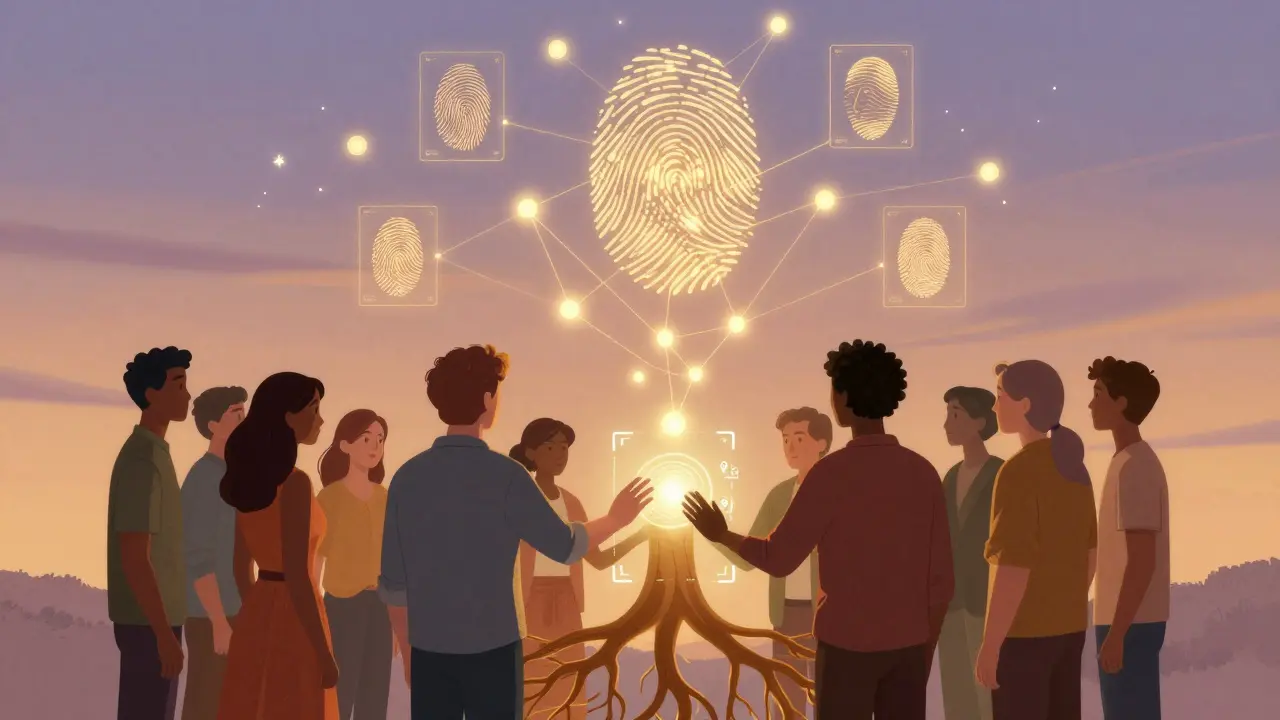
Instead of staking HMND tokens or running expensive mining rigs, you prove you’re a real person using your body. That’s right - your face, your fingerprint, or another unique biological trait. When you set up a Humanode node, the app captures a biometric sample from your device’s camera or sensor. That data isn’t stored as an image. It’s turned into a mathematical template - a digital fingerprint of your uniqueness - and locked into the blockchain. Once verified, you become a node. And that node gets a vote in network decisions, no matter how many HMND tokens you own.
This is called Proof-of-Uniqueness. It’s not about how much you have. It’s about who you are. And it’s designed to stop Sybil attacks - where one person creates hundreds or thousands of fake accounts to take over a network. On Bitcoin, you’d need millions in mining gear. On Humanode, you’d need hundreds of real people willing to scan their faces. That’s nearly impossible.
The HMND Token: More Than Just a Currency
The HMND token is the fuel of the Humanode network, but it doesn’t work like Ethereum’s ETH or Solana’s SOL. You don’t need to buy HMND to run a node. You don’t even need to own any to participate. That’s a radical break from the rest of crypto.
Instead, HMND powers the network’s monetary system, called Fath. Fath is a self-adjusting economy. If the network processes more transactions - meaning more people are using it - the total supply of HMND increases by the same percentage. That new supply is distributed evenly to every active node holder. So if network fees go up 5%, the money supply grows 5%, and everyone holding HMND gets 5% more. No mining. No staking. Just growth tied to real usage.
Node operators earn rewards from transaction fees, paid in HMND. But here’s the twist: fees are calculated in USD terms. So if HMND’s price swings wildly, your cost to use the network doesn’t change. A $0.10 transaction fee stays $0.10, no matter if HMND is at $0.02 or $0.05. That makes it practical for real-world use, not just speculation.
Why This Matters: The Governance Revolution
Most blockchains are governed by token holders. The more tokens you own, the more votes you get. That leads to centralization. A handful of wallets control 80% of Ethereum’s voting power. Humanode says: no. Every human gets one vote. Period.
This changes everything for DAOs (decentralized autonomous organizations). Imagine a community fund where every member - whether they own $100 or $1 million in crypto - has equal say. No rich investors can buy control. No bots can flood the vote. It’s like digital democracy, built into the code.
Early adopters are excited. One user on CryptoSlate said: “Finally, a blockchain that prevents whale dominance in governance - this could be revolutionary for DAOs if the biometrics work reliably.” That’s the dream. And it’s why Humanode has backing from heavyweights like Tribe Capital, Republic Capital, and even Polygon co-founders.

The Big Problems: Privacy and Accessibility
But here’s the catch. Storing biometric data on a blockchain sounds like a nightmare for privacy. Once it’s on-chain, it’s immutable. You can’t delete it. GDPR in Europe and BIPA in Illinois say you have the right to be forgotten. Humanode claims it doesn’t store raw images - only encrypted templates. But can you really trust that? What if a government demands access? What if the encryption is cracked?
And what about people without smartphones? Or those with disabilities that make facial recognition unreliable? Or people in countries where biometric collection is banned? Humanode’s system could exclude millions. It’s a beautiful idea - but it risks becoming a tool for the tech-savvy elite, not the global population.
Then there’s the scale problem. Can a biometric system handle billions of users? Can it work reliably in poor lighting, with masks, or across different skin tones? Early testers report issues. The tech is promising, but it’s still young.
Market Position and Real-World Use
As of late 2023, Humanode’s market cap hovered around $3.4 million. That’s tiny compared to Ethereum’s $200 billion. It’s ranked around #1576 on CoinGecko. It’s not a mainstream coin. It’s a bet on the future.
Its price has been volatile, trading between $0.015 and $0.036. Analysts predict it could hit $0.24-$0.46 by 2026 - but that’s based on adoption, not current usage. Right now, there are few real-world applications. No major exchanges list it widely. No apps are built on it yet. It’s still in the lab.
But the potential is there. The digital identity market is expected to hit $38 billion by 2030. Governments and companies are desperate for secure, fraud-proof identity systems. Humanode isn’t just a coin - it’s a prototype for a new kind of online identity. If it solves privacy and accessibility, it could be the foundation for voting systems, social networks, and even decentralized healthcare records.

Who Is Building This?
The team behind Humanode includes Ph.D.s in cryptography and biometric security. Sasha Shln, the Chief Research Officer, has a background in decentralized systems at Paradigm. Hardik Gajera specializes in private biometric authentication. Their backers aren’t random investors - they’re firms that understand deep tech.
The code is open-source on GitHub, with around 15 active contributors. That’s small compared to Ethereum’s hundreds, but it’s steady. They’re not chasing hype. They’re building slowly, carefully. Their security tool, Humanode BotBasher, is already in use to test the network’s resistance to fake nodes.
Is Humanode Right for You?
If you’re looking for a quick crypto flip, skip it. HMND isn’t going to moon next month. It’s too early, too niche, too risky.
If you care about digital democracy, hate whale-dominated DAOs, and believe identity should be human-centered - not token-based - then Humanode is worth watching. It’s not perfect. It’s not proven. But it’s one of the few projects trying to fix the root problem of crypto: the disconnect between money and humanity.
Think of it this way: Bitcoin solved digital scarcity. Ethereum solved programmable money. Humanode is trying to solve digital identity. And if it works, it could change how we interact online - not just as investors, but as people.
What is the total supply of HMND?
The total and maximum supply of HMND is fixed at 400 million tokens. As of late 2023, around 150-160 million were in circulation. Unlike most cryptocurrencies, HMND’s supply can increase over time through its Fath monetary system, which expands the supply in proportion to network usage growth.
Do I need to buy HMND to run a node?
No. You don’t need to own any HMND tokens to become a node operator. Humanode’s design allows anyone to join the network by proving they’re a real human through biometric verification. Tokens are earned as rewards from transaction fees, not required for participation.
How does Humanode prevent fake identities?
Humanode uses biometric authentication - like facial recognition or fingerprint scanning - to verify each user is a unique human. The system creates a mathematical template of your biological traits, not a stored image. This template is recorded on the blockchain. The network’s BotBasher tool continuously tests for duplicate or spoofed identities, making it extremely difficult to create multiple fake nodes.
Is Humanode safe for my biometric data?
Humanode claims it doesn’t store raw biometric images - only encrypted, one-way mathematical templates. However, because the blockchain is immutable, you can’t delete this data later. This raises serious privacy concerns under regulations like GDPR, which grant users the right to be forgotten. Experts warn that if this data is ever compromised, it could lead to irreversible identity theft.
Can I use Humanode on my phone?
Yes. The Humanode app is designed to run on modern smartphones with biometric sensors - like Face ID or fingerprint scanners. You don’t need special hardware. But if your device doesn’t support these features, or if you’re in a region where biometric collection is restricted, you won’t be able to join the network.
What makes Humanode different from Ethereum or Solana?
Ethereum and Solana rely on token staking or mining power to secure their networks. That gives control to those with the most money or hardware. Humanode uses biometric proof to ensure each node is a real human. This removes financial barriers to participation and prevents wealthy actors from dominating governance. It’s a shift from wealth-based control to human-based equality.





Adam Bosworth
December 6, 2025 AT 04:22Uzoma Jenfrancis
December 6, 2025 AT 14:03Renelle Wilson
December 7, 2025 AT 00:08Elizabeth Miranda
December 7, 2025 AT 20:09Chloe Hayslett
December 9, 2025 AT 09:29Jonathan Sundqvist
December 9, 2025 AT 10:07Jerry Perisho
December 11, 2025 AT 07:15Manish Yadav
December 12, 2025 AT 16:30Krista Hewes
December 13, 2025 AT 23:54Noriko Robinson
December 14, 2025 AT 08:28Mairead Stiùbhart
December 15, 2025 AT 21:42ronald dayrit
December 17, 2025 AT 07:47Doreen Ochodo
December 17, 2025 AT 10:20Tisha Berg
December 17, 2025 AT 14:35Billye Nipper
December 18, 2025 AT 03:12Roseline Stephen
December 19, 2025 AT 04:06Jon Visotzky
December 19, 2025 AT 12:32Isha Kaur
December 20, 2025 AT 21:22