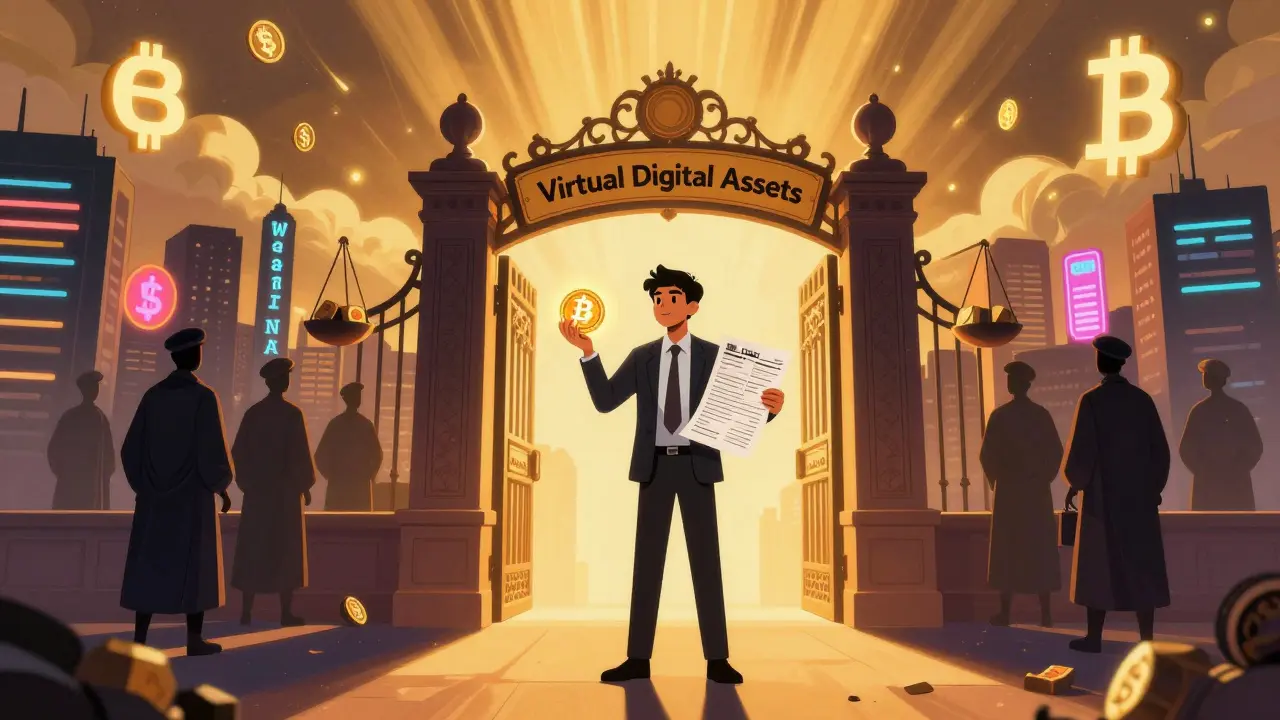
India doesn’t ban cryptocurrencies, but it doesn’t treat them like money either. As of 2026, you can buy, sell, and hold Bitcoin, Ethereum, and other digital assets legally - but only if you’re ready to pay heavy taxes, jump through compliance hoops, and accept that no business has to take your Bitcoin as payment. This isn’t a ban. It’s a cage with high walls and a steep price tag.
They’re Not Money - Just Digital Assets
In India, cryptocurrencies aren’t called "crypto" in official documents. They’re labeled Virtual Digital Assets (VDAs). That’s not just a name change. It’s a legal reset. The government made this shift in 2022 to avoid recognizing them as currency, which would mean they could be used to pay for groceries, rent, or electricity. Instead, VDAs are treated like collectibles or commodities - think gold or rare stamps - but with digital records on a blockchain.
This means you can’t walk into a store in Mumbai and pay for a phone with Dogecoin. Even if the shop owner says yes, the law doesn’t back that transaction. Only the Reserve Bank of India’s digital rupee has legal tender status. Everything else? It’s just data with a price tag.
Trading Is Legal - But Taxed Like a Lottery Win
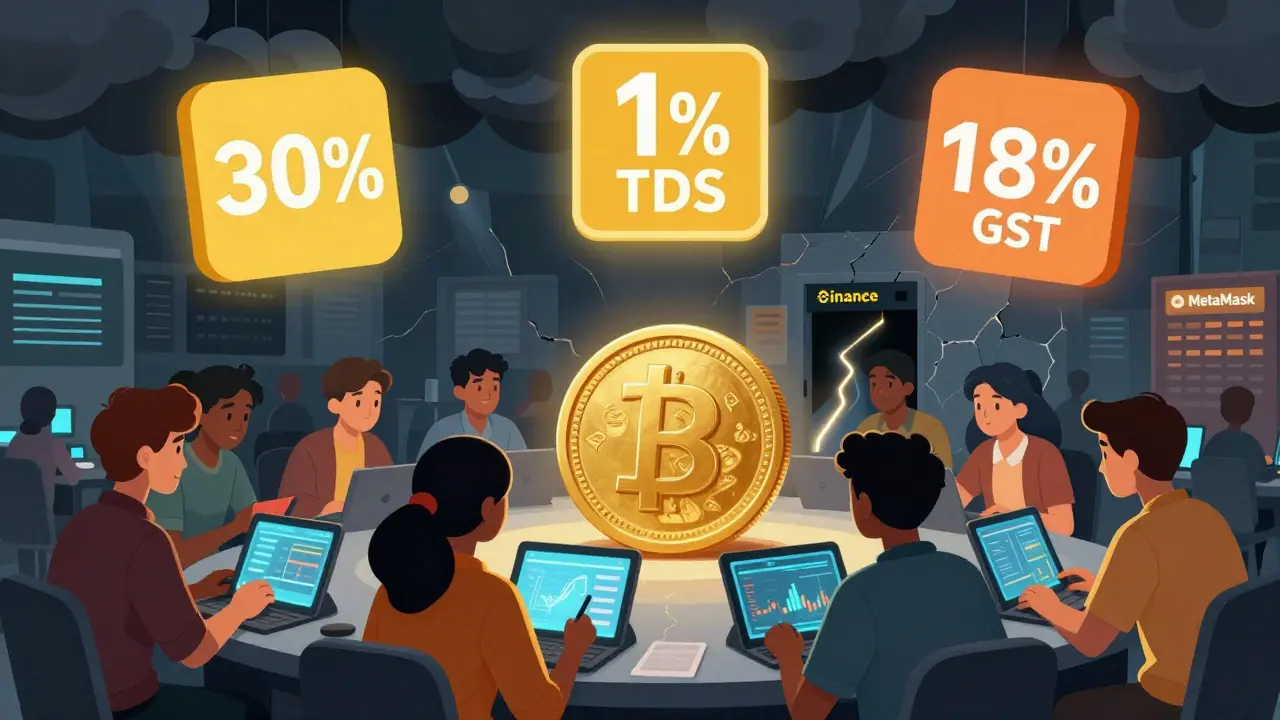
Here’s the reality: if you trade crypto in India, you’re paying one of the highest tax rates in the world. The government slapped on a flat 30% tax on all profits from selling crypto, no matter how long you held it. That’s not like stocks, where holding for over a year cuts your tax in half. In India, even if you bought Bitcoin yesterday and sold it today, you still owe 30% of your gain.
And that’s not all. There’s also a 1% Tax Deducted at Source (TDS). Every time you sell crypto - even a small amount - the exchange takes 1% of the total transaction value and sends it to the government. So if you sell $1,000 worth of Ethereum, $10 gets taken before you even see your money. You don’t get this back. It’s not a refundable deposit. It’s a tax on the sale, not the profit.
Then came the 18% GST in July 2025. Bybit and other major exchanges started charging this on every trade - spot, margin, staking, even withdrawals. That’s right: you pay tax on the act of moving your crypto, not just when you cash out. Add it up: 30% income tax + 1% TDS + 18% GST = up to 49% in taxes on a single trade. For someone trading frequently, that’s a death sentence for small profits.
The Compliance Maze: Who’s Watching You
It’s not just about taxes. If you run a crypto exchange, wallet service, or even a peer-to-peer trading platform in India, you must register with the Financial Intelligence Unit (FIU-IND) under the Prevention of Money Laundering Act. This isn’t optional. Since March 2023, every VDA service provider has to:
- Verify every user’s identity (KYC)
- Track every transaction
- Report suspicious activity
- Keep records for at least five years
Smaller platforms couldn’t afford this. Many shut down. International exchanges like Binance and Kraken started blocking Indian users. Only big players like WazirX, CoinDCX, and ZebPay survived - and they did it by spending millions on compliance tech. Now, if you want to trade crypto in India, you’re mostly stuck with just a few domestic platforms.
SEBI Just Jumped In - And It Changes Everything
On April 1, 2025, the Securities and Exchange Board of India (SEBI) took control of crypto tokens that act like securities. That means if a token promises you profits based on someone else’s work - like a DeFi staking pool or a tokenized real estate project - SEBI now regulates it like a stock. You can’t just launch a new token and sell it to the public. You need approval. You need disclosures. You need to follow strict rules.
This doesn’t affect Bitcoin or Ethereum. But it kills a lot of DeFi projects and new blockchain startups. If your token looks like an investment, SEBI says it’s a security. And securities in India? They’re heavily controlled. This move signals that the government isn’t just taxing crypto - it’s trying to control its growth.
Why the Supreme Court Ruling Still Matters
Back in 2020, the Supreme Court overturned the Reserve Bank of India’s 2018 ban on banks dealing with crypto firms. That ban had shut down every exchange in the country. No bank accounts. No withdrawals. No deposits. It was a total freeze.
The court called that ban "disproportionate" and unconstitutional. That ruling didn’t legalize crypto - but it did stop the government from cutting off its lifeline. Today, banks can and do work with crypto exchanges. That’s why you can still deposit rupees, buy Bitcoin, and withdraw cash. Without that 2020 decision, crypto in India would be dead.
The 107 Million Users and the Silent Majority
Despite all this, over 107 million Indians are using crypto. That’s more than the population of Germany. Why? Because inflation is high. The rupee is weak. And global crypto markets offer returns that Indian stocks and mutual funds can’t match. Many users are young, tech-savvy, and tired of traditional finance.
But most aren’t using regulated exchanges. They’re on international platforms like Bybit, OKX, or decentralized wallets like MetaMask. They’re using P2P platforms like LocalBitcoins or Paxful. They’re trading with friends via UPI. They’re avoiding TDS. They’re not reporting gains. They’re gambling - not just on price, but on whether the government will ever catch them.
What’s Next? The Quiet Push for a New Law
The government has been talking about a new cryptocurrency bill since June 2025. No one’s seen it. No one knows what’s in it. But experts expect it to do two things: first, make the tax rules even stricter - maybe even taxing staking rewards and airdrops as income. Second, it might introduce a licensing system for crypto businesses, turning them into regulated financial institutions.
The Reserve Bank of India still hates crypto. They call it a threat to financial stability. The Finance Ministry? They love the tax revenue. That’s why they’re not banning it. They’re monetizing it.
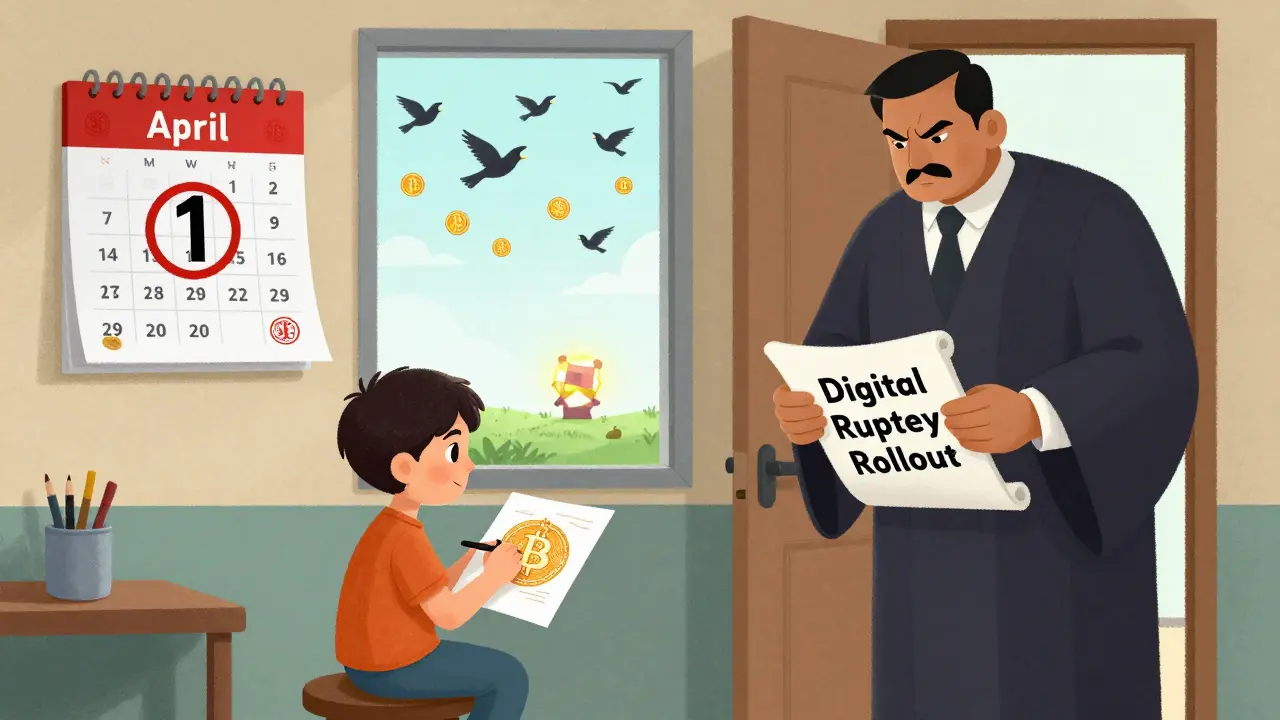
Meanwhile, the digital rupee - India’s own central bank digital currency - is slowly rolling out. It’s not meant to compete with Bitcoin. It’s meant to replace cash. And once people get used to a government-backed digital currency, they might stop caring about Bitcoin altogether.
The Bottom Line
Cryptocurrency in India is legal - but it’s treated like a dangerous hobby. You can own it. You can trade it. But you’ll pay more in taxes than in most Western countries. You’ll be tracked. You’ll be limited. And if you try to use it to buy anything real, you’re on your own.
If you’re an investor, you’re playing a high-stakes game with rules that change every few months. If you’re a developer, you’re building on shaky ground. If you’re just curious? You can still join - but know this: the government didn’t make crypto legal because it believes in it. They made it legal because they figured out how to tax it.
Is it legal to buy Bitcoin in India in 2026?
Yes, buying, selling, and holding Bitcoin and other cryptocurrencies is legal in India. They are classified as Virtual Digital Assets (VDAs), and there is no law banning individuals from owning them. However, you must comply with tax rules and reporting requirements.
Can I use crypto to pay for goods and services in India?
Technically, yes - if both you and the seller agree. But legally, no. Cryptocurrencies are not legal tender in India. No business is required to accept them, and you cannot force someone to take crypto as payment for a debt. Only the digital rupee issued by the RBI has legal tender status.
What is the tax rate on crypto gains in India?
Crypto gains are taxed at a flat 30%, with no deductions allowed except for the cost of acquisition. In addition, a 1% TDS applies on every crypto transaction over a certain threshold, and an 18% GST is now charged on trading fees, staking, and withdrawals by major exchanges. Combined, this can push your effective tax rate above 49%.
Do I need to report my crypto trades to the government?
Yes. All Indian residents must report crypto gains as income in their annual tax return. Exchanges are required to report transactions to the Income Tax Department and deduct 1% TDS. Failure to report can lead to penalties, interest, or even prosecution under income tax laws.
Are decentralized exchanges (DEXs) legal in India?
Using DEXs like Uniswap or PancakeSwap is not explicitly illegal, but they are not regulated. If you trade on them, you’re responsible for tracking your own taxes and reporting gains. The government has no way to monitor DEX activity, but if you later cash out through a regulated exchange, your transactions may be traced back.
What happens if I don’t pay crypto taxes in India?
You risk penalties, interest charges, and legal action under the Income Tax Act. The government has access to transaction data from regulated exchanges and can match it with your tax filings. Non-compliance can lead to fines up to 200% of the unpaid tax, asset seizure, or even criminal prosecution in extreme cases.






Kevion Daley
March 24, 2026 AT 03:07At this point, crypto in India is just a high-stakes tax evasion simulation.
Tammy Stevens
March 25, 2026 AT 02:01It's like letting your kid have a pet snake - you let them keep it, but you make them clean the cage, pay for its food, and never let it leave the house. The VDA label? That's the snake enclosure.
And honestly? The 18% GST on withdrawals? That's the real genius. You're not just taxing profit - you're taxing movement. It's psychological. You start to think twice before even moving your coins.
Justin Credible
March 25, 2026 AT 07:13Sam Harajly
March 25, 2026 AT 08:55This is a regulatory innovation, even if it’s punitive. It’s a third way between full legalization and prohibition. The fact that they’ve managed to tax every possible interaction - trades, staking, withdrawals - shows deep policy design. It’s not anti-crypto. It’s anti-unregulated-crypto.
And honestly? The SEBI move on security tokens is the most consequential. They didn’t shut down DeFi - they forced it into the financial system. That’s not repression. That’s integration.
Zion Banks
March 26, 2026 AT 19:55And don’t get me started on the digital rupee. That’s not a currency - it’s a weapon. Once you’re on it, they can freeze your money for political dissent. They’re not taxing crypto - they’re replacing freedom with code.
Annette Gilbert
March 27, 2026 AT 00:53Most of them are 19-year-olds who saw a meme about Dogecoin and thought, 'I’m gonna be rich before my dad finds out I skipped class again.'
And the 'silent majority'? More like the silent majority who don’t pay taxes and hope the IT department never finds their MetaMask.
John Alde
March 27, 2026 AT 11:34And the GST on staking? That’s absurd. You’re being taxed on interest income as if it were a service fee. That’s not crypto policy - that’s bureaucratic ignorance. The government is treating blockchain like a vending machine, not a financial system.
Meanwhile, the real innovation is happening off-chain: P2P UPI trades, offshore wallets, decentralized bridges. The law doesn’t control behavior - it just makes it riskier. And that’s why adoption keeps growing. People don’t care about compliance. They care about returns.
manoj kumar
March 28, 2026 AT 13:12We have 1.4 billion people. If you can't handle 30% tax, go work in a call center. Crypto isn't for broke dreamers. It's for those who play by rules - even if the rules are unfair.
Alicia Speas
March 28, 2026 AT 13:33That’s the difference between authoritarianism and governance. India chose governance. They could have shut it down. They chose to tax it, regulate it, and absorb it into the financial architecture. That’s not a cage - it’s a transition.
And honestly? The digital rupee isn’t meant to replace Bitcoin. It’s meant to replace cash. Once cash disappears, crypto becomes a bridge - not a threat.
Jeannie LaCroix
March 29, 2026 AT 16:54The way India turned a global financial revolution into a bureaucratic tax trap is both genius and horrifying. You can’t blame them - they’re trying to control a force they can’t contain.
But here’s what no one says: this is the first time a major economy has tried to monetize crypto without embracing it. That’s a new model. And if it works? The world will copy it. Not because it’s fair. Because it’s profitable.
Sarah Terry
March 29, 2026 AT 22:48It’s not about revenue - it’s about deterrence.
Shayne Cokerdem
March 30, 2026 AT 09:57then why not just ban it?? like if you hate it so much why let people do it??
aravindsai pandla
March 31, 2026 AT 03:04This isn’t suppression. It’s assimilation. And for a country with such deep informal economic roots, that’s a quiet revolution.