Back in 2013, the crypto world was exploding with new coins. Everyone wanted a "Bitcoin killer" or a faster alternative. One of those projects was Feathercoin, an open-source cryptocurrency launched as a community-driven experiment. Today, it sits quietly in the background of the market. It’s not trending on Twitter, and you won’t find it dominating headlines. But for long-time enthusiasts and hobbyist miners, it remains a fascinating piece of crypto history that is still technically alive.
If you are wondering what happened to this coin, how much it costs now, or whether it is worth your time, you have come to the right place. We will break down its origins, its current status in mid-2026, and what makes it tick under the hood.
The Origins: A Fork Born from Community Spirit
To understand Feathercoin, you have to look at where it came from. It wasn't built from scratch. Instead, it started as a fork of Litecoin, which itself was based on Bitcoin. This lineage gives Feathercoin a unique heritage. It combines the technical stability of Bitcoin with the speed improvements originally introduced by Litecoin.
Peter Bushnell, an IT manager at Brasenose College, University of Oxford, founded the project in April 2013. His goal wasn't to create a complex financial instrument. He wanted something approachable. The name "Feathercoin" suggests lightness and ease. The logo features a feather, reinforcing the idea of a lightweight, user-friendly digital currency.
In the early days, around January 2014, the community was buzzing. Users reported prices hovering around $0.37 per coin. Miners were active, with network hash rates hitting 741 MH/s. It felt like a viable competitor. But the crypto landscape changes fast. As bigger players like Ethereum rose to prominence, many early altcoins faded into obscurity. Feathercoin survived, but it shifted from a mainstream contender to a niche legacy asset.
Technical Specs: How Does It Work?
Under the hood, Feathercoin runs on a proof-of-work blockchain. This means miners solve complex mathematical puzzles to secure the network and validate transactions. Originally, it used the Scrypt algorithm, just like Litecoin. However, over the years, the project has evolved.
Here are the key technical attributes you need to know:
- Consensus Mechanism: Proof-of-Work (PoW)
- License: MIT/X11 Open-Source License
- Max Supply: Approximately 336,000,000 FTC
- Block Time: Faster than Bitcoin (customized parameters)
- Base Code: Forked from Bitcoin Core
One of the most significant updates in recent history is the adoption of modern Bitcoin features. In May 2026, the team released version 0.21 of the software. This update aligns Feathercoin with Bitcoin Core 0.21. More importantly, it includes support for Taproot.
Taproot is a major soft fork that improves privacy and efficiency for smart contracts and complex transactions. By activating Taproot, Feathercoin proves that its developers are still maintaining the codebase. They aren't just letting the project rot. They are keeping it compatible with the latest security standards of the broader Bitcoin ecosystem.
| Feature | Feathercoin (FTC) | Bitcoin (BTC) | Litecoin (LTC) |
|---|---|---|---|
| Launch Year | 2013 | 2009 | 2011 |
| Max Supply | 336 Million | 21 Million | 84 Million |
| Algorithm | Scrypt (Historically) / PoW | SHA-256 | Scrypt |
| Current Status | Niche/Legacy | Digital Gold Standard | Major Payment Coin |
| Taproot Support | Yes (v0.21) | Yes | Yes |

Market Reality: Price and Liquidity in 2026
Let's talk numbers. If you are looking to invest heavily, you need to be realistic about the current market conditions. As of late May 2026, Feathercoin trades at approximately $0.001258 USD.
That price tag might sound cheap, which attracts some speculative buyers. However, the real story is in the volume. The 24-hour trading volume sits at a mere $48.56 USD. Compare this to Bitcoin or Ethereum, which see billions in daily volume. This low liquidity means two things:
- High Volatility Risk: A small buy order could spike the price temporarily, while a small sell order could crash it.
- Limited Exchange Support: You won't find FTC on every major exchange. It is listed on platforms like Coinbase, but often with limited pairs.
The circulating supply is around 336 million FTC. With such a large supply and a tiny unit price, the total market capitalization is very small. This places Feathercoin firmly in the "micro-cap" category. It is no longer a vehicle for massive institutional investment. Instead, it serves collectors, historians, and hobbyists who appreciate its role in the early altcoin boom.
How to Use Feathercoin: Wallets and Mining
If you decide to hold or mine FTC, you need the right tools. The good news is that the infrastructure is straightforward because it mirrors Bitcoin's setup.
Wallet Options
You have three main ways to store your coins:
- FeathercoinCore: This is the official full-node wallet. It downloads the entire blockchain. It is the most secure option because you verify all transactions yourself, but it takes time and disk space to sync.
- Electrum-Style Wallet: For users who want speed without the bulk, there is a lightweight client similar to Electrum. It connects to remote servers to check balances, making it faster to start using.
- Multi-Asset Wallets: Apps like Atomic Wallet support Feathercoin. This is convenient if you already use Atomic for other coins like Ethereum or XRP. You can manage FTC alongside hundreds of other assets on desktop or mobile.
Mining FTC
Can you still mine Feathercoin? Yes. Since it uses proof-of-work, you can generate new coins by contributing computing power. However, the economics have changed since 2014. Back then, a hash rate of 741 MH/s was respectable. Today, mining profitability depends on electricity costs and hardware efficiency.
Because the network difficulty is relatively low compared to Bitcoin, it is accessible to hobbyists with older GPUs or even CPUs. But don't expect to get rich. Most miners today do it for fun, to support the network's decentralization, or to collect coins rather than earn significant income.
Why Does Feathercoin Still Exist?
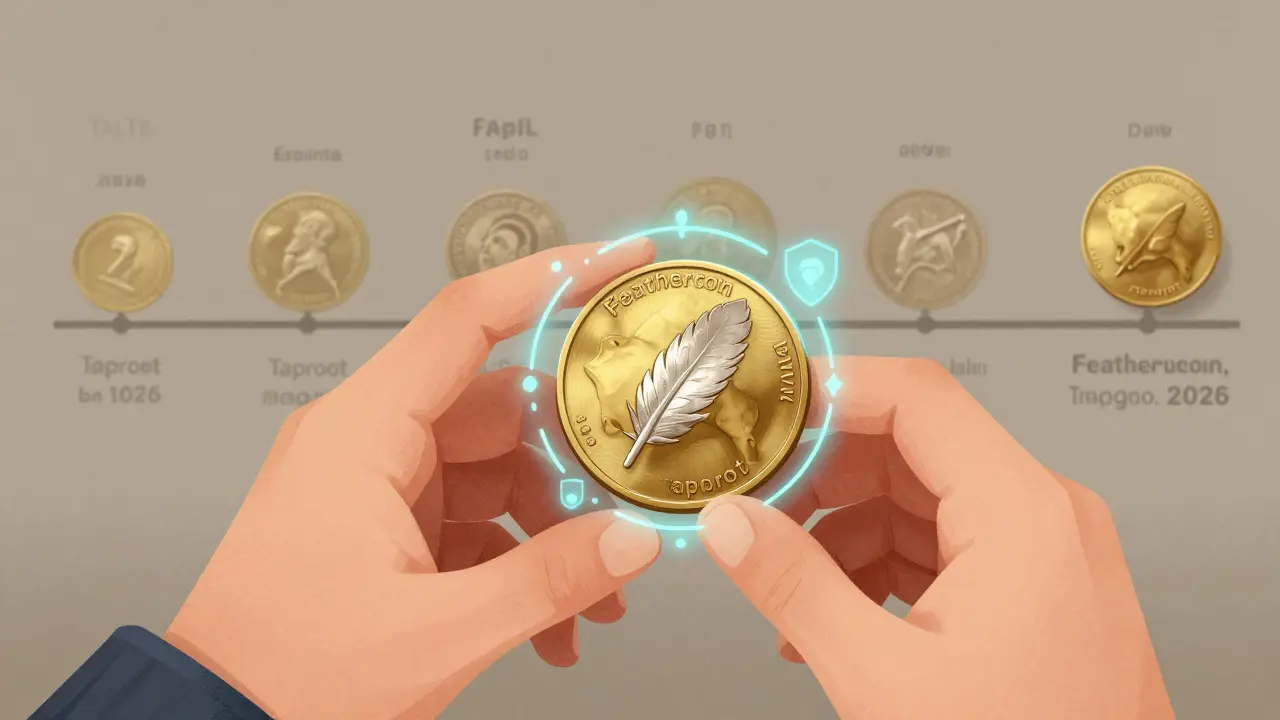
In a sea of abandoned projects, Feathercoin stands out for one reason: maintenance. The GitHub repository shows consistent activity. While it doesn't have thousands of commits like top-tier projects, it has enough to show care. The release of version 0.21 and the integration of Taproot prove that the core team is engaged.
Additionally, libraries like feathercore-lib are updated periodically. This ensures that developers building on top of Feathercoin have stable tools. The community, though smaller, remains dedicated. Reddit threads and GitHub guides are still updated, helping new users navigate the setup process.
Feathercoin represents a specific era of crypto culture. It was a time when forks were common experiments, and community spirit drove development more than venture capital funding. Today, it serves as a living museum of that era, kept running by enthusiasts who value its simplicity and historical significance.
Is Feathercoin a Good Investment?
We need to be direct here. Feathercoin is not a high-growth investment vehicle. Its low liquidity and lack of mainstream adoption mean it lacks the catalysts needed for massive price surges. It does not have a vibrant DeFi ecosystem, NFT marketplace, or enterprise partnerships.
However, it holds value for certain types of investors:
- Collectors: People who want to own a piece of crypto history.
- Hobbyist Miners: Those interested in learning about mining mechanics without competing against industrial-scale ASIC farms.
- Privacy Advocates: Users who appreciate a decentralized, censorship-resistant network with Taproot-enhanced privacy features.
If you are looking for quick profits, look elsewhere. If you are curious about how early altcoins operate and want to support a long-running open-source project, Feathercoin offers a low-barrier entry point.
What is the current price of Feathercoin (FTC)?
As of May 2026, Feathercoin trades at approximately $0.001258 USD. Please note that due to extremely low trading volume (around $48 USD daily), prices can fluctuate significantly with small trades.
Is Feathercoin safe to use?
Yes, Feathercoin uses robust cryptographic security inherited from Bitcoin. The recent upgrade to version 0.21 includes Taproot support, enhancing transaction privacy and efficiency. As long as you use official wallets like FeathercoinCore or trusted multi-asset wallets, your funds are secure.
Can I mine Feathercoin with my computer?
Yes, Feathercoin is mineable using proof-of-work algorithms. Due to lower network difficulty compared to Bitcoin, it is possible to mine with consumer-grade hardware, though profitability is low. It is best suited for hobbyists supporting the network rather than professional miners seeking profit.
What is the maximum supply of FTC?
The configured maximum supply of Feathercoin is approximately 336,000,000 FTC. This is significantly higher than Bitcoin's 21 million cap, resulting in a lower individual coin price.
Does Feathercoin support Taproot?
Yes. The release of Feathercoin 0.21 in May 2026 activated Taproot support. This brings advanced privacy features and script flexibility to the network, aligning it with modern Bitcoin standards.
Where can I buy Feathercoin?
Feathercoin is listed on several exchanges, including Coinbase. However, due to low liquidity, availability may vary. It is also supported in non-custodial wallets like Atomic Wallet, allowing for peer-to-peer transfers.