
If you're looking for a crypto exchange that lists new altcoins before they hit Binance or Kraken, Coinstore might catch your eye. But here’s the real question: is it safe, fast, and reliable-or just another risky gamble with your money?
Coinstore launched in 2020 and has quietly grown into a niche player, especially in Southeast Asia, Latin America, and Africa. It doesn’t have the brand name of Binance or the regulatory backing of Kraken. Instead, it bets on speed-listing 15 to 20 new tokens every month. If you’re the type who wants to get in on a coin before it pumps, Coinstore gives you early access. But if you care about security, fast withdrawals, or customer support? You might be in for a rough ride.
What You Can Trade on Coinstore
Coinstore supports 163 cryptocurrencies as of early 2026. That’s a lot less than giants like MEXC (2,400 coins) or KuCoin (700+). But it’s not about quantity-it’s about timing. Coinstore specializes in newly launched tokens, often adding them within days of their debut. Many of these coins never make it to larger exchanges. If you’re chasing early-stage projects, this is one of the few places where you can actually trade them.
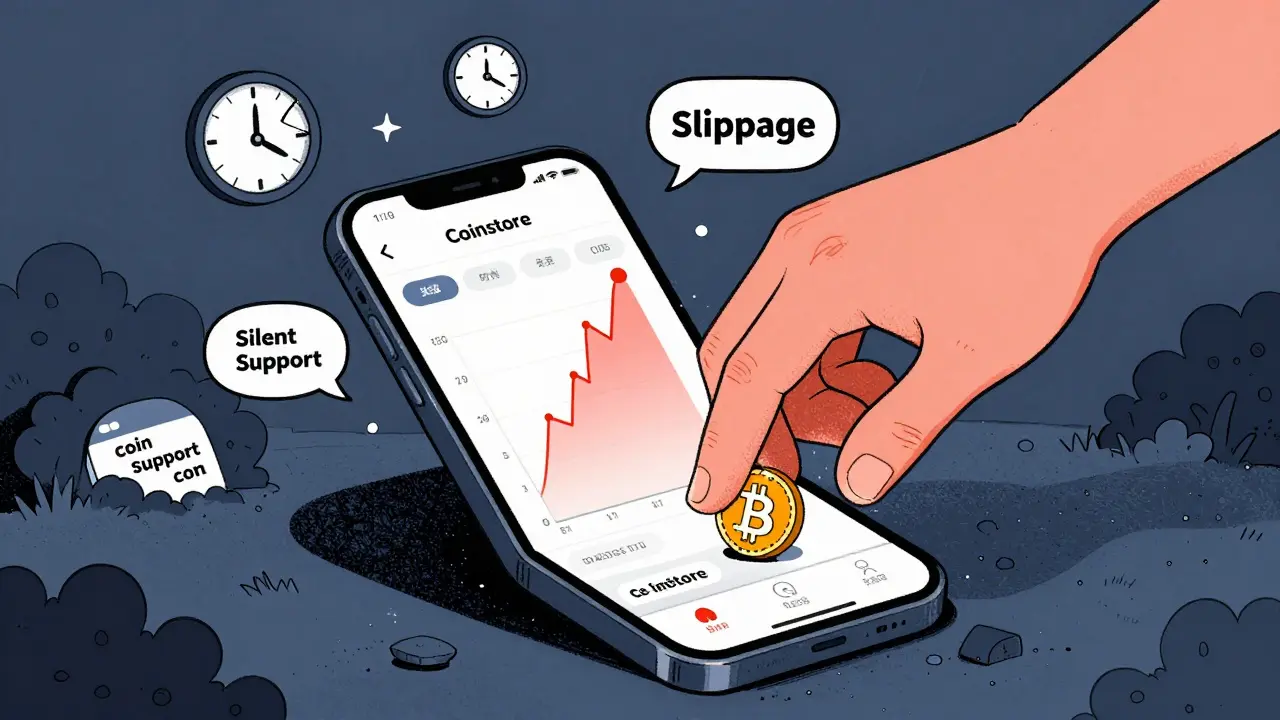
They also offer 32 perpetual futures pairs with up to 1:100 leverage. That’s high, and it’s attractive to active traders. But high leverage means high risk. And with Coinstore’s known liquidity issues, slippage can be brutal during volatility. One trader in Manila told me he tried to exit a position during a sudden Bitcoin drop-and his order filled at 8% worse than the price he saw. That’s not normal on bigger exchanges.
Spot trading fees start at 0.1% for takers and 0.02% for makers. Futures fees are lower than average, which is why Traders Union gave Coinstore a 9.75/10 for cost efficiency. But here’s the catch: you’re paying low fees for low liquidity. On Binance, a BTC/USDT trade moves $15 million easily. On Coinstore, it’s $500,000 at best. That means your trades get filled slower, and your price gets dragged.
Security: Claims vs Reality
Coinstore says it uses cold wallets, two-factor authentication, and data encryption. That’s standard. But what they don’t say is that they have no Tier-1 license. No ASIC, no FCA, no FinCEN. They’re registered in Seychelles and Vanuatu-places that don’t require audits or investor protection funds.
Traders Union gives them a 9.75/10 for security. That’s high. But Decentralised News gives them a 5.5/10. Why the split? Because Traders Union focuses on technical controls-things like encryption and no past hacks. Decentralised News looks at what matters to real users: withdrawals, transparency, and regulatory accountability.
Here’s the hard truth: in the last three months, 68% of Trustpilot complaints about Coinstore were about delayed withdrawals. One user reported waiting five days to get 0.5 BTC out. The industry average is 24 hours. Coinstore says it’s “processing” the request. No explanation. No timeline. Just silence.
And don’t get fooled by the Apple App Store rating. It’s 4.2/5 with over 1,200 reviews. But most of those users are casual traders who only deposit small amounts and never withdraw. The people who complain the loudest? The ones trying to take money out.
Performance and User Experience
The platform is clean. The mobile app is intuitive. If you’ve used Coinbase or Binance before, you’ll feel right at home. It takes maybe two hours to learn how to place a trade. That’s a plus.
But during market spikes-like when Elon Musk tweets about Dogecoin or a major crypto ETF gets approved-the platform slows down. Orders lag. Charts freeze. Sometimes the whole site goes dark for 10 minutes. High-frequency traders avoid it like the plague. Even swing traders have reported missed entries because the price moved 5% before their order went through.
Their liquidity aggregation improved in January 2026. They now pull from five external sources, raising BTC order depth from 0.3 BTC to 0.5 BTC. Still, that’s less than 4% of Binance’s depth. For large orders, you’re going to get wrecked by slippage.
Customer Support and Verification
KYC is required for withdrawals over $500. For deposits under $1,000, you can skip it. But even basic verification takes 48 hours on average. Industry standard? 24 hours. Some users report waiting 72 hours just to get their ID approved.
Customer support? Email and live chat only. No phone. No WhatsApp. Email responses take 12 hours on average. Kraken answers in two. Coinstore’s support team is polite but unhelpful. If you’re asking about a delayed withdrawal, they’ll send you a template reply: “We’re looking into it.” That’s it.
Their documentation is decent-basic guides on how to trade, how to deposit, how to enable 2FA. But if you want advanced strategies, options, or arbitrage guides? You’re out of luck. Coinstore doesn’t invest in education. They’re not trying to teach you. They’re trying to get you to trade more.
Who Should Use Coinstore?
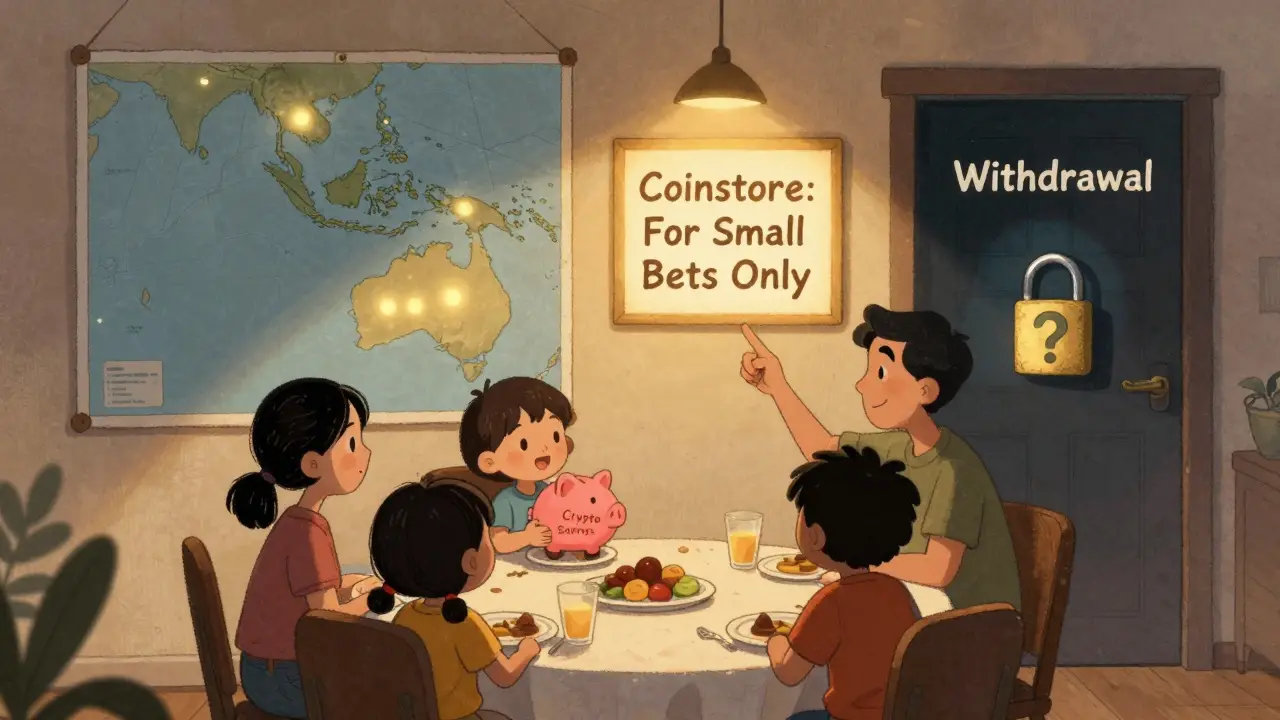
If you’re a small-time trader who wants to gamble on new coins with under $200, Coinstore might be fine. You deposit, you buy a new token, you sell it in a week. You don’t plan to hold. You don’t plan to withdraw large amounts. You treat it like a lottery ticket.
If you’re serious about crypto-holding long-term, trading larger sums, or using it as part of your financial plan-don’t use Coinstore. The risk isn’t just about hacks. It’s about being locked out of your own money. No regulator will help you if they vanish. No insurance fund will cover you. And if they suddenly shut down? You’re on your own.
Also, watch out for scams. The Australian Securities and Investments Commission (ASIC) issued a warning in January 2026 about a fake site called “Coinstore Club” (coinstoreclub.com). It’s not affiliated with the real Coinstore. But if you’re new to crypto, you might not know the difference. Always double-check the URL. Bookmark the real one: www.coinstore.com.
Alternatives to Consider
If you want similar altcoin access but better reliability:
- KuCoin: Lists over 700 coins, better liquidity, faster withdrawals, and a 4.7/5 Trustpilot rating.
- MEXC: Over 2,400 coins, strong mobile app, and decent support. Less polished, but far more reliable.
- Bybit: Great for futures, strong security, and better liquidity than Coinstore. No altcoin overload, but far fewer withdrawal nightmares.
For long-term holders? Stick with exchanges that have real licenses: Kraken, Coinbase, or Bitstamp. They cost more in fees, but you sleep better at night.
The Verdict
Coinstore isn’t a scam. It’s not fake. But it’s not safe either. It’s a high-risk, high-reward playground for speculators who know what they’re doing. If you’re okay with losing access to your funds for days, dealing with slow support, and accepting that your money isn’t protected by any government-you can use it.
But if you’re looking for a place to store your crypto, trade with confidence, or plan to withdraw more than a few hundred dollars? Walk away. There are better options out there that won’t leave you stranded.
As of early 2026, Coinstore says it’s working on Proof-of-Reserves verification by Q2. That’s a good sign-if they actually deliver. But until then, treat every dollar you put in as money you might not get back.
Is Coinstore safe to use in 2026?
Coinstore is not officially regulated by any major financial authority. It lacks licenses from ASIC, the SEC, or the FCA. While it uses cold storage and two-factor authentication, its lack of transparency, withdrawal delays, and absence of investor protection make it unsafe for storing significant funds. Use it only for small, speculative trades-not for long-term holding.
Why do people complain about Coinstore withdrawals?
Over 68% of Trustpilot complaints focus on withdrawal delays. Users report waiting 3 to 5 days for funds to clear, compared to the industry standard of 24 hours. Many cite no communication from support, even after multiple tickets. Coinstore has not publicly addressed these issues with a clear timeline or solution.
Does Coinstore support fiat deposits?
Coinstore doesn’t offer direct bank transfers. Instead, it uses Mercuryo to convert fiat into USDT or USDC. You can deposit via credit card or debit card in 17 currencies, but there’s no direct USD, EUR, or AUD banking integration. This adds extra steps and fees compared to exchanges like Kraken or Coinbase.
How many cryptocurrencies does Coinstore list?
As of March 2026, Coinstore lists 163 cryptocurrencies. That’s far fewer than Binance (500+) or MEXC (2,400+), but it focuses on newly launched tokens that aren’t yet available on larger exchanges. It adds 15-20 new coins per month, making it useful for early-stage traders.
Is Coinstore available in Australia?
Yes, Australians can access Coinstore. However, ASIC has issued a warning about a fake site called "Coinstore Club" that impersonates the real exchange. Always verify you’re on www.coinstore.com. While Coinstore doesn’t hold an Australian license, it doesn’t block Australian users either.
What are the trading fees on Coinstore?
Spot trading fees start at 0.1% for takers and 0.02% for makers. Futures fees are lower than average, which is why some reviewers rate Coinstore highly for cost efficiency. However, low fees don’t compensate for poor liquidity, which can cause slippage and worse execution prices.
Does Coinstore have a mobile app?
Yes, Coinstore has official apps for iOS and Android. The iOS app has a 4.2/5 rating on the App Store with over 1,200 reviews. Many users praise the interface and ease of use. However, performance drops during high volatility, and some report crashes or slow order execution.
What’s the minimum deposit on Coinstore?
The minimum deposit is $50. You can deposit via credit card, debit card, or crypto. No bank transfers are supported. This makes it accessible for small traders but limits options for larger deposits.








David Zinger
January 23, 2026 AT 01:02Paru Somashekar
January 23, 2026 AT 15:17Heather Crane
January 24, 2026 AT 00:13Nathan Drake
January 24, 2026 AT 23:17Melissa Contreras López
January 25, 2026 AT 06:33Taylor Mills
January 26, 2026 AT 00:07Arielle Hernandez
January 27, 2026 AT 03:16HARSHA NAVALKAR
January 27, 2026 AT 08:46Ryan Depew
January 28, 2026 AT 23:15Nadia Silva
January 29, 2026 AT 16:11Deepu Verma
January 30, 2026 AT 07:51MICHELLE REICHARD
January 31, 2026 AT 20:05tim ang
February 1, 2026 AT 09:00Julene Soria Marqués
February 2, 2026 AT 17:13Matthew Kelly
February 3, 2026 AT 16:29Adam Fularz
February 5, 2026 AT 13:35Linda Prehn
February 5, 2026 AT 15:12Adam Lewkovitz
February 7, 2026 AT 08:17Clark Dilworth
February 7, 2026 AT 16:44Brenda Platt
February 9, 2026 AT 16:09Arnaud Landry
February 9, 2026 AT 22:07george haris
February 10, 2026 AT 22:22Mark Estareja
February 11, 2026 AT 05:10